
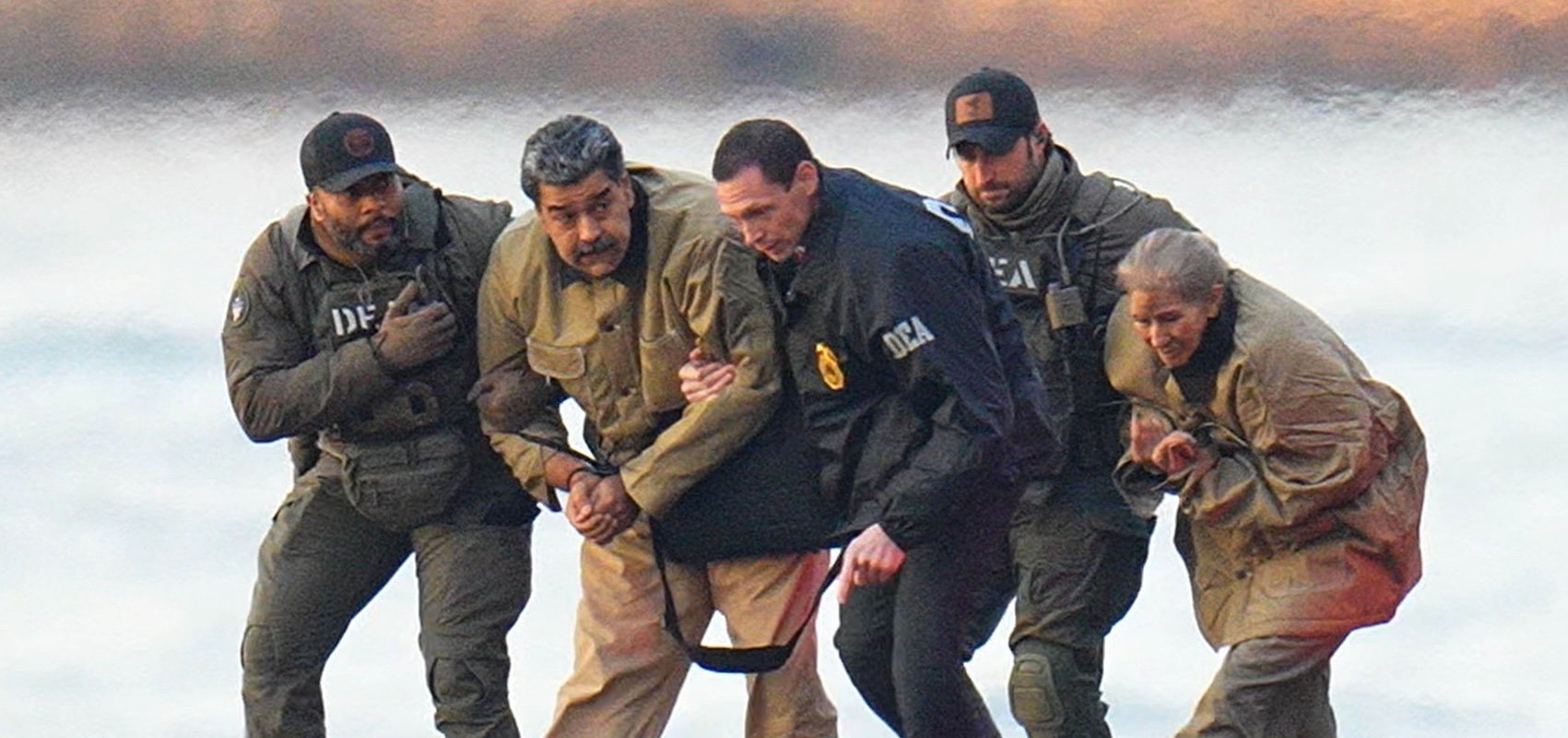
The Trump administration’s arrest of Nicolás Maduro in Venezuela and his subsequent appearance in federal district court in Manhattan has reignited a familiar legal controversy. How can the United States arrest a foreign head of state for violating U.S. narcotics laws when the alleged conduct occurred outside the country and the foreign state did not consent to the arrest? Doesn’t that violate international law—most notably Article 2(4) of the U.N. Charter, which prohibits the use of force against the territorial integrity or political independence of another state? How can Maduro’s prosecution proceed?
This issue arose exactly thirty-six years ago with respect to another Latin American strongman whom the United States arrested, transferred to the U.S., and ultimately convicted in Florida on federal drug charges, Panama’s Manuel Noriega. The legality of Noriega’s arrest was approved at the time by the Justice Department’s Office of Legal Counsel, though people continue to contest the office’s conclusion. The Maduro case is likely to play out in much the same way.
In some respects, the legal analysis is straightforward. International law permits a state to criminalize conduct that occurs outside its territory when that conduct is intended to have substantial effects within the state. The conduct alleged here—large-scale narcotics trafficking aimed at U.S. markets—fits comfortably within that principle. Whatever one thinks about the arrest itself, there is little mystery about why U.S. law can (and does) reach the underlying conduct alleged in the Maduro indictment. And although international law grants sitting heads of state a degree of immunity from foreign criminal prosecution, most countries—including the United States—do not recognize Maduro as the legitimate head of state of Venezuela.
In other respects, the legal analysis is more complicated. Maduro’s arrest, which involved a significant U.S. military operation in Venezuelan territory, may well violate the U.N. Charter. Still, the administration can plausibly argue that his prosecution in U.S. courts may proceed—even assuming the U.S. violated international law and even assuming one can meaningfully speak of international law as a constraint in the real world. Understanding why requires an appreciation of the United States’ traditionally dualist approach to international law.
Dualism holds that international law and domestic law are separate systems operating on different—dual—planes. International law governs relations among states, but it does not necessarily have effect within a state’s domestic legal system. The two regimes are independent. On a dualist understanding, if the United States were to violate a treaty, that violation could carry international consequences—for example, diplomatic retaliation or an adverse judgment from an international tribunal such as the International Court of Justice. But it would not necessarily have consequences in U.S. courts.
Dualism means that treaty obligations have force in U.S. courts only if the United States incorporates them into domestic law. Sometimes a treaty itself makes clear that it has domestic effect—a so-called self-executing treaty. Sometimes further congressional action is required. But the basic idea is this: A private party cannot invoke a treaty in U.S. courts unless the United States has indicated that the treaty is meant to create domestically enforceable rights. The United States can be, simultaneously, an outlaw abroad but not at home. This has been the prevailing understanding in U.S. law since the time of Chief Justice John Marshall.
Article 2(4) of the U.N. Charter is almost universally regarded as non-self-executing. As a result, U.S. courts would not treat alleged violations of Article 2(4) as grounds for judicial relief, including dismissal of criminal prosecutions. Indeed, the Supreme Court held in United States v. Alvarez-Machain (1992) that the illegality of a defendant’s capture under international law does not divest a U.S. court of criminal jurisdiction. This result follows naturally from dualism. The international-law implications of a defendant’s seizure and the authority of U.S. courts to try him for violations of U.S. law are analytically distinct.
True, some scholars argue that even non-self-executing treaties like the U.N. Charter bind the president as a matter of constitutional obligation. On this view, the Constitution’s Supremacy Clause and the president’s duty to “take Care that the Laws be faithfully executed” require the executive to comply with international law even when courts lack the power to intervene. But even if international law binds the president in this sense, it does not necessarily follow that it creates legal rights that criminal defendants may assert in court.
In short, the Maduro prosecution, like the Noriega prosecution more than three decades ago, is likely to go forward. Critics predict that this will backfire on the United States. The administration’s action, they contend, will entangle the U.S. in Venezuelan politics and embolden adversaries—Russia’s Putin, China’s Xi—also to invade their neighbors and seize their leaders in violation of international law. Those aren’t fanciful concerns, though it does seem more likely that Putin and Xi would act based on their own assessments of power and interest. But judges are rightly reluctant to make decisions about such matters. Whatever the foreign-policy merits of the new Monroe Doctrine—I suppose we are calling it the “Donroe Doctrine” now—U.S. courts are unlikely to stand in the way.
Image by XNY/Star Max via Getty Images

YOU MIGHT ALSO LIKE
Turned Away on Palm Sunday
In politics, diplomacy, war, or pretty much any field of human interaction, one must contend not only…
Timothée Chalamet Is Right About Art (ft. Suzy Weiss)
In this episode, co-founder and reporter for the Free Press, Suzy Weiss, joins Virginia and Germán to…
A Medieval Pilgrimage in Modern Assisi
When you go to the hilltop town of Assisi, you’re immediately struck by how medieval it is:…
