
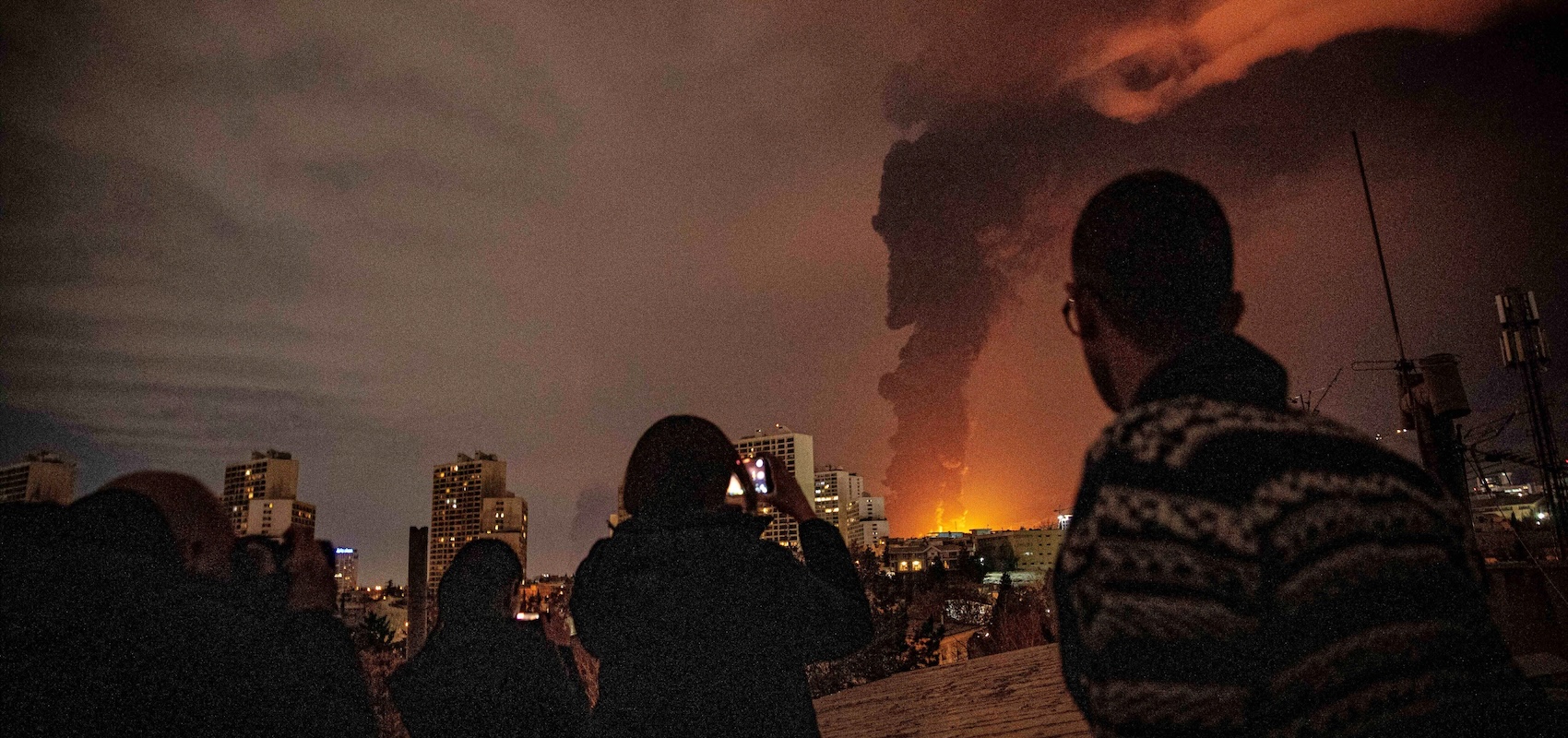
Does the U.S.-Israel assault on Iran fill the criteria of Christian just war theory? A number of observers have asked the question, including R. R. Reno, and given inconclusive answers. Reno is right: Just war reasoning isn’t a simple checklist that allows us to bypass the uncertainty inherent in complex moral judgments. Still, in this case I believe the answer is a decided “No.” A just war must have clear and achievable objectives, but the Trump administration’s messaging, if not its moral reasoning, has been muddled. Do we have reasonable expectation of success? It’s difficult to tell what’s real and what’s not, but it seems the U.S. is in danger of depleting our munitions before we gain a decisive victory. We seem to have underestimated Iran’s military capability and determination, especially after Khamenei’s death, while overestimating the Iranian opposition’s appetite for a coup. Have we stumbled into the position of the king in Jesus’s parable, who starts a war without first counting the cost (Luke 14:31–33)?
The most cogent explanation for the attack has come not from the administration but from commentators such as Tanvi Ratna, who views the war as a new phase of an ongoing shift in geopolitical strategy, away from balance of power realism or Wilsonian idealism toward protection of “economic systems.” These days, we drop bombs or send in troops not to preserve or establish democracy, not to protect allies from assault, not to avenge injustices, not to suppress violence, not even to defeat global enemies, but to set up our chosen rulers in resource-rich countries, to ensure the free flow of energy, to maintain high tech supply chains, to gain access to rare minerals, and to preserve the digital infrastructure on which we all rely. From this perspective, Trump’s saber-rattling over Greenland and his attack on Iran are of a piece. But perhaps Curtis Yarvin is right in his hyper-realist assessment: Trump has long wanted to vaporize the Islamic Republic of Iran, and his plan now is to keep bombing until a cooperative leader crawls out from under the rubble. But just war principles don’t allow states to go to war to stay rich or get richer, nor to ensure we have a friendly in charge of Iran’s oil resources and the Strait of Hormuz.
Debates about just cause may miss an equally momentous question, which has to do with ius in bello, the just conduct of war. Both President Trump and Secretary of War Pete Hegseth bristle at global standards of war. In an address at the Marine Corps Base in Quantico, Virginia, back in September, Hegseth declared,
We unleash overwhelming and punishing violence on the enemy. We also don’t fight with stupid rules of engagement. We untie the hands of our warfighters to intimidate, demoralize, hunt and kill the enemies of our country. No more politically correct and overbearing rules of engagement, just common sense, maximum lethality and authority for warfighters.
Trump and Hegseth regularly attack “dumb,” “woke” and “politically correct” warfare, and Trump has praised American soldiers as “killing machines.”
Most of the time, Trump and Hegseth’s attacks target fairly recent rules of engagement that put American soldiers on the defensive and unduly tie their hands in the chaos of combat. But Hegseth has also gone after the Geneva Conventions. In his The War on Warriors, he asked, “Should we follow the Geneva Conventions?” and answered: “What if we treated the enemy the way they treated us? Would that not be an incentive for the other side to reconsider their barbarism? Hey, Al Qaeda: If you surrender, we might spare your life. If you do not, we will rip your arms off and feed them to hogs.” Maybe, he pondered, we’re “better off winning our wars according to our own rules?! Who cares what other countries think.”
Such statements raise the question of whether the Trump administration regards war as a rule-bound enterprise at all. Laws of war aren’t a given. Cicero articulated some of the basic principles of what became the just war tradition, but Romans sometimes solved lingering problems by the Carthago delenda est method, applied to Carthage in the Third Punic War and, later, to Jerusalem. Once Roman soldiers broke through the defenses of a besieged city, they had the right to plunder, rape, and kill for a day.
Yahweh, the divine commander in chief, governed Israel’s warfare. When they attacked Canaanite cities during their initial invasion, Israel slaughtered “everything that breathed,” devoted the wealth of the city to Yahweh, and burned the city as an ascension offering. Herem war was limited to the original conquest. In all other circumstances, Yahweh gave Israel other rules of war, detailed in Deuteronomy 20. When they first approached a city, they offered peace; if the city accepted, the residents were put to forced labor. If they refused, Israel had permission to kill all the fighting-age men, sparing women, children, and animals. Israelite soldiers weren’t permitted to rape, but they could take war-brides who, through a complex rite of passage, could be incorporated into Israel (Deut. 21:10–14). Yahweh prohibited soldiers from cutting down fruit-bearing trees to build siege works: “For is the tree of the field a man, that it should be besieged by you?” That prohibition implies protections of fruit-bearing civilian populations.
Augustine tempered the Old Testament by applying the teaching of Jesus to warfare. Can war be an act of love or, as Daniel Bell Jr. puts it, of Christian discipleship? Augustine said “Yes.” Christians fight to protect the weak, but also to do good to their enemies, whose souls are endangered by their own pride, cruelty, and injustice. Even when it’s just to right with harsh charity, Augustine said, men should “grieve that they must fight at all—even in a just war,” and anyone who gushes over killing “has lost touch with his humanity.” “Even in waging war,” Augustine urged, “cherish the spirit of peace-maker; that, by conquering those whom you attack, you may lead them back to the advantages of peace.”
Secretary of State Marco Rubio is right: We’re in a new world. On balance, that’s a good thing. The old liberal order, in both its realist and idealist forms, has frayed and needs to be demolished. But that leaves the world, especially the world’s military superpower, in moral peril: Do we acknowledge any limits, or have we convinced ourselves war is justified so long as it’s started by a “smart” president whose only acknowledged limit is his own moral compass? “Not woke” isn’t any kind of standard for ius in bello. We don’t want to be a superpower that relishes killing, without restraint or conscience. The modern variants of just war thinking have sometimes been wrong-headed, but we shouldn’t abandon the effort to bind our most primitive instincts to law. Winning cannot become the sole law of war. Jesus warned us: Nations and militaries, like individuals, can win the whole world and lose their souls.
Alireza Sotakbar/ISNA via AP

