
On February 3, I stood in a poorly lit meeting room in the National Security Services building in Yerevan, Armenia, as Archbishop Bagrat Galstanyan prayed a blessing over me and my colleagues—a Catholic priest, a Swiss MP, and the president of Christian Solidarity International.
Then a group of friendly guards came to take the archbishop back to his cell.
Armenia is the last country where I expected to visit an archbishop in prison. But the archbishop reminded us that for clergy from the Armenian Apostolic Church, he is far from exceptional. His ecclesiastical namesake, Archbishop Bagrat Vardazaryan, was imprisoned by the Soviet authorities in the very same building and executed in its basement.
When we left the prison, we took with us a letter the archbishop wrote to Vice President JD Vance, who visited Armenia yesterday. In the letter, the archbishop told the vice president that the Church is “simply doing what it has done for 1,700 years: safeguarding the Armenian nation, the world’s first Christian nation.”
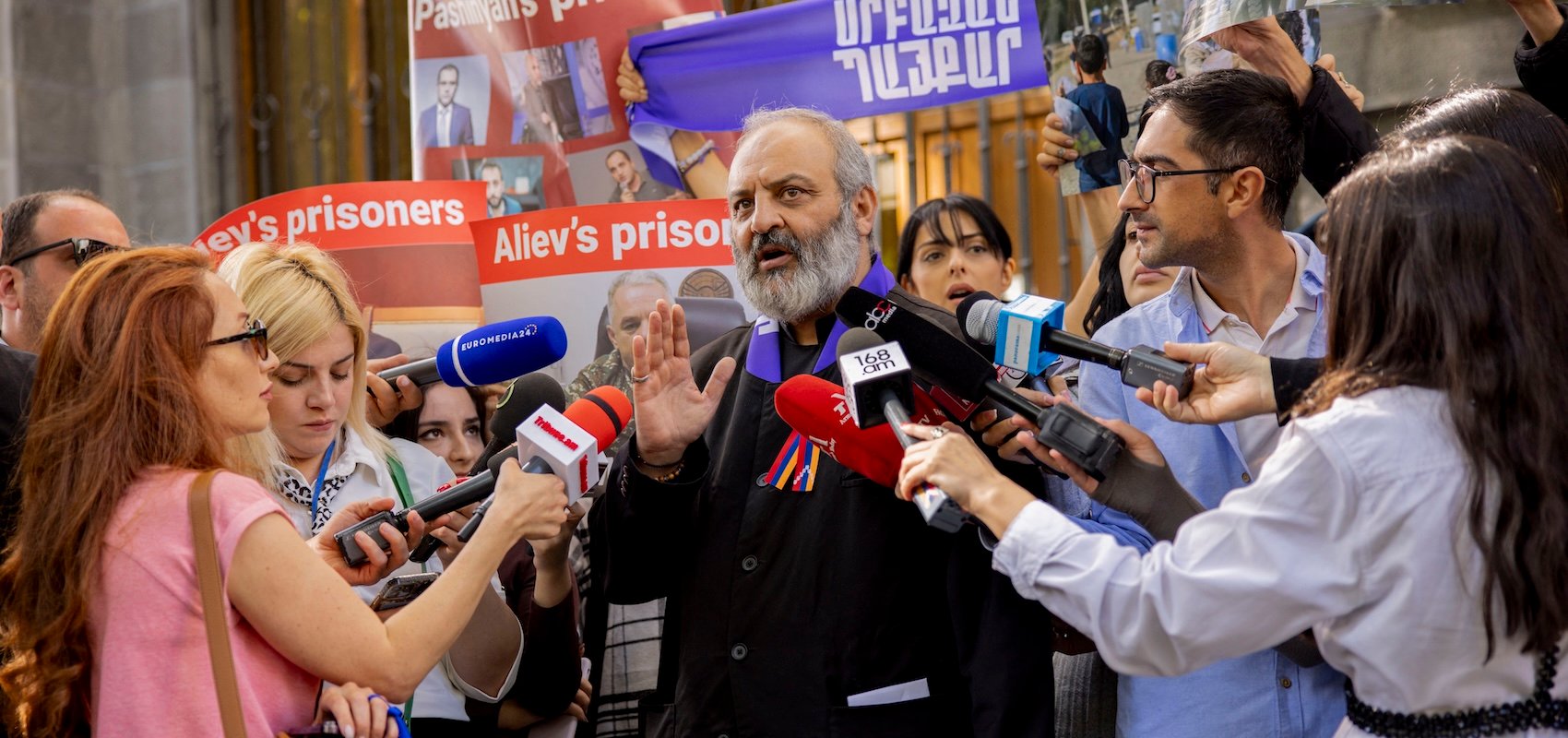
Archbishop Bagrat was arrested on June 25. He was charged with plotting a coup, based on audio recordings that were later shown to have been falsified. Since then, three other bishops have been arrested. Archbishop Mikael Ajapahyan is serving a two-year sentence for a charge that Armenia’s public prosecutor had previously rejected as groundless. Bishop Mkrtich Proshyan is in pretrial detention on charges of “coercing political activity.” Archbishop Arshak Khachatryan is held on charges of planting a marijuana joint on a protestor in 2018. The marijuana in question was purportedly held in an evidence locker for the past few years, but has now gone missing.
The absurdity of the charges shows that they are beside the point. As Stalin’s executioner Beria said, “Show me the man, I’ll show you the crime.”
Armenia’s prime minister, Nikol Pashinyan, has made the real point crystal clear. He is publicly demanding that the Catholicos of All Armenians, the head of the worldwide Armenian Apostolic Church, resign and be replaced by someone picked by a state-appointed committee. From a religious freedom and ecclesiastical perspective, it is as absurd as if Giorgia Meloni were demanding the resignation of Pope Leo XIV.
To neutralize the Church, Pashinyan has resorted to using the old Soviet playbook. Pashinyan’s government has imprisoned the Church’s leading benefactor, Samvel Karapetyan, and begun nationalizing his businesses. He has organized a group of renegade bishops who call for “reforming” the Church, much as the Bolsheviks used a group of “free Church” clerics to foment a schism in the 1920s.
This new wave of persecution has a context. In 2020, Armenia lost a war to its neighbor Azerbaijan, which was backed by its powerful ally Turkey. Three years later, Azerbaijan attacked Nagorno Karabakh (or Artsakh), a land where Armenians have been living for thousands of years. All 120,000 Armenian Christians living there were forced to flee. In the aftermath, the European Union and the United States have been pushing Armenia toward peace on Azerbaijan’s terms, and toward “economic integration” with Azerbaijan and Turkey.
The West’s strategy for the region is to establish an economic corridor connecting Turkey, Armenia, and Azerbaijan, which would allow Europe to receive oil and gas from Central Asia and goods from China. Such an arrangement risks making Armenia permanently vulnerable and economically dependent on the powers that carried out the Armenian Genocide and the ethnic cleansing of Artsakh.
With admittedly few good choices before him, Pashinyan has tried to make this vision his own. Pashinyan seeks to re-found the Republic of Armenia based on a new ideology he calls “Real Armenia.”
Armenia was founded as a state dedicated to preserving the Armenian people in the wake of the Armenian Genocide. But Real Armenia is a Western-facing state, focused on delivering economic gains for the people who live there. For Pashinyan, the memory of the genocide, the lost homelands in Karabakh and Anatolia, and even the worldwide Armenian diaspora are distractions from “Real Armenia.”
The Armenian Church has openly challenged the prime minister’s agenda. In May 2024, the Armenian government unilaterally conceded some territories in Tavush province, where Archbishop Bagrat has his diocese, to Azerbaijan. The archbishop responded by organizing a protest march from Tavush to Yerevan. This march grew into a political movement that named the archbishop a candidate for prime minister. (The Catholicos granted him leave from his ecclesiastical duties.)
But the arrests did not begin until a year later, when the Catholicos spoke at a conference organized by the World Council of Churches in Switzerland. In his speech, he demanded that the Armenian refugees from Artsakh be allowed to return to their homeland. Within days, the prime minister began attacking the Catholicos. A few weeks later, Archbishop Bagrat was arrested.
Westerners may balk at the thought of archbishops running for prime minister, or a Church trying to shape foreign policy. For the Armenian clergymen we have spoken to—both behind bars and not—there is no contradiction. They are shepherds defending their endangered flock. “The church cannot stand by and watch while this happens,” the archbishop told us. “That’s why I’m in here.”
In his letter, Archbishop Bagrat points out that Vice President Vance has “warned the EU that it has been committing civilizational suicide by giving up Europe’s Christian identity.” “This is precisely what the Armenian Prime Minister is engineering in Armenia,” he writes.
One may or may not share the archbishop’s assessment. But this crisis poses an inescapable question to Western Christians, especially those of us who believe that Christianity should play a role in politics and society in our own countries. How will we respond to an attempt by a secular state—a U.S. ally—to break one of the oldest churches in the world?
As our visit ended, we asked Archbishop Bagrat if he would be happy for other Christian leaders to visit him in prison. He responded with enthusiasm: “Yes! Come!”
Image by Anthony Pizzoferrato via Getty Images

YOU MIGHT ALSO LIKE
How the State Failed Noelia Castillo
On March 26, Noelia Castillo, a twenty-five-year-old Spanish woman, was killed by her doctors at her own…
The Mind’s Profane and Sacred Loves
The teachers you have make all the difference in your life. That they happened to come into…
History’s Pro Tips on Iran
Nothing in human experience compares to the wars of the last 120 years. Their scope has grown…
