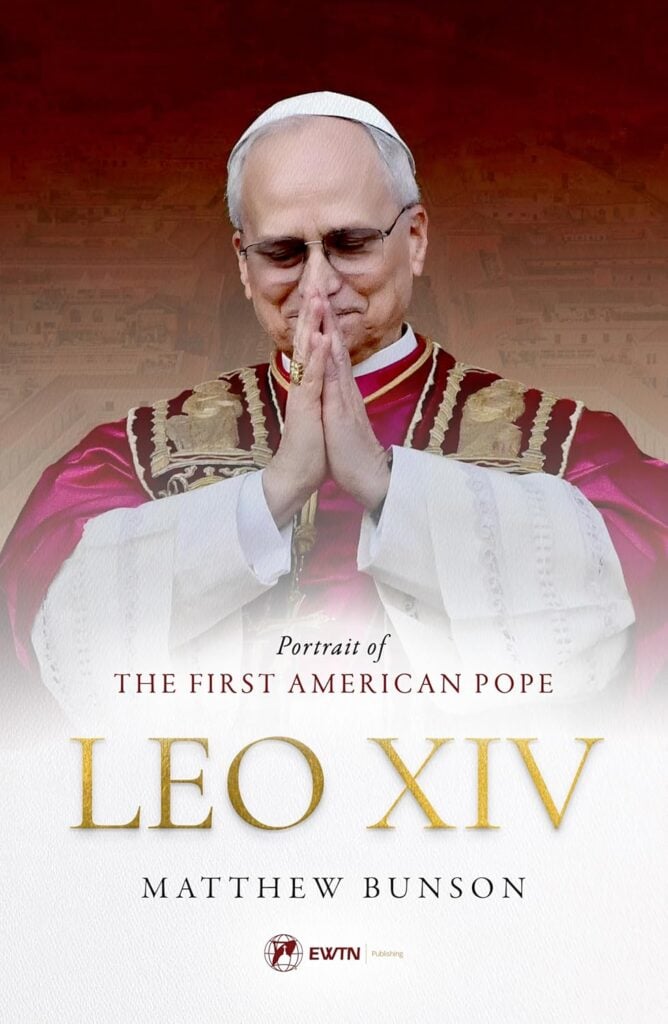
Leo XIV: Portrait of the First American Pope
by matthew bunson
sophia institute, 160 pages, $17.95
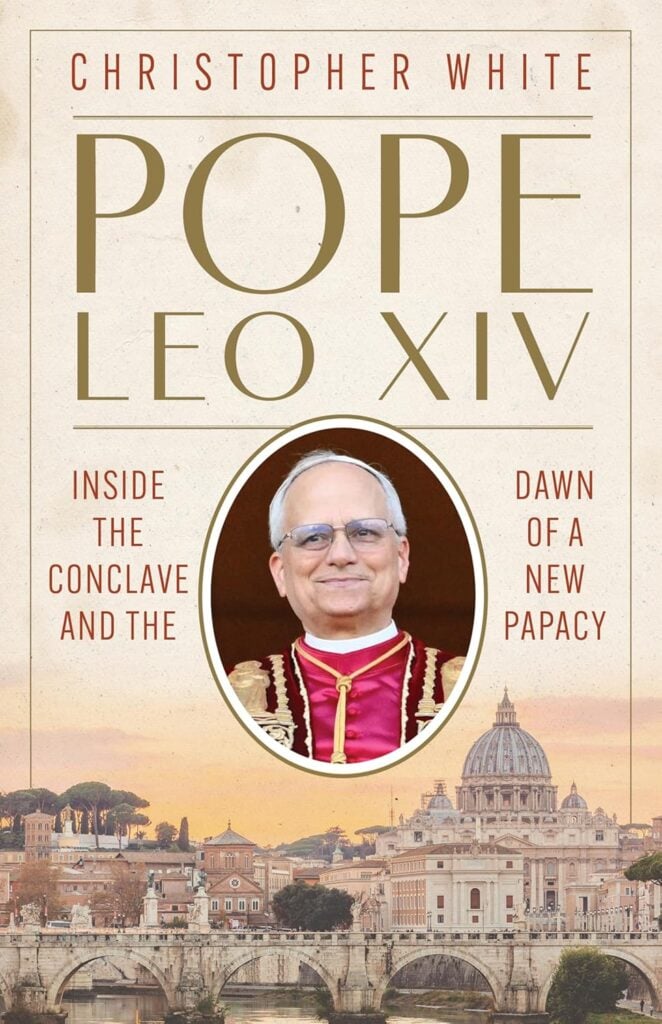
Pope Leo XIV: Inside the Conclave and the Dawn of a New Papacy
by christopher white
loyola, 168 pages, $19.99
Already we have had an array of first-hundred-days analyses of Pope Leo XIV, as though the first American-born pope could be judged like an American president. Yet Robert Prevost of Chicago’s south side is more like an ideal Supreme Court nominee: the able jurist of considerable achievement about whose views not very much is definitively known.
Cardinal Robert Prevost is a man of achievement and wide experience: an American missionary priest in Peru; traveler to dozens of countries as worldwide superior of the Augustinian order for twelve years; bishop of Chiclayo, Peru for a decade; finally, for two years head of one of the most important Vatican departments, that charged with the appointment of bishops.
In the latter roles, he was entirely a creature of Pope Francis. Such figures often rise in the Church hierarchy—men rapidly elevated, made powerful and prominent because of their pontifical patrons. Think of the late cardinals John O’Connor of New York, Jean-Marie Lustiger of Paris, and Carlo Martini of Milan—all creatures of St. John Paul the Great.
After the death of Pope Benedict XVI on the last day of 2022, Francis appeared to feel more free. As long as Benedict was alive, Francis always spoke of his abdication in favorable terms, as an act of courage and humility, opening new paths for the papacy. Less than two months after Benedict was buried, Francis declared his view: The papacy is for life. It was gentlemanly of him to save his honest view for after Benedict was dead.
Francis also seemed then to feel more free in his curial appointments. In 2023, he placed two of his “creatures” at the pinnacle of the Roman Curia—Prevost as prefect of bishops and Victor Manuel Fernandez as prefect of doctrine—before creating them cardinals later that year.
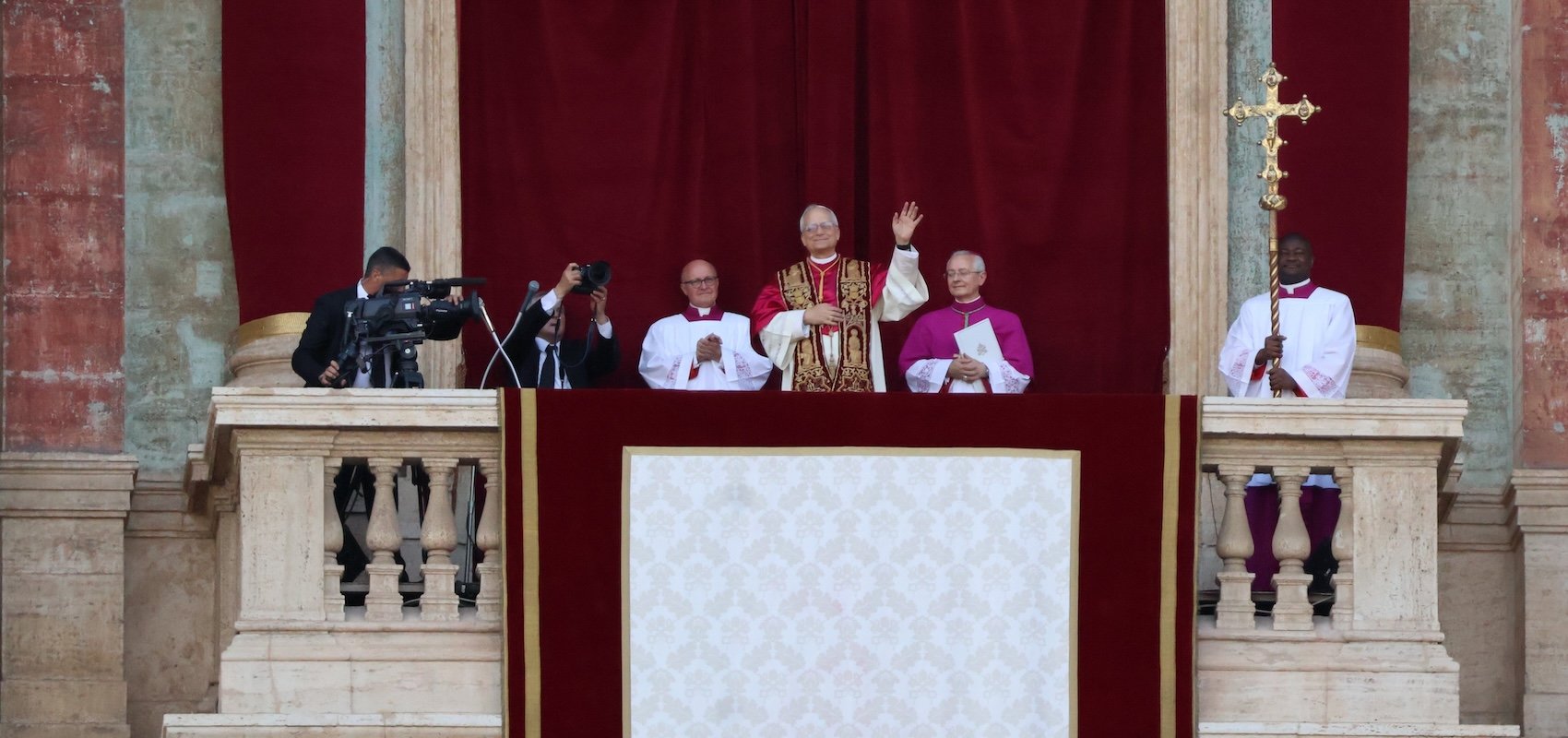
Thus, at conclave 2025, both Prevost and Fernandez were favored sons, comfortable choices for the cardinal electors who desired someone in the line of Francis. The latter, Fernandez, was a nonstarter as the father of the on-again-off-again-by-region fiasco of blessings for same-sex couples, not to mention his eyebrow-raising published writings about kissing and orgasms. Prevost, in contrast, was evidently acceptable to nearly everyone and was on the loggia of St. Peter’s less than twenty-four hours after the first ballot.
Part of his wide appeal was that nothing about him raised eyebrows. Growing up in affluent America, he had admirably chosen to serve as a missionary in Peru; he had gained administrative experience while running his religious order; he had the confidence of Pope Francis but was not a partisan.
Consider that, as prefect of bishops, he managed to get through the marathon synods of 2023 and 2024 and the controversy over same-sex blessings without saying anything notable or attracting any attention to himself. He was billed by the Vatican press as the least American of the Americans, given his missionary service in Peru, but more important was that he was the least Francis-like of the Franciscan creatures.
This history poses a challenge for the two Catholic journalists, one conservative and the other liberal, who have published quick biographies of the new Holy Father.
Both Bunson’s and White’s books are slender, and both fail at an impossible task, that is, telling us what Leo thinks about controverted issues. A man of significant ecclesiastical responsibility who gets to age sixty-nine without attracting attention to his thinking has made a deliberate choice. It may be that he has largely been an ecclesial administrator.
As a missionary, he was not Willa Cather’s Jean-Marie Latour, venturing out into the wilderness of the desert Southwest. He was superior of his local Augustinian community, formator of novices, a seminary professor, and a canon lawyer at the diocesan tribunal, while also doing parish work. Later, as Augustinian superior and bishop, he may well have decided—like a great many superiors and bishops—that if it was not necessary to say anything, it was better to say nothing. For those cardinal electors exhausted by the voluble and volatile Francis, his reticence may have been his most attractive trait.
Prevost’s first major stint in Peru was from 1988 to 1998, a time when the country was wracked by Alberto Fujimori’s violent crackdown on the Shining Path Marxists. Neither biography tells us anything significant about how Prevost engaged with that issue, dominant though it was in national life. Similarly, neither biography gives much insight into how Prevost dealt with liberation theology, still massively influential in the 1980s. When Prevost returned to Peru as a bishop (2013–23), despite serving in senior roles in the Peruvian episcopal conference—a sign of confidence from his confreres—he seemed to pass through political upheavals without revealing himself. Bunson notes that, during Fujimori’s war on the Shining Path, Prevost “criticized the excesses of both sides.”
There is a paucity of material to work with. White solves that problem by devoting the first part of the book to the greatest hits of Pope Francis, the middle part to the “most secretive election on earth”—from which, audaciously, he relates details—and the final part to a superficial account of Leo’s life.
White’s judgments are often dubious, bordering on comical. May 2025 was the “most important conclave in sixty years.” Pope Benedict XVI “may have been a great professor, but . . . often the classroom was empty, or at least the students were not engaged”—a bizarre characterization of the world’s most widely read theologian before, during, and after his pontificate. White is deeply impressed that “as heads of state arrived at the Vatican, Francis would give each one a copy of the Paris [Climate] Agreement,” but he does not recognize that the Supreme Pontiff’s offering UN documents is an ultramundane approach to the office. It is, perhaps, what one should expect from an author who lists Austen Ivereigh and Robert Mickens as “comrades and co-conspirators.”
Bunson’s telling of the story is much better. He offers a searching account of Prevost’s early life in a chapter titled “Witness to Decline.” Prevost was born in 1955, in the middle of the American century and at the height of the Catholic institutional ascendancy. He was baptized in a church built in 1953, where he served the early daily Mass as a boy. In 1969, at age fourteen, he left home for a seminary boarding school. By the time he was ordained a priest, the seminary had closed. By the time he was ordained a bishop, his boyhood parish was shuttered.
His life as an Augustinian friar coincided with the dramatic shrinking of religious life in the United States. Sociologically and in terms of cultural influence, Prevost was born at a peak of American Catholicism, and he has witnessed seven decades of decline. When he travels to the United States, there will be no heartwarming visits to his baptismal font in Chicago or his seminary chapel in Michigan.
Like his predecessors, he speaks of a missionary Church and the new evangelization; but unlike them, he has experienced the collapse of Catholic institutional life. Growing up in the Chicago suburbs, he saw what Catholic immigration to the United States could accomplish—and how the lack of deep adherence, interior conversion, and evangelization led it to unravel in only a few generations.
Every pope is the product, even the prisoner, of his biography. As a young adult, John Paul was inspired by the heroic martyred priesthood of Nazi and communist Poland. Benedict was, by his thirties, conversant in the German-speaking world of Guardini, Balthasar, and the biblical scholars, and familiar with the renewal of mid-century theology. Francis lived his adult life amid, and suffered from, a divided and declining religious community, a dysfunctional local Church, and a country whose leaders have, over successive generations, brought tyranny, violence, corruption, and pauperization to what was once—when the Bergoglio family chose to immigrate there—a peaceful and prosperous land. It should not have been a shock that his pontificate was marked by authoritarian divisiveness. It was the Argentine way.
The key question of Leo’s pontificate is what he learned from his two dominant life experiences: first, as a witness to ecclesial decline at home; second, as a missionary in Peru.
There are, broadly speaking, two missionary dispositions, though an admixture of the two is possible in any particular missionary. One type sees the mission land as lacking and in need of help from abroad. This type shows a willingness to criticize and to present an alternative path. The shadows in the history of the missions are usually examples of this disposition, imposing “civilization” on the “savages.”
The second type is, in part, a reaction to the first, and was probably dominant in the 1980s when Prevost first went to Peru. This kind of missionary believes he has much to learn from the mission land, and that the critiques from abroad are not only unwise but often unjust.
What does Leo think? It is not known. He has produced no major texts interpreting his missionary experience. He evidently loves the Peruvian people, but does he want a different future for them?
Latin America has had a rough century. Even the most elderly Latin Americans would be hard pressed to recall two consecutive decades of peace, order, and good government, with stable economic growth, low unemployment, and low inflation. Many have memories only of lurching from one crisis to another. That is an embarrassment for a Catholic continent. The Catholic Church in Latin America is not flourishing—to the point that it is simply assumed that Peru needs missionaries, five hundred years after the faith arrived from Europe. Why?
The great lacuna of the Francis pontificate is that he had little guidance to offer his declining Jesuit order, his declining local Church, and his declining country—one of the few countries that repeatedly defaults on its sovereign debt. Has Leo made different diagnoses? Is he able to offer better remedies?
It is not only a matter of astute application of the Church’s social doctrine. Leo chose his regnal name in honor of Pope Leo XIII, father of Catholic reflection on the questions of culture, politics, and economics. It is also a matter of direct governance.
The archdiocese of Lima is a mess. In 2019, with the combative partisanship that corrodes Latin American politics, secular and ecclesial, Pope Francis replaced Cardinal Luis Cipriani Thorne with Carlos Gustavo Castillo Mattasoglio—created a cardinal in 2024—a professor whom Cipriani, as archbishop, had once forbidden to teach Catholic theology due to accusations of heterodoxy and dissent. Cipriani’s retirement came amid sexual misconduct allegations, and already serious allegations of financial and sexual misconduct have emerged at the seminary under Castillo.
Prevost watched all this unfold while a bishop in Peru and as prefect of bishops in Rome. What lessons did he learn from a deeply divided, dysfunctional Church in the Peruvian capital? Castillo is now past retirement age. What Leo does with Lima might be the clearest indication of where his pontificate is headed.
In his first summer, Leo was careful to prolong the season of goodwill and unity that followed his election. He quotes Francis, dresses like Benedict, and, like John Paul, tells young people to “be not afraid.” He met with Cardinal Raymond Burke and James Martin, S.J., publishing those audiences in his official calendar, stroking both his right and left wings. The flying has been smooth thus far, and it seems that Leo is the sort of pilot who can handle turbulence. It is the direction he wishes to fly that remains unknown.
Image by Edgar Beltrán / The Pillar, licensed via Creative Commons. Image cropped.