
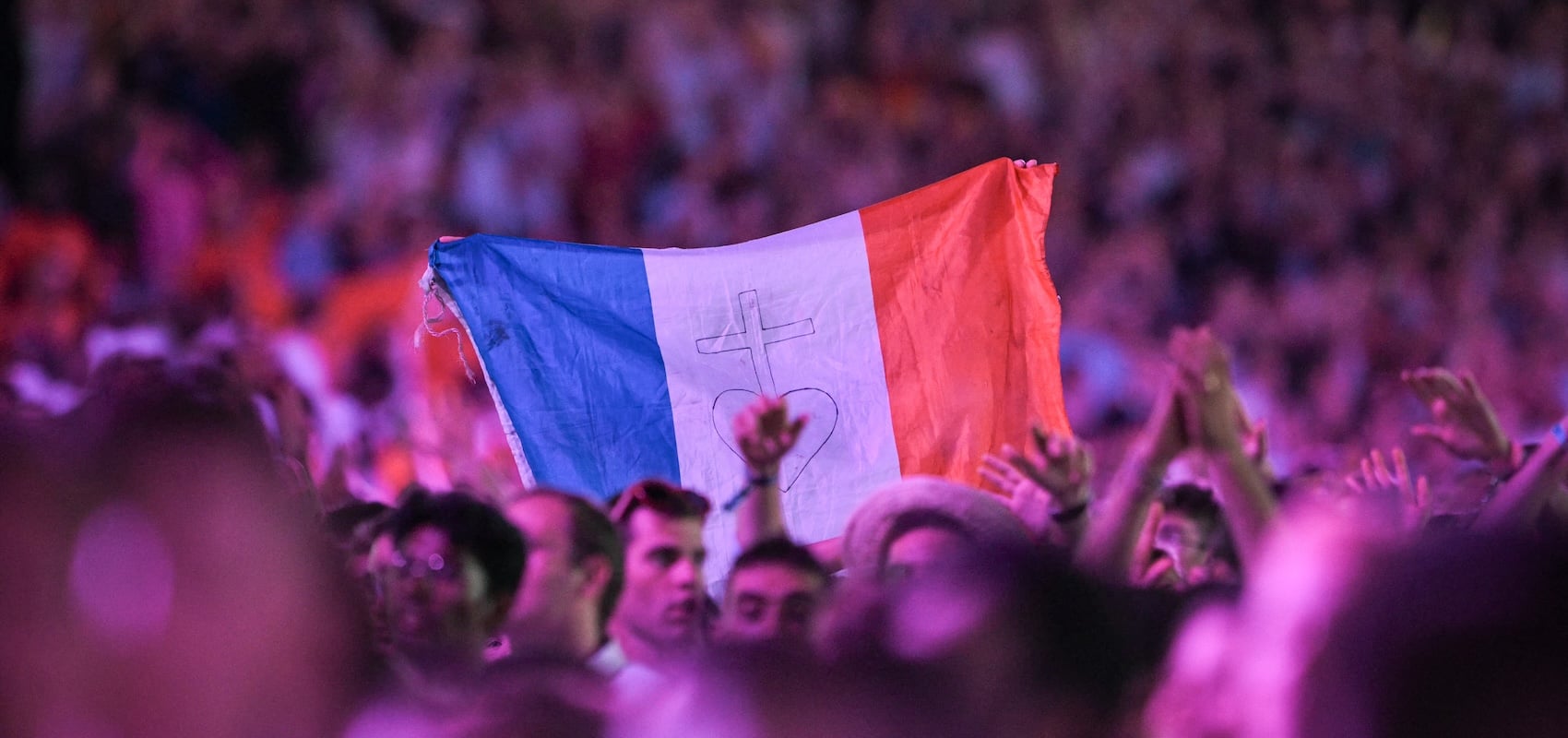
The Stade de France, the country’s largest soccer stadium, holds about 80,000 fans. On Friday, September 25, it was filled with young Catholics. Pope Leo entered to sounds of the toccata from Charles-Marie Widor’s Symphony for Organ No. 5, arranged for orchestra and overlaid with the proclamation “Tu es Petrus, Alleluia,” sung by a choir of 2,500. After addresses, a commemoration of the many saints of France, and a litany in which numerous relics were processed into the stadium, the evening closed with a fireworks display. In celebrating France through its exemplary Christians, the evening provided a welcome respite from the self-critical pessimism bent on deconstructing national identity, a mood that was most notoriously on display at the opening ceremony of the 2024 Paris Olympics.
The centerpiece of the youth vigil was a theatrical parade that told the story of France through its “Army of Saints.” Beginning with Lazarus and Mary Magdalene (who, according to French tradition, sailed to the country’s southern coast and lived out their days as bishop and anchoress), and ending with the most recently beatified Frenchman, Gabriel-Maria Nicolas, the parade wove its way through the crowd, drawing attention to the great figures of French Catholic—and French national—history.
The sounds, too, were distinctly French. The early martyrs were hailed with “Christus vincit, Christus regnat, Christus imperat,” a chant of probable Frankish origin that inverts Roman imperial acclamations. The mellifluous twentieth-century melodies of Maurice Duruflé introduced religious reformers Francis de Sales, Vincent de Paul, Louise de Marillac, John Eudes, Jean-Baptiste de La Salle, and Louis de Montfort. The formative influence of France on Western Christian liturgy, belief, and practice—as well as the inverse—is hard to overstate.
The success of the pope’s visit in general—800,000 people reportedly attended the Saturday papal Mass in Paris—and of the youth vigil in particular has been hailed as a sign of promise. As some have noted, the 2024 Paris Olympics remain most memorable, at least to Catholics, for the opposite reason: an opening ceremony that staged France’s cultural suicide. Telling the story of France through the abstract nouns liberté, égalité, fraternité—as well as even more “abstract” nouns such as synchronicité and obscurité—the show drew harshest criticism for a tableau vivant of da Vinci’s The Last Supper, complete with actors of all shapes and genders. The Vatican responded: “The Holy See was saddened by certain scenes during the opening ceremony of the Paris Olympic Games . . . at a prestigious event where the whole world comes together to share common values, there should be no allusions ridiculing the religious convictions of many people.”
True as the Holy See’s complaint may have been, it missed the larger point. What was most galling in that parody of The Last Supper was not its mockery of religious conviction, but its pointed mockery of the Church that shaped Gaul and its people centuries before a unified Francia, let alone a French nation-state, was even imaginable. As the “Army of Saints” showed, French national history can be more compellingly, and proudly, told through the lives of its great Christians.
The 2024 ceremony openly celebrated the more gruesome elements of modern revolution. Dozens of Marie-Antoinettes, heads in hand, sang a heavy-metal number from the windows of the Conciergerie, the prison from which the real Marie-Antoinette went to the guillotine. The morbid display testified to the critical attitude toward national history that has too long held sway in France and elsewhere, an attitude that runs roughshod over taste, to say nothing of “compassion.” Now, two years on, the performance is just another cringe-inducing relic of an unserious culture. At the 2026 youth vigil, the historical portrayals were earnest, and the crowd cheered the emergence of a young Louis IX—king, Crusader, saint.
It would be trite simply to conclude that the French kids are alright. Though baptisms among adolescents are rising in the country, infant baptism numbers continue to decline. Weekly Mass attendance remains at a paltry 5 percent. But optimism is hard to kill, and for at least one night, the Church in France told its young people an alternative tale of France’s past, and presented an alternative possibility for its future.
Image by Sipa USA via AP. Image cropped.
Dear Reader,
Can I be direct with you?
War abroad. Socialists on the rise. AI upending human life. Endless uproar online. The modern attention economy doesn’t want readers — it wants users enslaved to the tyranny of the present.
First Things is the antidote: literary excellence, timeless truths, and a fixed point of reference in a culture that has lost its bearings.
But we can’t do it without readers like you.
Our goal: Raise $150,000 by November 1 to sustain First Things in the year ahead.
Your gift anchors readers in the permanent things.
Make your Fall Campaign gift now using the button below.
If you have any questions or would like more information, please contact Giovanni Del Piero, Director of the Editor’s Circle, at gdelpiero@firstthings.com or 212-627-1985.

YOU MIGHT ALSO LIKE
Why the Death Penalty Is a Sore Point for Papal Authority
Pope Leo XIV marked World Day Against the Death Penalty, observed on October 10, with the following…
Candace Owens and the Sin of Anti-Semitism
According to the online Encyclopedia Britannica, Sir Moses Montefiore (1784–1885) was “an Italian-born businessman who was noted…
How Sweden’s Immigrant Vote Toppled the Right
For decades, Sweden had perhaps the most open immigration policy and the strongest commitment to tolerance and…
