
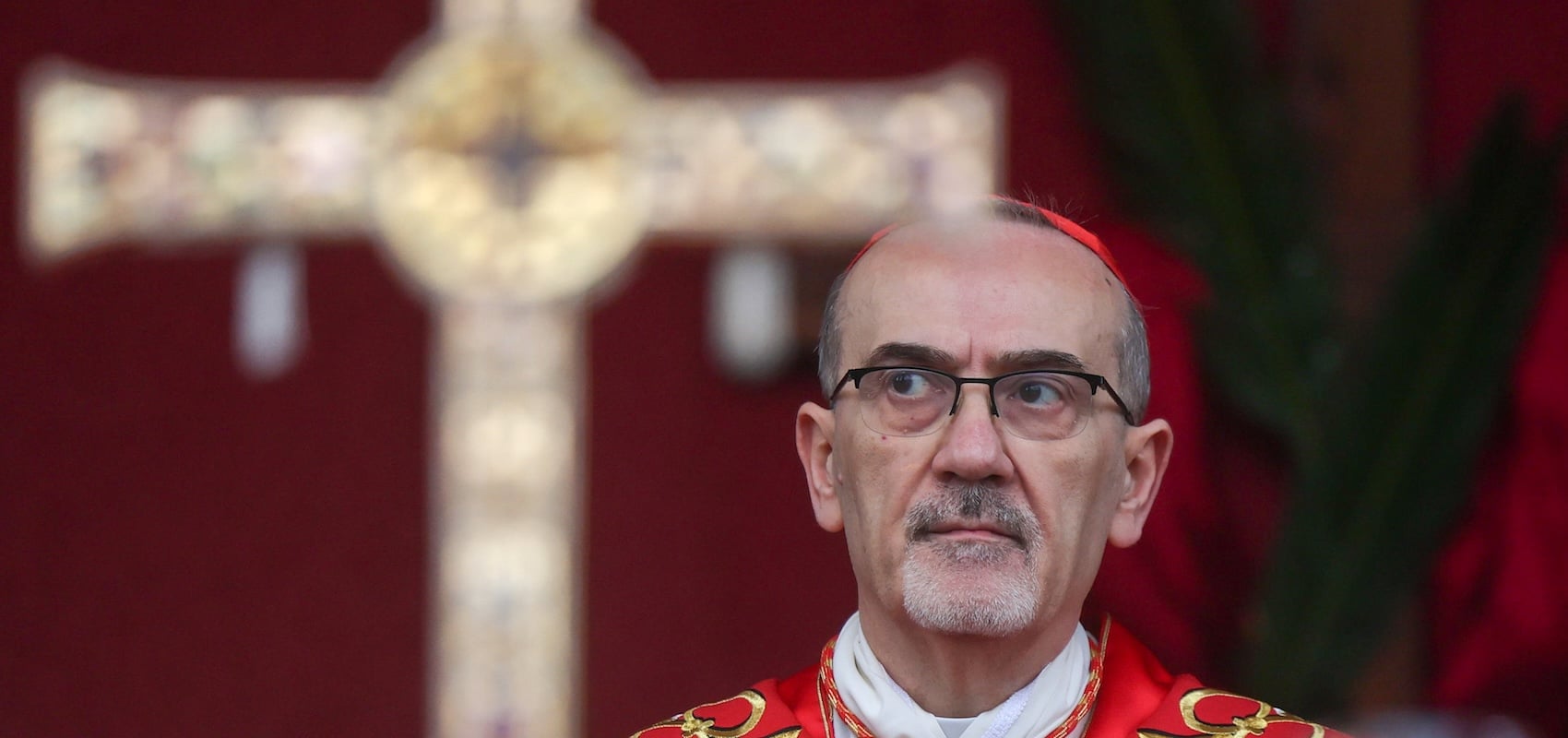
In politics, diplomacy, war, or pretty much any field of human interaction, one must contend not only with the actions of one’s enemies but with those of one’s own side. Benjamin Netanyahu may have been reminded of that recently when Israel faced an uproar of international opinion following the barring of the Latin patriarch of Jerusalem, Pierbattista Cardinal Pizzaballa, and the Franciscan custos of the Holy Land, Fr. Francesco Ielpo, from entering the Church of the Holy Sepulchre on Palm Sunday. The traditional procession on the Mount of Olives had already been canceled, but the patriarch and the custos had been planning to offer Mass and livestream it to an online congregation unable to take part in person.
Since the beginning of the Iran war in March, the holy sites of Jerusalem—including the Western Wall, the al-Aqsa Mosque, and the Holy Sepulchre—have been closed to the public by the Israeli police, citing security concerns; indeed, fragments of an Iranian missile landed on a rooftop next to the Holy Sepulchre in the middle of the month. Liturgies within the church have carried on regardless, offered by the resident clergy, though without outside congregants. Cardinal Pizzaballa and Fr. Ielpo were perfectly within their rights under the restrictions then in force, but were turned away by Israeli police officers all the same.
Understandably, the incident provoked much rending of garments and gnashing of teeth—both internationally and in Israel itself. Emmanuel Macron of France, Giorgia Meloni of Italy, and Pedro Sánchez of Spain all issued prompt condemnations of the move. Former Jerusalem Post editor Avi Mayer attacked it as “foolishness” and noted that “everyone who deals with” Cardinal Pizzaballa knows he is “an honest and decent person” who takes care to treat the Israeli authorities properly. By the afternoon, Israel’s President Isaac Herzog had phoned the cardinal to express “great sorrow” over what he called an “unfortunate incident.” Shortly after midnight, Prime Minister Netanyahu announced on X that he had “instructed the relevant authorities” that the Latin patriarch be granted “full and immediate access” to the Church of the Holy Sepulchre. A meeting was hastily arranged the next day, at which the cardinal was seen laughing and shaking hands with representatives from the Israel Police, who described the gathering as “productive.”
The swift resolution of the problem within twenty-four hours belies the harsher reality that life for Jerusalem’s ancient Christian community has been under increasing pressure for years. The Greek Orthodox patriarchate of Jerusalem has faced repeated attempts by the municipal government to impose tax demands on church-owned properties long exempt under the delicate Status Quo governing relations among the religious communities. The Armenian Quarter faces one of the gravest threats to its existence from attempts to seize land through a suspicious and now canceled deal. Christian residents of these quarters endure regular verbal abuse, spitting, and harassment from a small but confident minority among their Jewish neighbors. These extremists are by no means representative of Jewish residents of the city; indeed, many Jews have offered to accompany their fellow Jerusalemites through the streets to discourage such intimidation.
For those of us who love Israel and its peoples, these are uncomfortable truths. The reality is that Israel is itself an intensely divided society, and even its Jewish majority is riven by social, cultural, political, and religious differences. In politics, these divisions are exacerbated by a system of proportional representation that ensures smaller, more extreme parties are often needed to form a workable coalition. On the very day Cardinal Pizzaballa was extending the hand of friendship to Israeli police, the national security minister, Itamar Ben-Gvir—leader of the far-right party Jewish Power in the governing coalition—was raising a glass in the Knesset to celebrate the passage of a law making the death penalty the default sentence for Palestinians convicted of lethal terror attacks.
I have had the privilege of meeting the patriarch on several occasions and found him an impressive, astute, and intelligent figure. I would certainly count myself among those who would have cheered loudly had he been elected to the Chair of St. Peter in last year’s conclave. Pizzaballa is, however, uniquely valuable in his current see, defending the position of Christians in the Holy Land. He is a fluent Hebrew speaker and was responsible for the translation of several liturgical texts, including the Roman Missal, into modern Hebrew. While custos of the Holy Land, he also served as the Latin patriarchate’s vicar for Hebrew-speaking Catholics in Israel, most of them of Jewish ethnicity. Pizzaballa can speak with Israeli politicians and officials with an ease and deliberation that few other advocates for Jerusalem’s Christians can match.
Across the Middle East, Christians face intensifying challenges. In Egypt, the authorities are encroaching on lands belonging to the Church of Sinai for tourist development. In Syria, majority-Christian neighborhoods of Damascus have been exempted from the Sharaa government’s new ban on the sale of alcohol, but many remain fearful of the direction of travel it suggests. The great strength of Jerusalem’s Christians is that, despite the plurality of their churches and denominations, when one is threatened, they speak with a single voice. When those voices are raised loudly enough—and heard clearly within Israel and around the world—there remains some hope that Christian life in the holy city will endure.
Ammar Awad/Pool Photo via AP
