
Something like a civil war is unfolding within the American conservative movement. It is not merely a dispute about policy agendas, foreign alliances, or the boundaries of political discourse. It is a deeper conflict—a struggle over the meaning of conservatism itself. The recent controversy surrounding Tucker Carlson’s interview of Nick Fuentes revealed a fissure that has been widening for years: a clash between two visions of the right, one grounded in universal moral principle, the other in cultural and civilizational loyalty. What might otherwise have been a marginal media dustup became a moment of revelation about the future of American conservatism.
For figures such as Robert P. George, McCormick Professor of Jurisprudence at Princeton University and perhaps the single most influential moral philosopher within conservative intellectual circles, conservatism begins with the claims of natural law. Its founding premise is the inherent dignity of every human being—an anthropology that descends from classical philosophy, Christian theology, and the Enlightenment. For George, conservatism is first a moral project: It safeguards life, liberty, marriage, family, and religious freedom because these institutions reflect universal truths about the human person. George has spent his career articulating these principles in philosophy, public policy, and constitutional thought. His is an approach to conservatism that emphasizes the primacy of the permanent things, the universals that transcend time and place.
Opposing this universalist strand is the ascendant nationalist wing of the right—a coalition influenced by the populist energies that surged after 2016 and represented by Tucker Carlson, Kevin Roberts of the Heritage Foundation, and polemicists such as John Zmirak. This faction sees conservatism less as an expression of moral philosophy than as a defense of Western civilization: a concrete culture, a historical inheritance, with its own people, faith, memories, and vulnerabilities. This conservatism is particularist rather than universalist. It begins not with abstract principles but with cultural loyalties. Whereas George begins with human dignity, Carlson begins with civilizational survival. Whereas George sees imperatives and violations of the moral law, Carlson sees a beleaguered West beset by global elites, porous borders, and cultural disintegration.
The recent dispute over Carlson’s treatment of Nick Fuentes brought these differences into sharp focus. Carlson’s critics—including George, Ben Shapiro, and others in the moral-universalist camp—argued that he had given a platform to a figure who traffics in anti-Semitic rhetoric and white-nationalist themes. For them, this was not merely a lapse in judgment but a failure of moral responsibility. Carlson’s defenders countered that conversation does not equal endorsement, and that conservatives must not mimic the left’s “cancel culture” by excommunicating those who question dogmas about foreign policy or Israel. They argued that a movement committed to free inquiry must not shrink from difficult conversations.
Beneath this quarrel lies a more fundamental question: Is American conservatism about preserving a moral order or protecting a civilizational identity? Is it grounded in rights and duties that apply to all human beings or in the defense of a particular way of life that belongs to a specific people? One could say that the universalist right worries about moral illegitimacy, whereas the nationalist right worries about cultural extinction.
This tension is not new. It has antecedents in the intellectual history of American conservatism, stretching back to the mid-twentieth century. The original conservative coalition—the so-called “fusionist” project—sought to reconcile libertarians, social traditionalists, anti-Communist hawks, and Catholic natural-law theorists. Buckley’s National Review, Irving Kristol’s neoconservatism, Goldwater’s libertarianism, and Reagan’s evangelical alliance all depended on maintaining a precarious balance between universalist commitment and civilizational loyalty.
That equilibrium was always fragile. The Old Right of the 1930s and 1940s, led by Robert Taft and the America First Committee, had been isolationist, nationalist, and wary of foreign entanglements. It was skeptical of global institutions and suspicious of cosmopolitan elites. The New Right that emerged after World War II reversed these tendencies, embracing international responsibility and moral universalism—especially once the Cold War framed America’s struggle against the Soviet Union as a defense of global democracy.
The rise of neoconservatism in the 1970s and 1980s intensified this universalist impulse. Figures such as Irving Kristol, Norman Podhoretz, and Jeane Kirkpatrick argued that America should use its power to defend democracy and human rights abroad. Many leading neoconservatives were Jewish Americans whose commitment to universalist ethics aligned with the American creed. For decades, this coalition kept nationalist particularism in check.
But the paleoconservative critique—articulated by Pat Buchanan, Sam Francis, and others in the 1990s—never disappeared. Paleoconservatives warned that the conservative establishment had subordinated national interests to abstract ideology and foreign entanglements. They were skeptical of immigration, free trade, and especially America’s close relationship with Israel. Their warnings did not dominate conservative politics—until the populist wave following 2016 revived them.
Carlson, whether he claims the mantle or not, stands squarely in the paleoconservative lineage. His skepticism of U.S. foreign policy, his warnings about demographic change, and his view that elites betray ordinary Americans place him in a tradition that prioritizes civilizational cohesion over universalist doctrine. The controversy over his interview with Fuentes cannot be understood apart from this lineage.
Understanding this history also helps clarify why Zionism has become the main flash point in the conservative civil war. Zionism is, in essence, a communitarian nationalism: the assertion of a people’s right to self-determination in its ancestral homeland. It is a repudiation of cosmopolitan universalism in favor of historical continuity and particular identity. By rights, the nationalist wing of the American right—which champions cultural sovereignty and civilizational rootedness—should admire Zionism. Israel is the very embodiment of the communitarian values that the New Right claims to defend: tradition, identity, faith, resilience.
And yet, the nationalist right has grown increasingly hostile to Israel. Carlson argues that American foreign policy has been excessively shaped by pro-Israel interests. Some of his followers express a deeper suspicion—one that veers into old patterns of anti-Semitism masked as anti-Zionism. Meanwhile, the universalist right sees criticism of Israel as a sign that the nationalist project is incubating bigotries long dormant but never extinguished.
These ironies reveal a conceptual flaw: The nationalist right’s suspicion of Jewish influence and of Israel makes little sense within its own stated values. It is driven less by philosophical coherence than by a populist resentment of perceived elites—elites who, in the nationalist imagination, overlap with Jewish identity. What begins as criticism of foreign policy slides, easily and dangerously, into civilizational suspicion. That suspicion contains a further irony, for what is Western civilization if Judaism is not one of its central pillars? Is it really possible to stand up for the Christian West by treating Jews as aliens?
On the other side, the universalist right, though morally correct in rejecting anti-Semitism, sometimes speaks as if universal principles alone can sustain a society. Their tendency to abstract from culture, tradition, and inherited forms can make them appear insensitive to the anxieties that fuel the nationalist revolt. They underestimate the importance of belonging, memory, and communal cohesion.
The conflict between these two factions would be difficult enough if it concerned only geopolitics or intellectual style. But it also touches on the internal dynamics of American Jewish identity—a subject that must be approached with care.
American Jews inhabit a dual identity that includes a universal moral tradition, rooted in prophetic ethics and the rule of law, and a particular solidarity with the Jewish people, rooted in shared history, ritual, and the existence of the state of Israel. This duality is not contradictory; it is the product of a long history. Jewish Americans have contributed profoundly to American life—in law, medicine, culture, academia, journalism, and politics—often championing the universal ideals that inspired the American founding and shaped the American creed. But global anti-Semitism and recent violence at home have heightened the sense among many Jews that Israel is essential not only as an idea but as a guarantor of survival.
The nationalist right’s skepticism of Israel places Jewish Americans in a difficult position. It implies—sometimes subtly, sometimes explicitly—that Jewish loyalty is divided, that the Jews’ commitment to America is compromised by their attachment to Israel. This accusation has a long and dark pedigree. It is the same charge historically leveled at Jews in Europe: that they are perpetual outsiders, cosmopolitans, disloyal to the nation, agents of foreign influence.
One need not accuse Carlson of anti-Semitism to recognize that the nationalist critique can activate these ancient suspicions. That is why George and others respond so sharply. They understand that criticism of Israeli policy is legitimate, but they also understand how easily such criticism can become a cover for more ominous attitudes.
To make sense of all this, let us turn to the experience of black Americans, not because the histories are equivalent—they are not—but because the structural problem both groups have faced is analogous: how to reconcile a strong subgroup identity with full membership in the American civic nation.
Black Americans have a unique and foundational place in American history. Unlike Jewish Americans or other immigrant groups, we are not a diaspora with an external homeland. Our ancestors’ arrival on these shores was coerced and brutal, but our presence is inseparable from the nation’s founding contradictions. We are not an added population but an integral one—a people forged in America’s crucible.
And yet, for centuries, our identity was viewed as incompatible with American citizenship. We were faced with the perpetual question: Were we Americans? Could we be? Should we be? The black freedom struggle answered those questions with clarity: We are Americans, and our fate is tied to the nation’s fate. But that patriotism was not naive. It did not ignore the injustices inflicted upon us. It was a patriotism grounded in struggle—a love of country that demanded moral redemption.
This posture—what I have called black patriotism—offers a model for resolving the tension between universal ideals and particular identity. Black Americans did not shed their cultural inheritance in order to claim American citizenship. We transformed the nation by insisting that the nation’s universal promise of equality applied to us. Our struggle did not weaken America; it strengthened America by forcing it to live up to its own principles.
In this sense, the black experience reveals the possibility of a civic nationalism that is both universal and particular, both aspirational and rooted. It shows that layered identities—cultural, religious, historical—need not threaten civic belonging. On the contrary, they can enrich and deepen it.
The comparison with Jewish Americans must be handled carefully. The histories differ profoundly. Black Americans are of America in a way that Jewish Americans, with their diasporic ties and in view of the existence of Israel, are not. Black Americans did not choose America; America was imposed on us, and we turned that imposition into a claim of ownership. Jewish Americans are immigrants or descendants of immigrants who have integrated into the American project with extraordinary success.
But both groups confront a similar challenge: how to be fully themselves and fully American. For Jews, it involves balancing solidarity with Israel and adherence to a universal ethical tradition with commitment to an American civic identity. For blacks, it involves reconciling the memory of slavery and segregation with the aspiration of constitutional equality.
The lesson from both histories is that civic nationalism need not require erasing particular identities. Rather, it requires a political framework that is capacious enough to accommodate them. When conservatism becomes too narrow, too suspicious of internal diversity, it risks undermining the civic unity it seeks to preserve. When it becomes too abstract, too detached from the lived experience of particular communities, it loses its cultural grounding.
The conservative movement, in its current turmoil, faces this very choice. It can embrace a cramped vision of America—one that mistrusts layered identities and treats cultural particularity as disloyalty. Or it can embrace a richer conception of the nation—one that honors universal principles while recognizing the importance of inherited traditions and communal attachments.
A conservatism worthy of the name must find room for Jewish particularism and black particularism within a shared civic framework. It must reject anti-Semitism and racism, not only because they are morally abhorrent but because they violate the very foundations of the Western civilization it reveres. At the same time, it must resist the temptation to use universalist rhetoric as a way to ignore the cultural preconditions of liberty. And it must avoid turning particularist suspicion into a politics of resentment.
A mature conservatism recognizes that universal principles require concrete communities to sustain them, and that those communities are enriched rather than threatened by the presence of diverse histories and identities. The American nation is not a tribe but a covenant—a shared project rooted in moral aspiration and historical inheritance. Both black Americans and Jewish Americans have contributed vitally to that project, each in ways shaped by their distinctive histories. We are a more vital nation for that.
The civil war within conservatism will not be resolved by the choice of universalism over nationalism or nationalism over universalism. It will be resolved by an integration of the two: by a vision of America that honors both the dignity of every person and the particular heritage of its people.
The future of our nation depends on whether we can achieve that synthesis. So does the future of conservatism. And if we are willing to learn from the stories of those who have wrestled longest with the tensions of identity and belonging—black Americans and Jewish Americans among them—we may yet find a path that avoids both abstraction and resentment, both moralism and tribalism.
A conservatism that achieves this synthesis will be intellectually coherent, morally serious, and culturally grounded. It will conserve not only the inheritance of the past but the promise of the future.
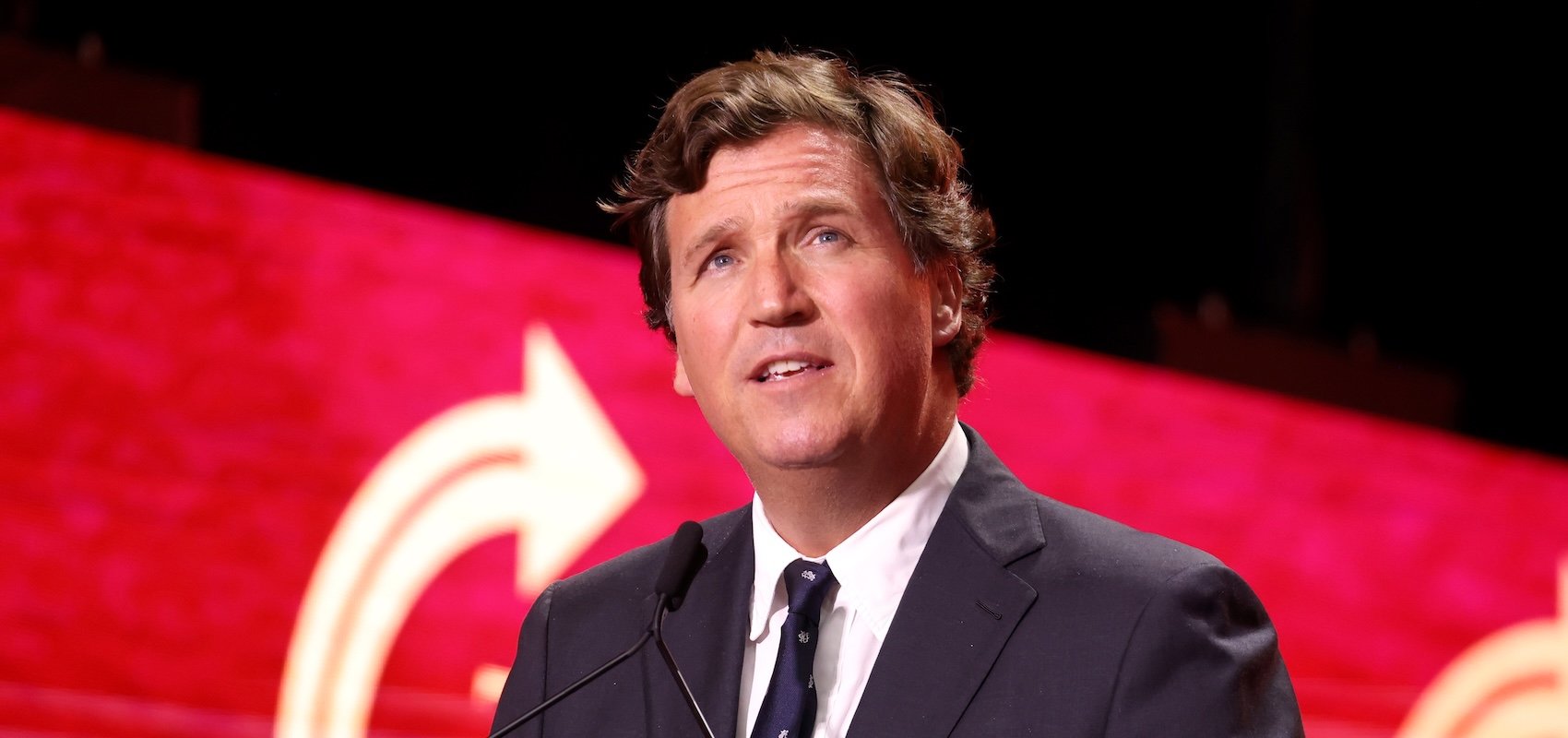
Image by Gage Skidmore, licensed via Creative Commons. Image cropped.

YOU MIGHT ALSO LIKE
Turned Away on Palm Sunday
In politics, diplomacy, war, or pretty much any field of human interaction, one must contend not only…
Timothée Chalamet Is Right About Art (ft. Suzy Weiss)
In this episode, co-founder and reporter for the Free Press, Suzy Weiss, joins Virginia and Germán to…
Trump’s Civilizational Project
Secretary of State Marco Rubio spoke at the recent Munich Security Conference. Last year, Vice President JD…
