Secretary of State Marco Rubio spoke at the recent Munich Security Conference. Last year, Vice President JD Vance issued stern warnings with harsh rhetoric. Rubio’s speech was conciliatory, often speaking warmly of common purpose and mutual friendship. But the substance was not much different from last year’s. Vance and Rubio convey the Trump administration’s conviction that the West suffers from civilizational malaise. Restoring confidence in our shared Western inheritance is of foundational importance.
Rubio asked the Europeans gathered in Munich to join the Trump administration in judging some of the central ambitions of the post–Cold War decades to have been mistakes. The end-of-history mentality that imagined a post-national global system has failed. The economic elements of globalization ended up deindustrializing the West, making us vulnerable militarily. What prosperity globalization brought has benefited the globally connected elite, not ordinary citizens. The political elements of globalization have eroded national sovereignty, and globalist rules and norms are often used by tyrants against efforts to curb their misdeeds.
Rubio identified the “climate cult,” which has imposed ruinously expensive economic policies on the West. He observed that open borders and lax policies have led to “an unprecedented wave of mass migration that threatens the cohesion of our societies, the continuity of our culture, and the future of our people.” More broadly, Rubio pointed to the damaging effects of what Roger Scruton dubbed “oikophobia,” a sour, critical attitude toward our shared home and inheritance.
After listing these mistakes, Rubio made a crucial concession to his European audience (and said something Americans need to hear): “We made these mistakes together.” He is certainly right. The problems besetting a weakened and demoralized West were the result of a powerful open-society consensus. America led the way in pioneering globalization. We encouraged the establishment and expansion of the European Union. Our universities have nurtured anti-Western ideologies such as postcolonialism.
The main thrust of Rubio’s speech was a call to action: reindustrialize, enforce borders, place the international order on a more modest and realistic foundation. However, the most important imperative concerns our shared civilization. Rubio announced, “We want allies who are proud of their culture and of their heritage, who understand that we are heirs to the same great and noble civilization.” Europeans should want the same from us. Strong allies require cultural self-confidence, which is not encouraged by land acknowledgments.
Rubio was treated to rapturous applause. I imagine that a good number of European elites recognize the mistakes of recent decades, not the least of which has been the deliberate cultivation of civilizational guilt. Perhaps they shrink from the new direction Rubio made explicit. But they see the problems facing their countries, which are problems that emerged after 1990, problems endemic to the open-society consensus.
There was one aspect of civilizational renewal that Rubio mentioned that I fear European elites won’t—or can’t—acknowledge. The Secretary of State observed that the central element of Western civilization is the “sacred inheritance” of “Christian faith.” He was right to do so. Hegel once wrote: “Religion is the sphere in which a nation [and a civilization] gives itself the definition of what it regards as the True.” Religion animates a culture, stimulating and guiding the perennial human desire for transcendence.
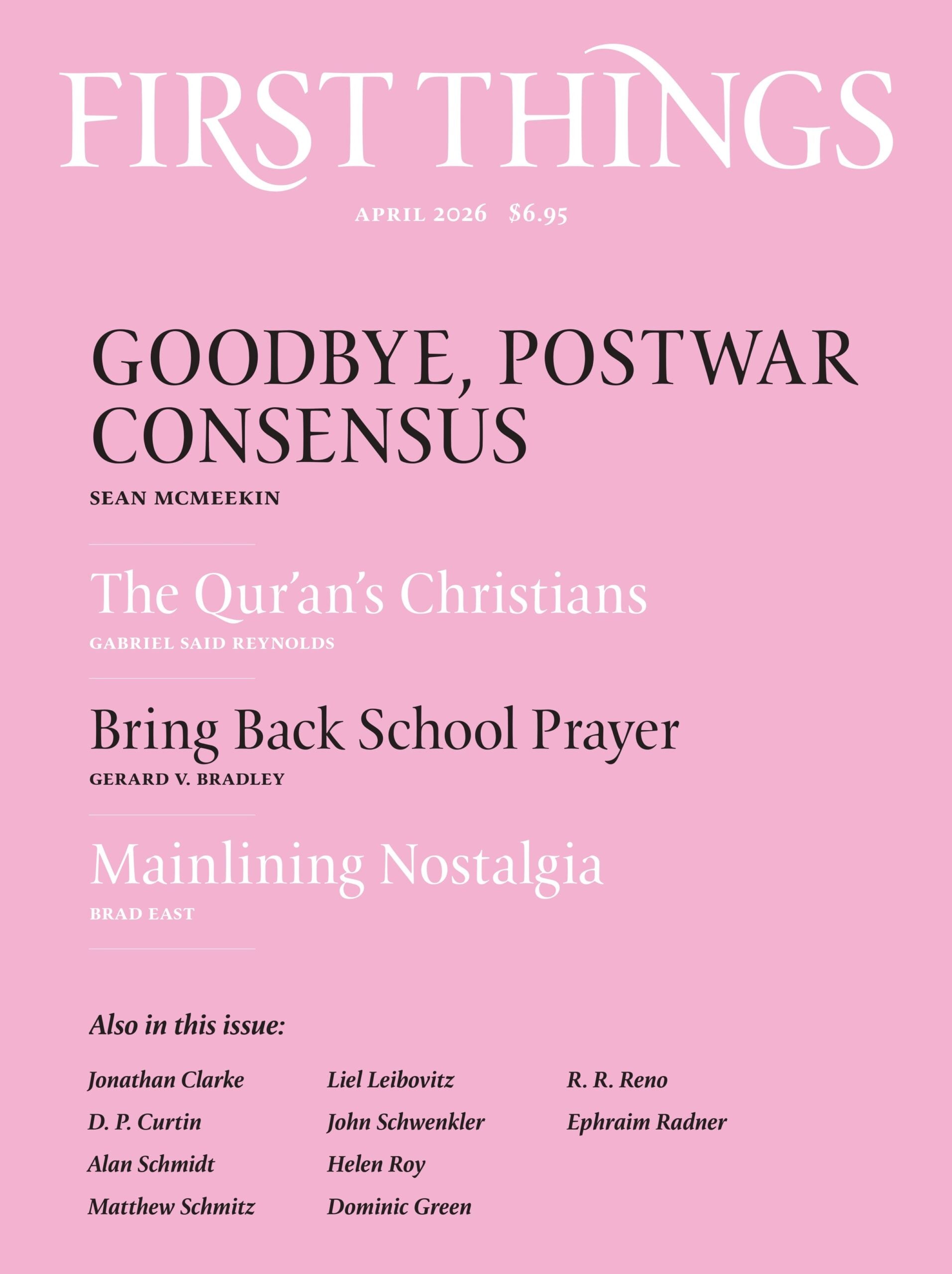
Unfortunately, as the twentieth century came to an end, the open-society consensus demanded that we have a culture without religion, something never before tried in human history. After intense debate, Christianity was deliberately not mentioned in the European Constitution formulated in the early twenty-first century. At the time, Pope John Paul II expressed dismay: “One does not cut the roots to one’s birthright.” The United States remains more religious than are nations in Europe. But as Gerard Bradley observes in this issue in “How to Bring Back School Prayer,” in the 1960s, our constitutional regime expelled religion from the public square. Today, multicultural ideology deems “divisive” any revival of the public influence of Christianity. And biblical morality collides with the sexual revolution, which remains dear to elites in Europe and America.
The animus against vibrant and civically engaged Christianity will be difficult to overcome. But as Rubio suggests, we must overcome it. He praised the great achievements of the West: the rule of law, scientific inquiry, great architecture, and noble traditions of freedom. It was “a faith in God that inspired these marvels,” noted Rubio. Men did not have faith so that they could do great things; they did great things because they had faith. Our civilizational future will depend on those whose eyes are turned toward something greater than the restoration of confidence in the West.
America and Europe are tied together. “Our destiny is and will always be intertwined with yours,” Rubio said in Munich. Indeed. America’s enduring piety continues to make Christianity a potent element of public life. We should pray that such influence waxes stronger, spilling over into the European scene. Civilizations are renewed by truths from above. Those who seek union with God move the world.