
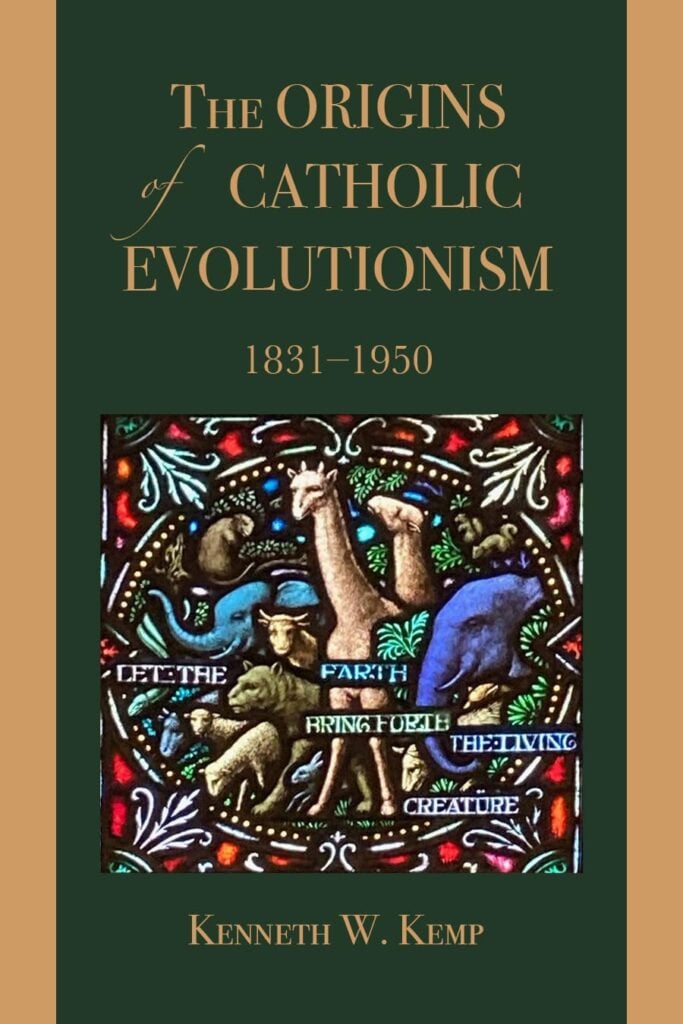
The Origins of Catholic Evolutionism, 1831–1950
by kenneth w. kemp
the catholic university of america, 540 pages, $85
Darwin and Doctrine:
The Compatibility of Evolution and Catholicism
by daniel kuebler
word on fire, 304 pages, $29.95
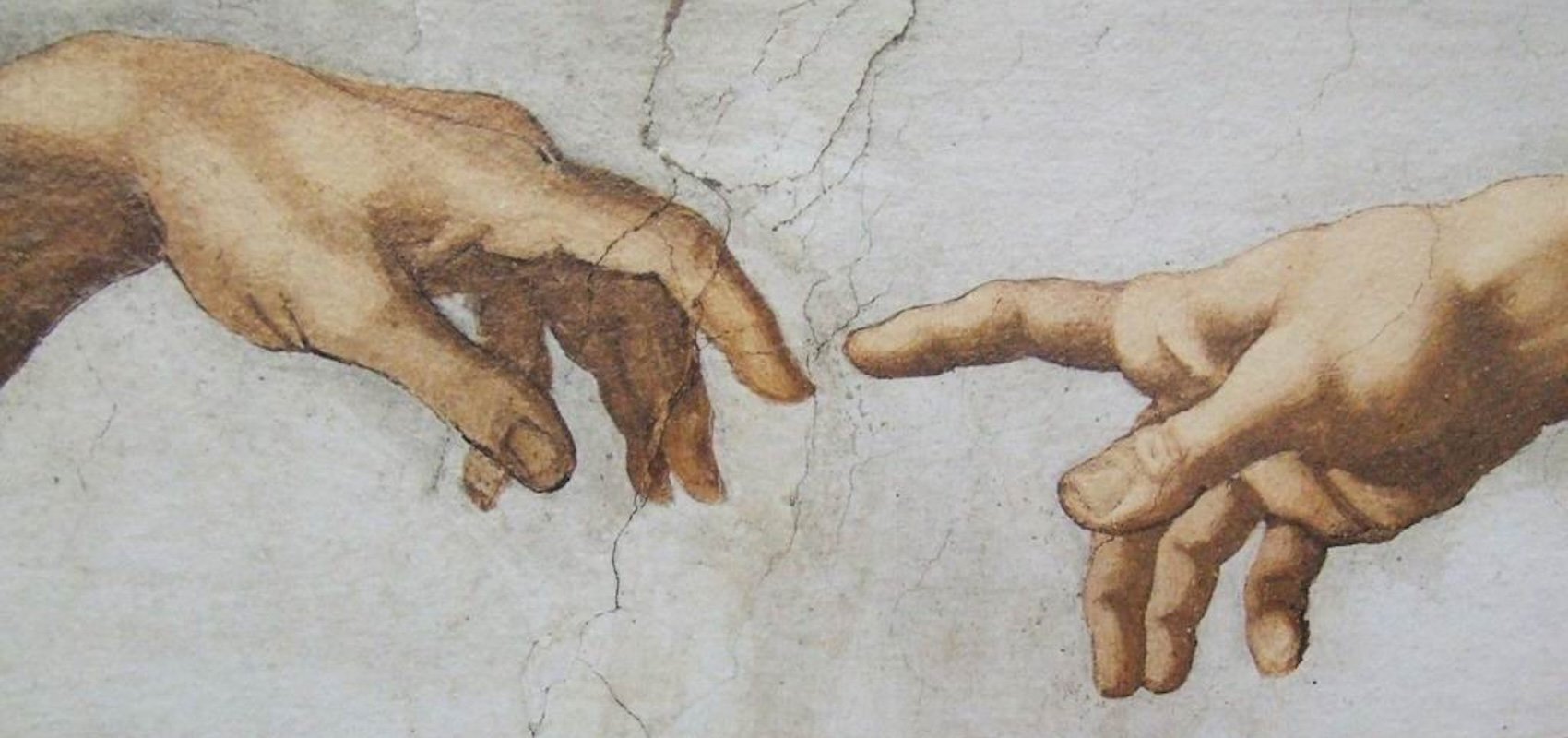
The Catholic Church never condemned the theory of evolution nor came close to doing so. One might have expected otherwise: Many of the factors that had led to the Galileo fiasco two centuries earlier were present again. Darwin, like Galileo, was proposing a radical theory that struck many people as absurd—and that seemed contrary to the “plain meaning” of certain scriptural verses as they had generally been construed. Both theories were at first controversial even among scientists and faced weighty scientific objections, both observational and theoretical, which could not be resolved until decades later. Both theories contradicted aspects of the Aristotelianism that prevailed among Catholic theologians. Finally, both Galileo and Darwin promulgated their theories at times when the Church faced powerful challenges to her credibility and authority, as a result of which her doctrinal defense mechanisms were on high alert. Even if the Vatican’s condemnation of Galileo did not formally and irrevocably commit the Church doctrinally, it put the Church, for a time, on the wrong side of a scientific issue. The same could easily have happened with On the Origin of Species.
Indeed, in some ways, the circumstances facing the theory of evolution were even less auspicious than those Galileo contended with. Galileo’s offending ideas, after all, concerned astronomy, which Cardinal Bellarmine admitted at the time pertained to the faith only “incidentally,” whereas the theory of evolution, as applied to human beings, concerned matters of the highest theological importance, such as the nature of man and the doctrine of original sin. And whereas in Galileo’s day no one was using heliocentrism to attack Christianity and virtually all scientists were Christians, by the late nineteenth century religious skepticism and scientific materialism had gained many adherents, and evolution was being used as a cudgel against religion. As a result, many Christians, both Catholic and Protestant, were disposed to be deeply suspicious of the new ideas and the people who advocated them.
And yet, no condemnation by the Catholic Church ever came. In fact, the universal magisterium of the Church said nothing about evolution until 1950, more than ninety years after Darwin published his Origin of Species. Part of the reason for this caution, no doubt, was that Church authorities were keenly aware that science had long since vindicated heliocentrism and they had no desire to repeat past mistakes. Moreover, discoveries in geology and paleontology in the preceding century had shown that both the planet and the life upon it were of much greater antiquity than a literal reading of Genesis would suggest. This had a strong impact, since it was an accepted principle in the Catholic Church, at least since St. Augustine, that Scripture should not be read in a way contrary to what is known with certainty from reason and experience. Even so, the Church’s forbearance with regard to evolution is remarkable.
The full story of how the Church did react to the theory of evolution is told in a fine new book by Kenneth W. Kemp, professor emeritus of philosophy at the University of St. Thomas in Minnesota. The Origins of Catholic Evolutionism, 1831–1950 is a monumental work of scholarship: massively researched, comprehensive, nuanced, restrained in judgment, and clearly written. Its focus is on the ideas of the many Catholic scientists, theologians, and philosophers who either advocated evolutionism in some form or at least defended its compatibility with Catholic belief, and on how their ideas were received within the Catholic Church and by her magisterium. Kemp seems intimately familiar with the vast body of primary sources, from the writings of the Catholic evolutionists and compatibilists themselves to discussions of their ideas in contemporary Catholic periodicals, encyclopedias, theological textbooks, and internal Vatican deliberations.
If there was one key factor in the Church’s restraint, it would seem to be the prudence of the popes of that era with regard to natural science. The reigning pope when Darwin published On the Origin of Species in 1859 and The Descent of Man in 1871 was Pius IX, who famously denounced eighty errors of the modern world in his 1864 Syllabus Errorum, and yet not one of the eighty concerned evolution. Nor was evolution mentioned, directly or indirectly, in the decrees of the First Vatican Council, which Pius IX convoked in 1869.
The next four popes, including the fiercely anti-Modernist Pius X, likewise made no pronouncements about evolution. In the case of Pius IX’s immediate successor, Leo XIII, the reason can be guessed from a comment made in a private letter in 1892, quoted by Kemp:
There are restless and peevish spirits who press the Roman Congregations to pronounce on matters that are still uncertain. I am opposed to that; I will stop them because it is not necessary to prevent scholars from doing their work. One must give them the time to suspend judgment or even to make a mistake. Religious truth can only gain from that. The Church will always be in time to put them on the right road.
Though there was no shortage of “peevish spirits” in the Church who wanted to see evolution condemned root and branch, they were by no means predominant. There was a wide spectrum of attitudes within the Church at all levels, with regard both to evolution as a scientific theory and to the philosophical and theological issues that it raised.
Some (under the influence of Aristotelian biology and metaphysics) thought the evolution of species was impossible. Others thought the scientific evidence for some evolutionary change was strong but doubted whether it could have produced the great qualitative differences that exist between plants and animals or among kinds of animals. Still others were open to the idea of the common ancestry of all living things on earth but drew the line at man himself, either because they found the idea of an animal ancestry for man “repugnant” or because they thought Genesis 2:7 taught that God had formed the first human body directly from the dust of the earth. And finally, there were many who had no such reservations but agreed with the English biologist and Catholic convert St. George Mivart (“St. George” being his given name), who in On the Genesis of Species (1871) defended the idea of a natural evolution of species, all the way up to and including the human body, as “perfectly consistent with the strictest and most orthodox Christian theology.” Here the distinction between the human body and soul is crucial. No Catholics, whether scientists or theologians, were arguing that evolution, or any purely material process, could produce the human spiritual soul, with its powers of intellect and will. All agreed on the metaphysical impossibility of that, and on the Catholic teaching that the spiritual soul is directly created by a supernatural act, not only in the first human beings, but in every human being.
Though many Catholics denied or doubted Darwin’s theory, or aspects of it, on scientific, philosophical, or theological grounds, few theologians thought that the idea of evolution of species was per se contrary to Scripture. Writing in the influential Catholic journal the Dublin Review in 1896, Fr. David Fleming, OFM (later to be secretary to the Pontifical Biblical Commission), wrote, “the great majority of Catholic theologians hold . . . that evolution in itself is not excluded by the text of Genesis.” Nor was it considered by most theologians to be contrary to the Catholic faith. As early as 1868, we find St. John Henry Newman writing in a letter:
We do not deny or circumscribe the Creator . . . if we hold that He gave matter such laws as by their blind instrumentality moulded and constructed through innumerable ages the world as we see it. If Mr Darwin in this or that point of his theory comes into collision with revealed truth, that is another matter—but I do not see that the principle of development, or what I have called construction, does.
Among theologians and Church authorities, doctrinal concerns were focused primarily on the origin of man, and in particular how the bodies of the first humans came to be. Some theologians argued that it was authoritative Church teaching (even if not de fide) that Adam’s body was created directly and immediately from the dust of the earth. For example, in a review of Darwin’s Descent of Man (1871) in the Dublin Review, Fr. John Cuthbert Hedley, OSB (who was later made bishop), wrote:
It is not contrary to Faith to suppose that all living things, up to man exclusively, were evolved by natural law out of minute life-germs primarily created, or even out of inorganic matter. On the other hand, it is heretical to deny the separate and special creation of the human soul; and to question the immediate and instantaneous (or quasi-instantaneous) formation by God of the bodies of Adam and Eve—the former out of inorganic matter, the latter out of the rib of Adam—is, at least, rash, and, perhaps, proximate to heresy.
On the other hand, Newman wrote in a letter to Edward Pusey in 1870:
‘All are dust’—Eccles iii, 20—yet we never were dust—we are from fathers, why may not the same be the case with Adam? I don’t say that it is so but if the sun does not go round the earth and the earth stand still, as Scripture seems to say, I don’t know why Adam needs to be immediately out of dust.
Many theologians were willing to concede that natural processes, including evolution, may have played a large role in the formation of the first human bodies, but some of them thought that direct divine intervention would also have been required to make those bodies capable of receiving a spiritual soul.
The numerous complex issues concerning evolution and the contending views about them were vigorously, but civilly, debated in many Catholic fora, both popular and scholarly, over many decades. Kemp quotes a passage from H. L. Mencken that gives an interesting glimpse of this. In commenting on the Scopes Trial of 1925, Mencken, no friend of any religion, wrote:
The current discussion of the Tennessee buffoonery, in the Catholic and other authoritarian press, is immensely more free and intelligent than it is in the evangelical Protestant press. In such journals as the [Commonweal], the new Catholic weekly, both sides were set forth, and the varying contentions are subjected to frank and untrammeled criticism. Canon de Dorlodot whoops for Evolution; Dr. O’Toole denounces it as nonsense. . . . The [Commonweal] itself takes no sides, but argues that Evolution ought to be taught in the schools—not as an incontrovertible fact but as a hypothesis accepted by the overwhelming majority of enlightened men. The objections to it, theological and evidential, should be noted, but not represented as unanswerable.
Of course, limits on freedom of discussion among Catholics could be placed by the Roman Congregations, specifically the Congregation of the Index of Prohibited Books (which existed in one form or another from 1559 to 1966), the Pontifical Biblical Commission (founded in 1902), and the Holy Office (called the Sacred Roman and Universal Inquisition from 1542 until 1908, and the Congregation for the Doctrine of the Faith after 1965). It was the Congregation of the Index that was most active with regard to evolution, especially in the 1890s, when it leaned decidedly against evolutionary ideas. However, unlike the Holy Office, it was not empowered to issue doctrinal pronouncements or condemnations, but only to act against specific books, generally by listing them on the Index without publicly stating its reason for doing so.
Though some books written by advocates of evolution were placed on the Index, it was generally for reasons other than the author’s advocacy of evolution: Some of these books were either explicitly anti-religious or atheistic and materialistic in outlook; others were reductive in their philosophical anthropology or gave inadequate accounts of the difference between human beings and lower animals; still others proposed unacceptable theories about the inspiration of Scripture.
There were, however, two important cases in which the Congregation of the Index did restrict books for their views on evolution: L’Évolution restreinte aux espèces organiques (second edition, 1891) by Dalmace Leroy, OP, and Evolution and Dogma (1896) by John A. Zahm, CSC. What offended the Congregation about these two books was primarily their position on the origin of the human body, which was essentially that of Mivart, namely that a Catholic could hold that the first human bodies (though not the soul) had arisen through evolution without any direct supernatural intervention. (It should be noted that Mivart’s own book was never censured, and Mivart was awarded an honorary doctorate in philosophy by Pope Pius IX after its publication.) In a key passage, Leroy wrote:
The human body is composed of matter and form. And the soul, its substantial form, comes directly from God, of course. But the matter, where does it come from? It comes from the slime of the earth, that is also certain, as the Church and tradition clearly teach. But was the human soul infused immediately into this slime, that is to say, without any preparation? And if it underwent preparation, as Genesis indicates, could it not have been evolution which effected it? That is the question that may still be asked.
Unfortunately, the Congregation thought otherwise, persuaded by a few “peevish spirits,” especially a Dominican theologian bitterly opposed to evolution named Buonpensiere (which, ironically enough, means “good thought”). Even in the cases of Leroy and Zahm, however, the Congregation decided not to put books on the Index but to command the authors—priests under religious obedience—to disavow them publicly and do what they could to remove them from circulation.
The issue came to a head in the 1920s and ’30s, when the Holy Office (which had not previously involved itself in evolution cases, but had recently been given responsibility for the Index of Prohibited Books) became concerned about the views on the evolution of the human body of the theologians Henry de Dorlodot, who died in 1929, and Ernest Messenger, whose 1931 book carried on Dorlodot’s work. After consultations that dragged on for several years, the Holy Office on June 10, 1936, voted eight to two that Messenger should be enjoined to withdraw his own book from sale. The next day, however, Pope Pius XI decided to accept the minority’s recommendation that the book be ignored for the time being; he also requested “an authoritative account of the scientific data of anthropological paleontology.” That report, which he received a year later, concluded that “our best attitude with regard to the question of the descent of man, so far as his bodily form is concerned, must be a patiently expectant one, with an evenly balanced mind, waiting till further discoveries and researches give us . . . a decisive result.” In the end no action was taken with regard to Messenger or Dorlodot. At no point did the Holy Office consider issuing condemnations of propositions connected with evolution.
The watershed for Catholic evolutionism came on August 12, 1950, when Pope Pius XII issued the encyclical Humani Generis, in which he wrote:
The Teaching Authority of the Church does not forbid that, in conformity with the present state of human sciences and sacred theology, research and discussions, on the part of men experienced in both fields, take place with regard to the doctrine of evolution, in as far as it inquires into the origin of the human body as coming from pre-existent and living matter—for the Catholic faith obliges us to hold that souls are immediately created by God.
Clearly implied is the position that Mivart put forward in 1871: that a natural, evolutionary origin of man at the bodily level is not contrary to the Catholic faith.
Humani Generis did not, of course, resolve the numerous important theological and philosophical questions surrounding evolution that have been discussed in the Church from Darwin’s day till now. Indeed, there has been relatively little official guidance for the ordinary Catholic concerning how to navigate these questions. Evolution is not explicitly mentioned, for example, in the Catechism of the Catholic Church. And antagonism to the idea of evolution—even the evolution of plants and animals—has begun to seep into some corners of the Catholic Church.
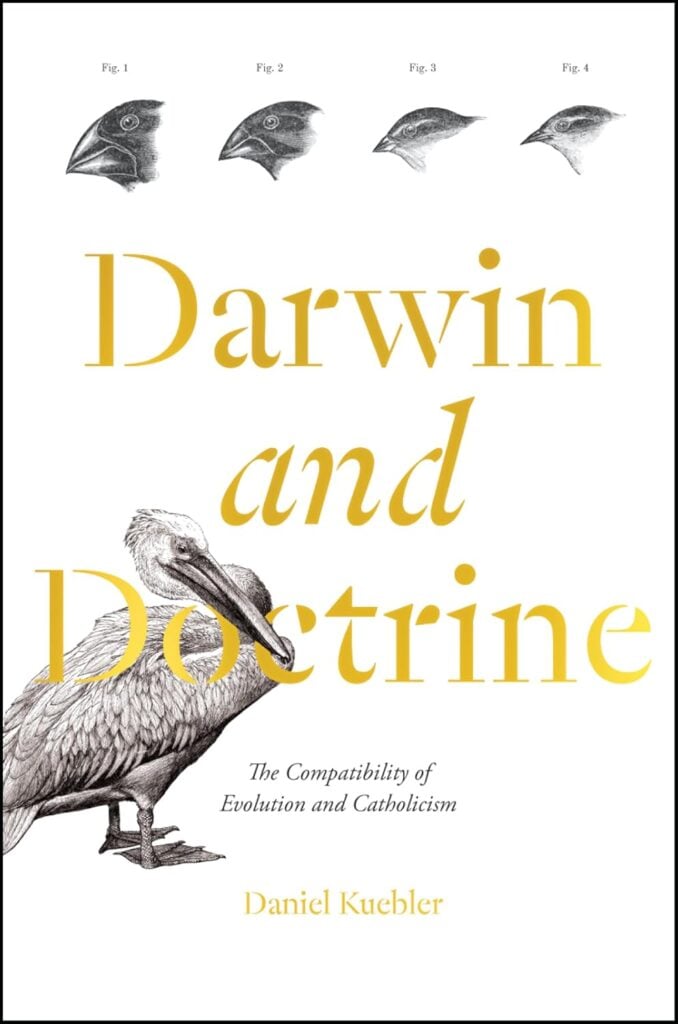
An excellent new book by Daniel Kuebler, professor of biology at Franciscan University of Steubenville, titled Darwin and Doctrine: The Compatibility of Evolution and Catholicism, is therefore timely. In the first five chapters, Kuebler (who I should note is a fellow officer of the Society of Catholic Scientists) reviews the Church’s understanding of the relation between faith and reason, the history of her engagement with evolution, the theology of creation, and the science of evolution, helpfully clearing up common misconceptions along the way. Each of the remaining chapters addresses an important theological or philosophical issue raised by evolution.
Chapter 6 is about the role of “chance,” which many see as opposed to God’s providence. Kuebler notes that this is hardly a new issue or one that arose only in relation to evolution: “Any cursory glance at our individual histories reveals a staggering number of chance events upon which our existence is predicated.” But, whether in evolution or in everyday life, chance in no way detracts from divine providence, since
a God who sustains creation at every moment, [and] who allows created things to act as causes in their own right, also sustains all the chance encounters that occur among created causes during the evolutionary process. Those chance events that we actually observe in evolution are his plan, although from God’s atemporal perspective, it’s hard to call such events “chance” at all.
Others think that chance undercuts arguments for design or purpose in nature, as if it rendered everything in nature adventitious. Kuebler notes, however, that the role of chance is greatly overemphasized in most discussions of evolution, which in reality is an interplay of chance and order. For biological or evolutionary processes to occur at all requires a great deal of order at the level of physics and chemistry, as Kuebler illustrates with many examples. He discusses the order in the properties of atoms, reflected in the Periodic Table, which allows them readily and spontaneously to form amino acids and the other building blocks of life. He shows how much of the structure of proteins follows from strong physical constraints on how they fold up into “alpha helices” and “beta sheets.” At a deeper level, the fundamental laws of physics appear to have many fortuitous features, called “anthropic coincidences” by physicists, that seem designed to make the existence of living things possible. All of this underlying order powerfully shapes evolutionary outcomes.
Kuebler argues that in evolution “it is the order that exists in nature that is primary, and it is the chance aspects of the process that are secondary. In fact, the chance aspects of evolution, by and large, operate in such a manner as to uncover” all the biological possibilities allowed by this order. This thesis is dramatically illustrated by the ubiquitous phenomenon of “convergent evolution,” in which evolution keeps stumbling upon the same designs and innovations over and over again. “It turns out that there is hardly a structure or behavior that one can find in living organisms that is not convergent.” The camera-like eye, for instance, has evolved independently “at least seven different times, including in vertebrates, cephalopods, marine annelids, gastropods and even jellyfish.” Meanwhile, “Ovoviviparity, in which the egg is retained within the female reproductive track prior to a live birth, has evolved over one hundred times [independently] in lineages as diverse as amphibians, reptiles, and fish.”
The next chapter deals with objections perennially raised by some Aristotelian-Thomistic philosophers against even the metaphysical possibility of species’ evolving. Such discussions can hardly avoid arcana, but Kuebler does a good job of explaining why these objections are not insuperable, making use of the insights of modern Thomists ranging from Jacques Maritain to Mariusz Tabaczek, OP. Indeed, he shows how evolution can be seen as a process by which the potencies inherent in the material world are actualized.
The next two chapters deal with the many complex questions relating to human origins and original sin. In chapter 8, Kuebler reviews both Catholic theological anthropology and the current state of our rapidly increasing knowledge of extinct hominins and early man. He introduces the crucial distinction between “biological humans,” that is, those who are human according to some physiological criteria, and what some authors have called “theological humans” or “true humans,” that is, those endowed with immortal rational souls. Whereas Homo sapiens as a biological species arose (as all species do) in a gradual way by the spread of new traits within populations, the appearance of beings who were theologically human must have been sudden, logically speaking, as one either has an immortal soul or hasn’t. And though genetic evidence clearly indicates that the ancestral population of biological humans was never less than many thousands, that does not necessarily imply that the first theologically human beings—those who “fell”—had to be more than two in number. Various authors, both Catholic and Protestant, have speculated that God might have conferred a rational soul initially upon just one pair out of an ancestral population of biological humans, as well as upon the descendants of that pair. There could be scientific as well as theological reasons to entertain this possibility. It would dovetail, for instance, with the suggestion of Noam Chomsky and Robert C. Berwick in their 2015 book Why Only Us that the neurological basis for the human language capacity might have appeared at first in just a few individuals.
In other words, the biological polygenism implied by the scientific evidence does not logically preclude the theological monogenism—the one pair of original “true humans”—taught in Humani Generis. It should be noted, however, that many theologians have suggested that Pius XII did not intend definitively to condemn theological polygenism. Rather than saying that Catholics must reject it, he said that they must not “embrace” it, a formulation that allows for suspension of judgment. And he gave as the grounds for not embracing it the fact that “it is in no way apparent” how a multiplicity of first true humans could be reconciled with the Church’s teachings on the fall of man and original sin; but he did not rule out its becoming apparent at some later time. The idea that Pius XII intentionally left the door open to further development is supported by Kemp’s recent study in the Vatican Archives of the preliminary drafts of that encyclical, which have only recently been made available to scholars. The preliminary drafts were more definitive in their rejection of theological polygenism than the final text.
Many Catholic theologians have acted as though the door that Pius XII left slightly ajar were wide open and rushed through it to embrace theological polygenism. Though doing so might help in resolving certain issues, such as whom the children of Adam and Eve could have married, it creates others, such as how to understand St. Paul’s statement that “by one man sin entered into the world.” Some caution seems still to be justified.
In chapter 9, Kuebler masterfully treats the subtle questions evolution raises about original sin and its consequences. He notes that some theologians have suggested that original sin is just the fact that humans have inherited from our hominin forebears the natural drives and impulses that often lead to aggression, lust, and selfishness. However, as Kuebler explains, those drives and impulses are not in themselves faults, nor the result of the fall of man. Rather, what resulted from the fall was the loss of those “preternatural gifts that allowed [the first true humans] to live in a state in which these drives were perfectly ordered [by reason] toward the good.” Similarly, he dispels some misconceptions about the sense in which death is a consequence of the fall. The human bodies that arose through evolution were just as naturally mortal as those of our animal ancestors but were conditionally granted immunity from death as a preternatural gift. Kuebler quotes St. Augustine: “It is one thing . . . not to be able to die, like [the angelic] natures which God created immortal, while it is quite another to be able not to die; and this is the way the first man was created immortal, something to be granted him . . . not by his natural constitution.”
Many have wondered how original sin can be inherited (or, in the words of the Council of Trent, acquired by “propagation, not by imitation”). It is surely not a physiological trait passed on genetically. But if it is a spiritual trait, how can it be propagated, given that the spiritual soul of a child is not produced by the parents but created directly by God? Kuebler helpfully explains that the fallenness we inherit is not a positively existing thing, susceptible of transmission, but a lack. What is passed on to us biologically is an animal nature with all its evolved drives and urges, raised indeed to the level of rationality by God, but without the gift of sanctifying grace and the preternatural gifts that were bestowed on the first humans and forfeited by them. “This is the state in which we find ourselves, saddled with the burden of attempting to order our desires without the aid of [those original gifts].”
At the end of his book, Kuebler presents a number of very interesting theological observations, which include some striking parallels between evolutionary history and salvation history. In neither history, for example, do we find a smooth triumphal progression, but rather vicissitudes, reversals, and even disasters that throw what had seemed to be the divine plan far off course. In evolutionary history, there were dead ends, environmental catastrophes, and mass extinctions. In salvation history, there were the sin of Adam, the Israelites’ lapses into idolatry, the Babylonian captivity, the destruction of the First Temple, and Judas’s betrayal. And yet, from failure, destruction, and death, new life arose.
Many Catholics and other Christians are just as unsure what to make of evolution theologically and how to integrate it into an orthodox Christian view of the world as were their predecessors in the nineteenth century. They will be helped immensely by these two excellent new books and the many fascinating discussions and analyses that they contain.

YOU MIGHT ALSO LIKE
Turned Away on Palm Sunday
In politics, diplomacy, war, or pretty much any field of human interaction, one must contend not only…
A Medieval Pilgrimage in Modern Assisi
When you go to the hilltop town of Assisi, you’re immediately struck by how medieval it is:…
Via Crucis, 2026
The Way of the Cross—and the third, seventh, and ninth stations in particular—has been an especially appropriate…
