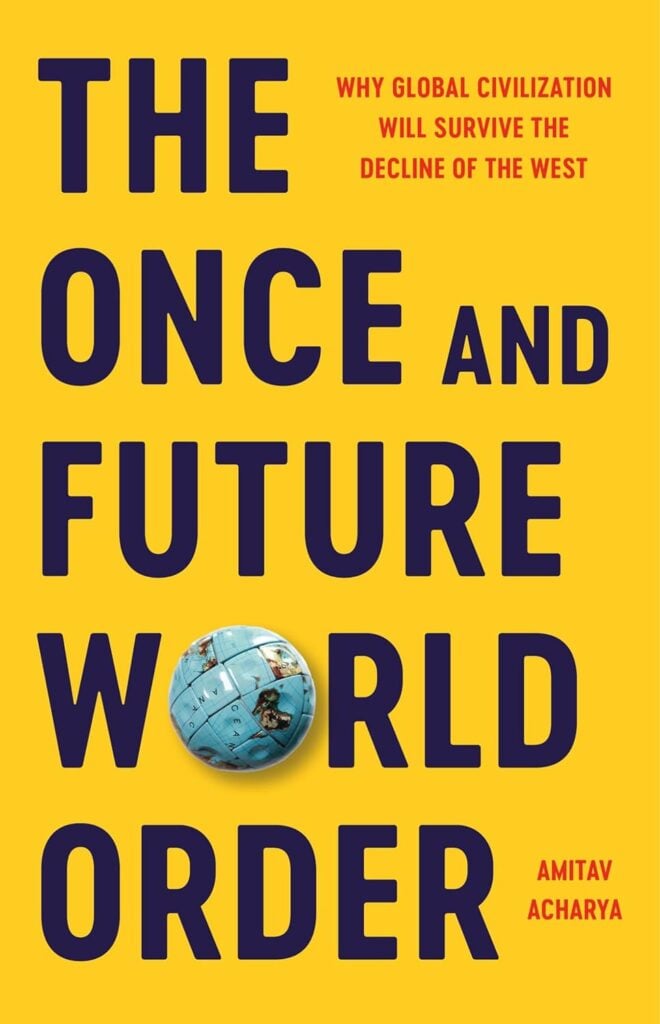
The Once and Future World Order:
Why Global Civilization Will Survive the Decline of the West
by amitav acharya
basic books, 464 pages, $32.50
G . K. Chesterton’s novel The Flying Inn begins with a strange seaside encounter involving one Misysra Ammon, a “little owlish man in a red fez, weakly waving a green gamp umbrella.” This eccentric seaside speaker is giving his amazed audience a lecture on etymology and the (untold) history of English taverns:
“Those inns were not poo-oot up in the beginning to sell ze alcoholic Christian drink. They were put up to sell ze non-alcoholic Islamic drinks. You can see this in the names of your inns. They are eastern names, Asiatic names. You have a famous public house to which your omnibuses go on the pilgrimage. It is called the Elephant and Castle. That is not an English name. It is an Asiatic name. You will say there are castles in England, and I will agree with you. There is the Windsor Castle. But where,” he cried sternly, shaking his green umbrella at the girl in an angry oratorical triumph, “where is the Windsor Elephant? I have searched all Windsor Park. No elephants.”
There’s more than a touch of Ammon in the zeal with which contemporary revisionist histories attack the idea of Western exceptionalism, or even particularism. Yet such arguments, claiming that the West, uniquely, has no culture or inventions truly its own, are far from marginal or dismissably eccentric—they are being made in deadly earnest, and by people with real power and influence. Not only are such claims about the derivative and malicious nature of Western civilization used to justify the politicization of classrooms and reckless and divisive policies on issues such as racial quotas and migration; they are also becoming a pretext for disarming Western foreign policy and emboldening revisionist powers. This, when boiled down to its essentials, is the case made in The Once and Future World Order, by Amitav Acharya.
Acharya is distinguished professor of international relations at American University in Washington, D.C., and a former president of the International Studies Association. He has addressed the U.N. General Assembly; this book was launched with an op-ed in the New York Times and comes garlanded with praise from prominent authors and a former Australian foreign minister.
This is no dispatch from the fringes—it indicates the kind of thinking that is getting a hearing from scholars and policymakers. All the more alarming, then, that The Once and Future World Order turns out to be a quite incredibly unhinged diatribe against the West.
Acharya’s opening gambit—the idea that ancient and non-Western civilizations have their own, neglected models of world order—is of course interesting and worthwhile. And the book’s “back to the future” prediction of a return to non-hegemonic geopolitics is an interesting provocation. In premodern China, for example, feng shui principles saw aesthetics, kinship bonds, urban planning, land management, and spirituality fused into a system of state ecology that contrasted starkly with contemporary Western divisions between nature and culture. Similarly, the idea—cited but underexplored in the book—that international order is theologically rooted points not just to non-Western, but also to Western premodern ideas, such as the pax dei movement in early medieval France and the role of the papacy in convening a noncoercive vision of world order. Yet such positive retrievals of the Western and non-Western tradition of world order are neglected by Acharya, whose book seems more concerned with delegitimizing the West than with building a genuine alternative to the current international system.
Acharya distinguishes his thesis from the now-commonplace idea of a “multipolar” world order, in which “conflict and cooperation are shaped by a handful of major powers using their superior military and economic capacity.” Rather, he says, we should anticipate a “multiplex” (as in cinema) world order, involving many more players—such as “corporations, foundations, nongovernmental organizations, and people empowered by social media.” Instead of being defined by “military and economic instruments of power,” the multiplex order would “take into account the role of ideas and culture,” amid which “new forms of leadership and cooperation” would emerge.
Acharya gives no indication of the steps by which such a world will emerge from the ruins of the American-led order; what distinctive non-Western idea or concept could shape or define it; or how it might function in practical terms. Instead we are offered the NGO jargon of stakeholders, panels, and “leadership” without hierarchy or, indeed, structure. And meanwhile, Acharya has begun to develop a vindication of the non-Western world, which he carries to the point of absurdity.
Did you know, for example, that the steam engine “was essentially first conceived in Song Dynasty China”? Do you believe that Islamic societies invented “proto-capitalist institutions such as partnerships, contract law, banking and credit”? Is it plausible, do you think, to suggest that the ancient Indian emperor Ashoka “anticipated contemporary human rights norms”? And are we really to believe that the Aztecs were the first civilization to enjoy “almost universal literacy”? By contrast, Acharya is unwilling to give sole credit to the West for inventing steel, steam engines, human rights, liberal democracy, or international law (to name a few examples).
In isolation, or shouted from the nearest rooftop, such ideas are only eccentric, even rather charming. Admittedly, it is alarming that Acharya’s claims were, according to the book’s acknowledgments, put before “distinguished historians,” which suggests that such ideas either are endorsed by or originated from mainstream academia. And once you have eliminated any sense of the early modern West as distinctively innovative, humanistic, or well-ordered, you are left with the head-scratching problem of how such a backward civilization was able to conquer most of the world’s surface, industrialize, and become the wealthiest society in human history.
What makes such ideas dangerous, not just quixotic, is their weaponization against Western culture and institutions by a figure near the heart of Western power. Acharya isn’t a man standing lecturing by the beach, and unfortunately he isn’t content with merely piling up credit on the non-Western side of the ledger. He is an influential figure in international relations with a chair at an American university, a platform he seems determined to use to denigrate, demean, and humiliate the Western culture of which he is a part and beneficiary. For there is at least one invention for which he gives Westerners full credit. “Racism based on skin color,” he writes, “is a distinctive Western invention.” He continually asserts this fact throughout the book, elsewhere noting that “in no other civilization was slavery associated with skin color.”
This simply isn’t true. There is a vast amount of scholarship on the pervasiveness of racial categories in, for example, the Arab world, where the term ʿabeed (slaves) was often used interchangeably to describe all sub-Saharan Africans, and where “son of a black woman” was a regular term of abuse. Indeed, Ibn Khaldun, the great Arab philosopher of history who is something of a hero for Acharya in the book, wrote that “the Negro nations are, as a rule, submissive to slavery, because [Negroes] have little that is [essentially] human and possess attributes that are quite similar to those of dumb animals.”
Acharya’s book consists mainly of a laundry list of civilizations, which, when identifiably “Western” (Greece, Rome, and America), are generally vilified, diminished, and sneered at and, when non-Western, are given exaggerated credit and praise for inventing the modern world. The Magna Carta, we learn, “was a violent demand for property rights by the nobility.” The idea that democracy emerged in Greece is “a Eurocentric belief”: “The Greek system did not include individual liberty.” Overall, Greek achievements are “exaggerated,” and there was “no true Roman identity or sense of genuine loyalty to Rome” within its empire. The Roman Empire itself is represented as exceptionally violent and imperialistic, and is unfavorably contrasted with India and the Aztecs:
Comparing Rome’s gladiatorial combats with ancient India, the Indian historian D. P. Singhal notes, “In the third century B.C., whilst [Maurya King] Asoka had renounced war and was preaching non-violence and compassion for all other beings [including animals], the Romans were indulging in human sacrifice.” While the Aztecs used human sacrifice to please the gods, the Roman practice was to please the people.
If you’re starting to detect a certain preference for India from our (Indian-born) author, you aren’t far wrong. The table of contents is worth a read. The second chapter title contrasts “Greek Myths” with “Persian Power,” whilst the chapters on China and Rome are respectively titled “Heaven’s Way” and “The Wrath of Rome.” The chapter on Indian civilization is titled, without apparent irony, “Conquest and Compassion.”
India receives a glowing write-up. It is the world’s “longest continuing civilization.” It “offers the most striking example of how a civilization can export its religion and political ideas to foreign lands without conquest or coercion.” In fact, so keen is Acharya on India that its geopolitical enemies, despite being non-Western, are sternly marked down. While no mention is made in the chapter on Islam (titled “Rejuvenating the World”) of centuries of brutal warfare and piracy against the Christian West, there is a bizarrely long digression into the wrongs and massacres perpetuated by Nazar Shah and the Mughal Emperor Akbar in India. Likewise, despite generally praising China as a peaceful non-expansionist power, Acharya finds time, contradicting himself, to lament that it “was not a peaceful nation” and that, in contrast to India, “there is no Ashoka-like figure in China’s history, promising not to expand his empire.”
Ashoka is central to Acharya’s analysis of India’s unique role in anticipating a modern world order. Along with Khaldun, he is a touchstone for Acharya—a progressive, human-rights-respecting, pacifist moral titan. But there are a few pretty basic problems with this hagiography. Acharya discusses Ashoka, and Indian history, as if he were a figure like Julius Caesar or Cyrus, continually recalled and written about, influencing history ever after by his example. But Ashoka was almost entirely forgotten in India until nineteenth-century British orientalist James Prinsep translated Brahmi script. Many of the accounts of his virtues come from essentially propagandistic and pious Buddhist texts, which have every reason to idealize his rule. Even if we believe the narrative, as Acharya has to admit, these same texts present Ashoka as a formerly brutal ruler, with accounts of his personal torture chamber wherein molten lead was poured down the throats of his victims.
It is a strain to know where to start when deconstructing the tottering towers of narrative Acharya strews throughout the book. The claims that the Treaty of Westphalia established “absolute sovereignty” among states, that the Westphalian system “included the separation of church and state,” or that the “idea of a Roman world order” applies “only to the worldview and institutions of the Western Roman Empire,” are all ungrounded in fact and widely refuted by recent scholarship. The Treaty of Westphalia, for example, legally mandates an official state religion for its signatories, and binds the states of the Holy Roman Empire to the authority of the Emperor—hardly a victory for state sovereignty or secularism.
Acharya’s inattention to the Eastern Roman Empire is especially glaring, given that it was more decisivein establishing an international order than mere imperial dominion. The lasting influence of Roman law, to note only one element, is largely creditable to its codification by Justinian. Similarly, the book does not register the central role of the Byzantine Empire in preserving and transmitting ancient texts to the West, even as the Islamic contribution is exaggerated. Indeed, the Byzantines had a tributary system and a primarily non-expansionist approach to empire, comparable to what Acharya praises in China.
The worst thing about this book is what it fails to be. Despite his assault on the “classical” idea of the West, Acharya never departs a millimeter from the Western consensus on the normativity of human rights, capitalism, state sovereignty, and free trade. Unlike thoroughgoing revisionist critics of the Western world order such as Aleksandr Dugin and Sayyid Qutb, who straightforwardly argue that Western notions of materialism, individualism, consumerism, and secularism are degrading and inferior to the ideals of traditional cultures, Acharya attempts to argue that such ideas have largely non-Western origins.
This essentially evacuates his book of any actual criticism of the contemporary Western world order (beyond a plaintive call for pluralism, which is itself an ideal arising in the postwar West) and renders it as what it is—a project to soothe the wounded pride of non-Western cultures without actually challenging Western modernity.
A really substantive book about the unique contributions of non-Western civilizations to the question of what sort of world order we should seek might—to name a few wholly neglected areas—have considered premodern ideas of property and gift exchange, pointed to the destruction of regional cultures by nation-states and economic globalization, and looked again at the theological roots of world order emerging in the “axial age” that linked Buddha, Zoroaster, Confucius, and Socrates. It might have made use of Eric Voegelin, whose work alone is proof that Western scholars have long taken the ideas of non-Western world orders seriously. As Voegelin observed in The New Science of Politics:
All the early empires, Near Eastern as well as Far Eastern, understood themselves as representatives of a transcendent order, of the order of the cosmos; and some of them even understood this order as a “truth.” Whether one turns to the earliest Chinese sources in the Shü King or to the inscriptions of Egypt, Babylonia, Assyria, or Pérsia, one uniformly finds the order of the empire interpreted as a representation of cosmic order in the medium of human society.
Importantly, such visions of world order, because they are rooted in transcendent or cosmic sources of legitimacy and authority, subvert our Hobbesian model of state sovereignty based on social contract theory and a monopoly of force. Likewise, as we noted in relation to feng shui, they seek to align human societies and laws with the natural world, so that ethical duties do not concern human beings alone.
The absence of a number of fundamental sources on the question of world order is a consistent problem. Whereas Buddhism, Islam, and Hinduism are endlessly praised (along secular liberal lines), the book almost entirely ignores the role of Christianity in shaping the Western world order, except in such outdated and ahistorical claims as that “Greek philosophy and science were . . . suppressed by the Catholic Church.”
One of the more baffling elements of the book is its tendency to act as if the last fifty years of academic life never happened. Acharya claims that students are taught “the story of Western dominance” and that attempts to decolonize the curriculum are “scarce” and have “met with little success.” This would come as a surprise to anyone who has been observing trends in academia and the arts over the past few decades.
Is it worth getting worked up about one bad book? It might be. The ideas Acharya is pushing may be naive and muddled, but that does not make them harmless. In my estimation, the most sinister claim in the book is the idea that the “magic potion” of Western success is “a blend of imperialism, slavery, and racism.” As we noted earlier, left with no positive account of Western dominance, the wounded pride of the Global South is forced to claim that such power and preeminence were won through some sort of wicked trick or theft.
The implications of this derogation of the West are extremely disturbing, in ways the author does not seem to have anticipated. If breaching ancient norms, using brutality, embracing chauvinistic self-assertion, and exploiting labor really were the paths to the West’s modern global hegemony, then non-Western powers seeking to modernize and advance would be well advised to adopt the same immoral methods. This dark path is where postcolonial ideology inevitably leads. Consider the work of Frantz Fanon, who urges retaliatory and compensatory violence that imitates the distorted image of the colonizer that he has imaginatively constructed.
Nor is this a purely theoretical danger. India’s Hindutva government is revising its education along religious-nationalist lines and using postcolonial ideology to justify its actions, reflecting a broader policy of treating Islam as culturally alien. Non-Western powers are employing slave labor, racial supremacy, and neocolonialism, often in order to challenge Western hegemony. China has cheerfully used slavery, sought to take control of natural resources in Africa and Latin America, and imposed Han identity in Tibet and Xinjiang. Clearly the Global South is only too happy to drink the “magic potion,” as Acharya describes it.
Whether you are enthusiastic or skeptical about the Western world order, there could be no less helpful starting point than the one set out in this book. According to this view, everything will be fine in a post-Western order, so long as you are a liberal progressive and believe that progressive ideas are inherently woven into every civilization across time—except Western civilization, which, despite having originated these ideas, is cast as the architect and inventor of racism and colonialism.
Far from being an outlier or an outsider, Acharya is telling the contemporary liberal Western establishment what it wants to hear. And ironically, by abstracting liberal, Western ideas from their origins and projecting them onto other cultures, Acharya obscures rather than reveals the contributions of non-Western civilization.
This, far more than its petty denigration of the West, is the real tragedy of The Once and Future World Order. The West is in trouble, and we are hitting the moral and imaginative limits of a secular, materialist worldview. It is not clear that democracy or liberalism, especially in an age of national populism, is a basis for solidarity rather than competition and conflict. The natural world, which Pope Francis described as our “common home,” is profoundly threatened, yet the Western world order has entirely failed to preserve or protect it. There are lessons that should be learned from religious traditions and ancient civilizations, from Western and non-Western cultures alike. But those seeking such insights will have to look elsewhere.