
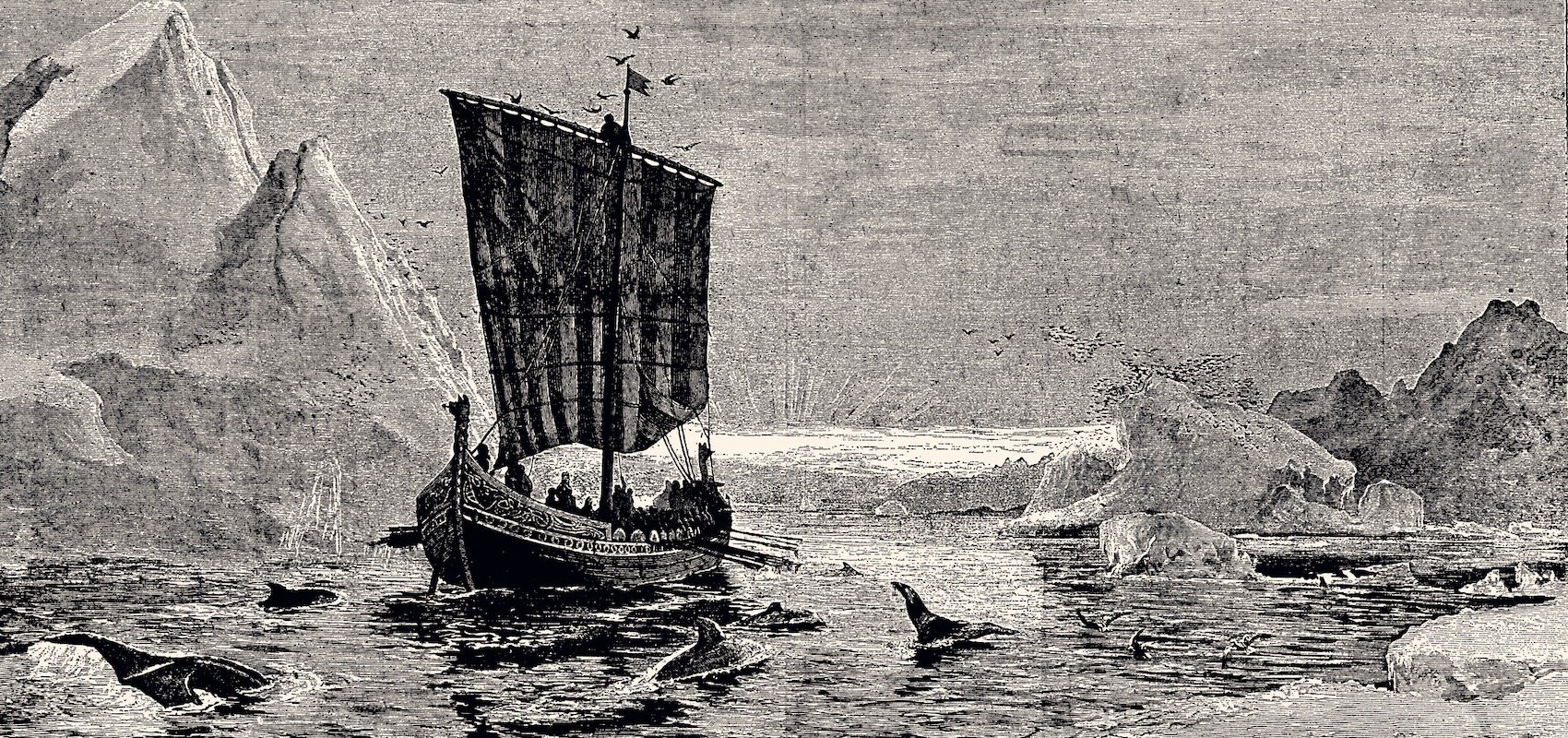
There was now much talk of looking for new lands.” This line from the thirteenth-century Icelandic Saga of the Greenlanders is an apt description of Washington, D.C., in 2026. The Saga of the Greenlanders and the related Saga of Eirik the Red (collectively known as the Vinland Sagas) tell the story of the Norsemen who crossed the Atlantic at the turn of the millennium (between 970 and 1030), striking out from Iceland to settle in Greenland. From there they launched multiple expeditions to the Americas, landing in present-day Canada. Deeply pragmatic, and no strangers to the art of the deal, these Viking explorers returned to Greenland with their longships laden with grapes, timber, and animal hides, as well as other goods traded with the indigenous Americans. Now, a thousand years later, there is once again “much talk” of new lands in the North Atlantic. These sagas (which mix history with literary embellishment) illuminate the intertwined past of the populations of Greenland and America, reminding us that questions of trade, resources, security, and power are never only about land, but about people. The details may change with time, but the human drama at the heart of such ventures rarely does.
In these texts, we read that Eirik the Red was the first European to settle in Greenland. The naming of his new home is presented as a shrewd piece of PR: “Eirik left to settle in the country he had found, which he called Greenland, as he said people would be attracted there if it had a favourable name.” We go on to learn about the lives of Eirik’s family and companions, including the repeated voyages undertaken by his children to North America. Like the current administration, the Vikings are explicitly pragmatic when it comes to assessing the usefulness of a land and its resources. One sailor, Bjarni Herjólfsson, after sighting a rocky and barren stretch of American coastline, refuses to make land, explaining that “this land seems to me to offer nothing of use.” When Eirik’s son Leif later undertakes wider exploration, he is pleased to discover a richly forested land that he names “Markland” (literally “Forest Land”). Further south, where they discover a rich abundance of wild grapevines, Leif calls the area “Vinland” (“Wine Land”). The Greenland Vikings were neither creative nor vainglorious in their naming practices, preferring to title new lands after whatever natural resources might sustain the Greenlandic settlement or yield profit through exchange with merchants.
While exploring America, the Norsemen make the first recorded contact with indigenous inhabitants. Some of their meetings result in successful trades, in which dyed cloth and dairy products are exchanged for animal skins. But at other times this contact proves fatal. On one voyage, Leif’s brother Thorvald is wounded in a battle with the Native Americans and is accorded what may be the first Christian burial on American soil, telling his men: “You will bury me . . . and mark my grave with crosses at the head and foot, and call the spot Krossanes [Cross point] after that.” A later expedition led by Thorfinn Karlsefni also descends into violence when a Native American reaches for the Vikings’ steel weapons. Thorfinn has unequivocally forbidden his men from trading these. The reason is never explicitly stated, but he is presumably aware that their steel swords and axes give them a significant military advantage over their trading partners should things go wrong. He is proven correct when the Norsemen rout the natives in a subsequent battle, such that “they had no more dealings with them.” These episodes mark the beginning of the, now once again, brittle relationship between the inhabitants of America and Greenland.
Conflict also arises from internal betrayal. Eirik’s daughter Freydis heads a joint expedition to Vinland with two Norsemen, agreeing to split the profits of the voyage equally. Once arrived, she engineers their deaths and personally slaughters the women in their group so she can claim the spoils for herself. When Leif learns of his sister’s treachery, he says: “I am not the one to deal my sister, Freydis, the punishment she deserves; but I predict that their descendants will not get on well in this world.” The narrative adds that “after that no one expected anything but evil from them.”
As well as navigating the high seas, making new discoveries, and trading with foreign peoples, the Viking settlers of Greenland also simply navigate the quotidian concerns of living and dying in a community. Issues of intergenerational conflict and how to bury the dead will be familiar across the millennia, although the details might seem a little bizarre to the modern reader. At one point, a disagreement arises between a pagan wise woman and a young Christian woman over whether the latter should participate in “heathen” rituals to divine the future. In another memorable episode, Thorstein Eiriksson temporarily rises from the dead as a draugr (a type of zombie revenant in Norse literary tradition) to admonish his wife for burying him in unconsecrated ground.
Christianity became an important bridge between Greenland’s Viking inhabitants and the rest of European civilization. Far from isolationist, the Greenlanders understood that belonging required integration with the wider powers of their world. For medieval Greenland, that power was Christendom. Even with a population never exceeding a few thousand, they actively sought clergy, sending envoys to Bremen in 1054 to request priests. The first bishop, Arnaldur, was ordained in 1124 and began constructing a cathedral at Garðar dedicated to St. Nicholas, the ruins of which can still be seen today. Settling in Greenland was never only about claiming land or resources, but about building a life for its people and taking responsibility for their spiritual and social well-being. Both sagas conclude by noting that descendants of the settlers would go on to serve as bishops themselves, weaving this remote community into the fabric of Christian Europe.
We are told to learn lessons from history, but the reader must draw what conclusions he will from the sagas and what they might teach us about expansion, alliances, conflict, trade, and collaboration. Greenland formally submitted to the rulership of the Norwegian crown in 1261, and eventually came under the auspices of Denmark when the Norwegian and Danish crowns merged. Recording the former occasion, the Icelandic poet Sturla Þórðarson penned the following verses in praise of King Hákon IV: “It pleases you to increase your power . . . around the cold world, all the way north beneath the North Star; reliable men will welcome that” (Hákonar saga Hákonarsonar). Whether “reliable men” will voice a similar paean to the White House if the U.S. takes over control of Greenland remains to be seen.

YOU MIGHT ALSO LIKE
Turned Away on Palm Sunday
In politics, diplomacy, war, or pretty much any field of human interaction, one must contend not only…
Timothée Chalamet Is Right About Art (ft. Suzy Weiss)
In this episode, co-founder and reporter for the Free Press, Suzy Weiss, joins Virginia and Germán to…
A Medieval Pilgrimage in Modern Assisi
When you go to the hilltop town of Assisi, you’re immediately struck by how medieval it is:…
