
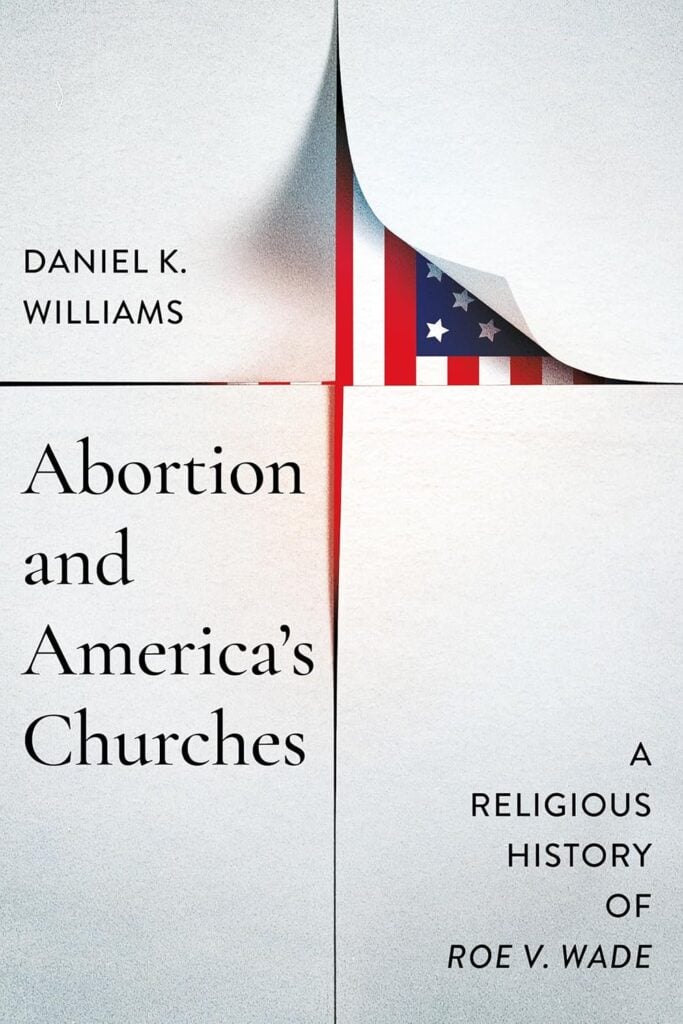
Abortion and America’s Churches:
A Religious History of “Roe v. Wade”
by daniel k. williams
notre dame, 384 pages, $35
A controversial abortion case reaches the Supreme Court, and men in black robes impose their religious views on the country. Counter to the justices’ expectation, a diverse movement rises up in protest. Civil disobedience leads to tens of thousands of arrests. It may take many years, but the decision will be reversed.
This is a description not of some future American Gilead but of the past. Daniel K. Williams’s important history of abortion politics explains how Roe v. Wade enshrined liberal Protestant assumptions in American law. Far from being a bulwark of secularism (as many on the right and the left have supposed), Roe v. Wade was the expression of a religious establishment that overestimated its legitimacy and staying power.
Religious divides over abortion emerged in the first part of the twentieth century. Up to that point there had been a broad consensus in favor of American laws, which banned abortion except when it was necessary to save the life of the mother. But under the influence of the Social Gospel, which stressed societal reform over individual salvation, many mainline leaders came to see contraception and abortion not as individual vices but as potential solutions to overpopulation and poverty. Liberal Protestants also placed a high priority on individual freedom, which they sought to respect by loosening abortion laws.
At the same time, liberal Protestants continued to believe that the unborn child possessed moral worth, which had to be balanced against the value of individual choice. In 1961, the Christian Century called for the repeal of laws that compelled “women to bear unwanted children forced upon them in criminal acts.” But it also warned that complete liberalization “leaves to the unborn no rights at all.”
This attempt to balance individual freedom, social reform, and the rights of the unborn was distinct from the Catholic position, which prioritized unborn life while drawing on natural law. It also differed from the approach of conservative Protestants. Williams puts to rest the frequently repeated claim that evangelicals did not oppose abortion until they were led to do so by the post-Roe culture wars. In fact, conservative Protestants were generally opposed to abortion—and for distinctively evangelical reasons.
Whereas liberal Protestants stressed individual freedom, conservative Protestants exalted family life. Their belief in the importance of childbearing reinforced their moral objections to the taking of unborn life. The same was true of their focus on individual sin and salvation, which made them comfortable with calling the choice to abort a sin and a crime rather than a social problem for which no one in particular could be blamed. It is true, Williams notes, that evangelicals were willing to support the availability of abortion “for a few carefully defined medical reasons.” But they rejected elective abortion outright.
In 1973, when Roe v. Wade was decided, it was still possible to imagine that liberal Protestant views could govern the country. Twenty-eight percent of Americans were members of mainline churches, the institutional home of liberal Protestantism. So were sixty-five of the Senate’s one hundred members and eight of the nine justices on the Supreme Court. Today, by contrast, only 11 percent of Americans, twenty-seven members of the U.S. Senate, and one Supreme Court justice are mainline Protestants.
Only in retrospect is it possible to see how distinctive—and fragile—the liberal Protestant approach to abortion was. The court’s decision in Roe was drafted by Harry Blackmun, a liberal Methodist who regularly attended church and occasionally preached. During the first twelve weeks of pregnancy, he wrote, abortion could be undertaken at the discretion of the mother. In the next twelve weeks, the state could regulate the procedure in ways consistent with maternal health. In the last trimester, the state could prohibit abortion outright, except where it was necessary to protect the life of the mother. This framework sought to balance individual choice with the value of unborn life. But by stressing the medical reasons for abortion, it also assumed the authority of doctors—92 percent of whom were male.
This balancing act reflected liberal Protestant concerns and tracked with specific policies proposed by liberal Protestant bodies. In June 1968, the American Baptist Convention proposed a trimester framework that sought to honor “the freedom of persons and the sanctity of life.” The woman would be free to choose in the first trimester, but after that she could procure an abortion only with the approval of a medical professional. A similar approach was proposed by the United Church of Christ in 1971. The parallels were clear enough that in 1973, after Roe was decided, the writers Mary Ellen Haines and Helen Weber noted that the UCC’s statement was “virtually identical with the Supreme Court ruling.”
Because of the decision’s soft paternalism and qualified concern for unborn life, feminists had reservations about Roe. They preferred the approach championed by Congresswoman Bella Abzug, who proposed a law to repeal all restrictions on abortion nationwide. Feminists rallied to Roe, though, when they realized that a determined movement was seeking to undo it. Blackmun was surprised by the intensity of the response. “The mail has been voluminous and much of it critical and some of it abusive,” he told a friend. “I suspect, however, that the furor will die down before too long. At least I hope so.”
It was not to be. Catholics, joined by evangelicals, led the resistance to Roe. They were joined by a formidable body of dissenters within the Protestant mainline. Charismatic Christianity also played an important role. In 1986, Randall Terry, a Pentecostal minister, founded Operation Rescue. The group adopted sit-in tactics from the Civil Rights movements to dissuade women from seeking abortions and obstruct the operations of clinics. By 1992, 40,000 volunteers had been arrested in one of the greatest waves of civil disobedience in American history.
Far from settling the abortion question on liberal Protestant grounds, as Blackmun hoped, Roe contributed to the decline of liberal Protestant hegemony. As Williams notes, it “set in motion a process that would polarize both national politics and Christianity in the United States.” Debates over abortion contributed to splits within mainline churches and powered the emergence of the religious right. It also led to the rise of a feminist movement that would, in time, win over the Democratic Party to an unambiguous defense of abortion as an act that should be not questioned but praised.
By tracing this history, Williams answers a question that has often troubled people with moderate instincts: Whatever happened to the idea that abortion should be safe, legal, and rare? The important thing to realize is that this formulation was not a compromise between the antithetical positions of pro-lifers and feminists. It was an expression of a distinctive viewpoint that enjoyed demographic and institutional backing within the Protestant mainline. As the mainline declined, so did this distinctive form of moderation—to be replaced by pro-abortion secularism on the one hand and a religiously conservative pro-life movement on the other.
Though the pro-life movement has succeeded in reversing Roe v. Wade, it has failed to achieve a new settlement that protects unborn life. Many abortion opponents, notably including the Catholic bishops of the United States, have sought to present opposition to abortion as part of a broader “ethic of life” or “seamless garment.” Their proposals seek to build a new center that protects the unborn by appealing to the political intuitions of the left as well as the right. They aspire to be nonpartisan, just as the drafters of Roe imagined they were being. But their success has not matched their ambition.
Indeed, over time, some of the most important advocates of the seamless garment have abandoned the cause. The evangelical Jim Wallis and his magazine, Sojourners, were important progressive voices for life. They cast the protection of the unborn as part of a broader liberal defense of the downtrodden. But sometime during Donald Trump’s first term in office, Williams notes, Sojourners began to defend abortion as a human right—succumbing to the process of polarization that had been working itself out since Roe v. Wade.
Williams’s history has implications beyond Roe v. Wade. If religious views inevitably inform court decisions in such sensitive cases, what views informed Obergefell v. Hodges, the 2015 Supreme Court ruling recognizing a constitutional right to same-sex marriage? A clue can be found in another recent book, Anthony Kennedy’s memoir, Life, Law & Liberty. Kennedy describes how his upbringing in the American West imparted to him a notion that each person is entitled to “basic dignity.” Dignity was to become the crucial concept in his jurisprudence. As Kennedy puts it, “Constant study . . . led me to a greater appreciation of the primacy of human dignity in constitutional analysis.”
Kennedy’s insistence on dignity marks him as part of a distinctively Catholic tradition of political reasoning. As the legal scholar Samuel Moyn argues in Christian Human Rights, the notion of individual dignity was first taken up in the early twentieth century by Catholics who sought a middle course between the secularist legacy of the French Revolution and anti-democratic forms of Christian politics. Recognizing individual dignity often meant placing limits on the state’s ability to coerce. As Moyn observes, the term’s eventual popularity was “essentially due” to Pope Pius XI’s employment of it in the anti-communist encyclical Divini Redemptoris.
Catholics on the Supreme Court adopted this language. As Adeno Addis has noted, “Justices Kennedy, Brennan, and Frank Murphy, the three Justices for whom dignity has played an important role in understanding humanness and its vulnerability to debasement and humiliation, all adhered to the Catholic faith.” Kennedy used the notion of dignity to fashion a liberal Catholic jurisprudence that reached its culmination in Obergefell. Not unlike Harry Blackmun’s opinion in Roe v. Wade, Kennedy’s opinion in Obergefell advanced a progressive change while retaining certain conservative instincts—notably, a belief that recognition of the dignity of same-sex couples must be balanced against respect for religious liberty.
Today Catholics are as dominant on the Supreme Court as mainline Protestants once were. But most of these Catholics are political conservatives and textual originalists who have little use for the language of dignity. Kennedy’s liberal Catholic jurisprudence is likely to be subjected to the same crosscutting pressures that Blackmun’s liberal Protestant jurisprudence once was. If the fate of Roe is any indication, the compromise Kennedy struck in Obergefell will be looked back on as a temporary settlement. Either Obergefell will be reversed, or religious liberty for objectors will be stripped away.
The reversal of Obergefell would be an undoubted conservative victory. But its effect would be limited unless conservatives can articulate a religiously informed jurisprudence that commands broad assent. Anyone hoping to do this has much to learn from the liberal Protestant and Catholic attempts to shape our nation’s laws.
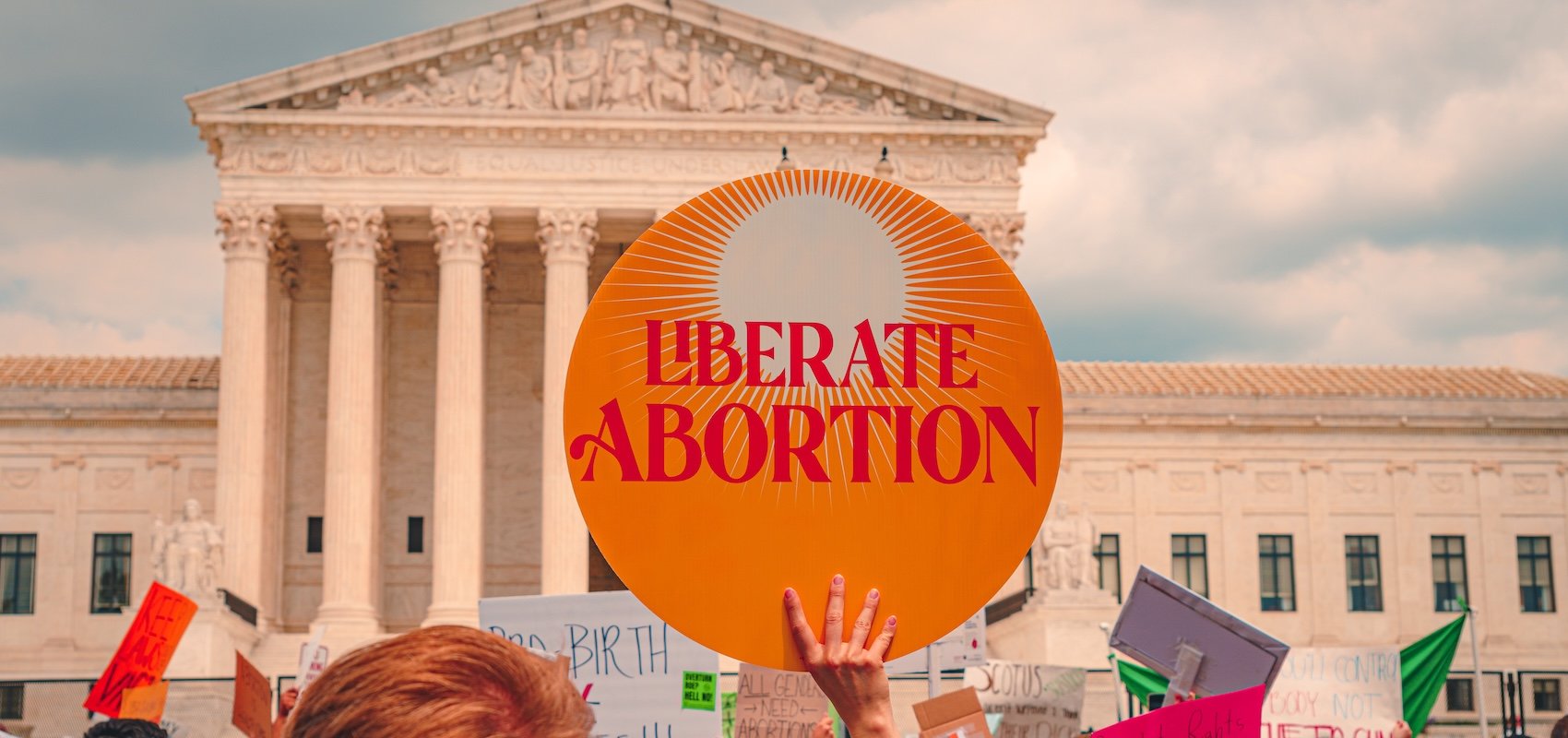
Image by Ted Eytan, licensed via Creative Commons. Image cropped.


YOU MIGHT ALSO LIKE
Päivi Räsänen and the Failure of Hate Speech Laws
On March 26, the Supreme Court of Finland handed down its verdict in the case of Päivi…
The Parental Rights Paradox
Two weeks ago, the U.S. Supreme Court intervened in Mirabelli v. Bonta, restoring a lower-court injunction that…
Epstein’s Revelations
Far from a mere sordid distraction or an endless supply of tabloid slop, the Epstein files may…
