
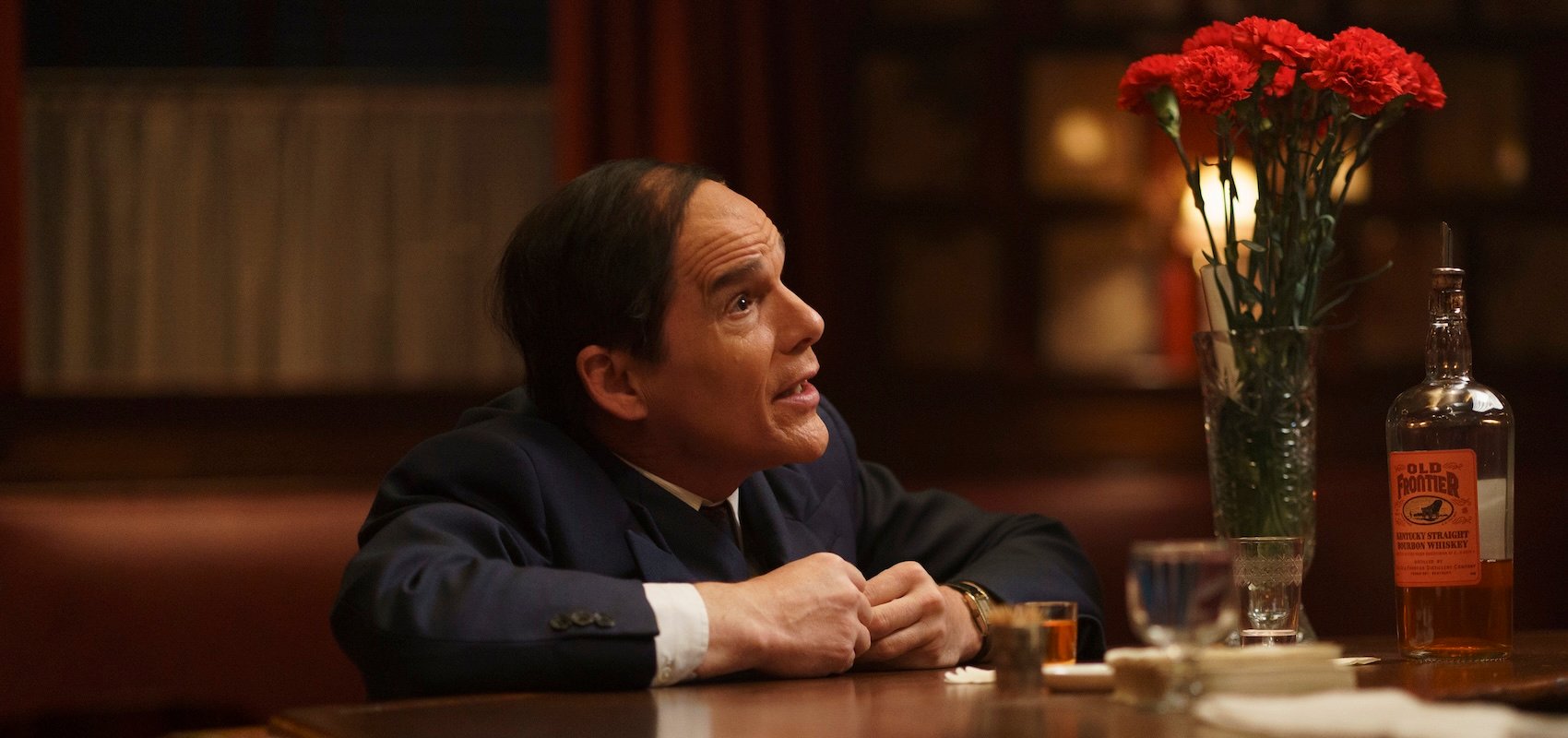
Because we live in an age of cheap cynicism and alleged sophistication, many viewers of Richard Linklater’s Blue Moon—nominated for two Academy Awards—will be inclined to adopt the stance of its hero, the great lyricist Lorenz Hart, whose songs were richly cynical and authentically sophisticated.
There is no question that tunes such as “My Funny Valentine,” “Bewitched, Bothered and Bewildered,” and, of course, “Blue Moon”—each penned by Hart and scored by his chief collaborator, composer Richard Rodgers—kindle a kind of world-weary moodiness that can be enormously companionable. But it would be a disservice to Linklater’s fine, subtle film—and Ethan Hawke’s fully inhabited, courageously unvarnished, Oscar-nominated performance as the talkative, resentful Hart—to unquestioningly accept the numerous pronunciamentos that Hart offers over the course of its 100-minute run time.
Like Billy Wilder’s Sunset Boulevard, Blue Moon is, in a sense, recounted by someone no longer among the living: The prologue shows Hart, inebriated and unsteady, making his way through an alleyway amid a torrential rainstorm—the circumstances that led to his death, not long after, at age forty-eight. From here, the film flips the calendar back seven months to the opening night of Oklahoma!, a musical that had been dreamt up by Rodgers (Andrew Scott) and the man he had picked to supplant the unreliable, often intoxicated Hart, Oscar Hammerstein II (Simon Delaney). Although he occupies a box seat with his mother and takes note of the vociferous applause that night, Hart spends the balance of the evening expounding on the many supposed deficiencies in Oklahoma!, one of the classic works of the American stage. Does he have a point? Is he meant to make a convincing case?
The film certainly shows us Hart giving Oklahoma! his best shot. Stationed at a bar in Sardi’s (the restaurant that has historically catered to Broadway’s movers and shakers), Hart marshals his abundant wit to eviscerate the emotional directness of the story, the name of the lead character (Curly), and the metaphor that judges corn to be as high as an elephant’s eye. “What’s an elephant doing in Oklahoma?” Hart asks to whoever might be listening, which—since everyone is still at the show—initially includes not many more than a good-natured bartender, Eddie (Bobby Cannavale), and a fellow sad-sack writer, future Charlotte’s Web author E. B. White (Patrick Kennedy). When Rodgers eventually puts in an appearance at Sardi’s, amid a crowd of worshipers and to a chorus of huzzahs, Hart tries to persuade his old pal that he is capable of more than what he regards as the treacle of Oklahoma!—whose titular exclamation point he mocks ceaselessly, too.
Because Hart has so many characteristics that appeal to the modern sensibility—he is mean, sarcastic, and very, very quick—some viewers will reckon that he is right to diminish Oklahoma! for what he characterizes as its goody-goody God-and-country piety. Yet Linklater and Hawke are too savvy to permit such a superficial reading to take hold. Indeed, they work to reveal Hart’s prejudices and blind spots: Not only has his partnership with Rodgers been put on ice, thus casting doubt on the reasons behind his violent reaction to Oklahoma!, but his own notions of what would make a good Broadway show are made to sound ham-fisted. His alternative to the corn-pone humor of Oklahoma! is a four-hour musical about Marco Polo that he keeps pitching to a polite but disinterested Rodgers. Linklater lets his fluid camera linger on the monologuing Hawke, but when he cuts to others in the vicinity, it becomes obvious that while many take pity on Hart, they do not take him particularly seriously. Nor should they.
Hart’s contempt for Oklahoma! is plainly part of a set of self-delusions that govern his character. He attempts to initiate a romance with a young college student named Elizabeth (Margaret Qualley). Hart, unmarried and, as he puts it, “omnisexual,” has anointed Elizabeth a mentee and possible romantic partner, but it is obvious from the first moment we see her that, for all her gracious kindnesses, she will decline both roles. When she talks to him, she talks down to him—literally, because she is quite tall and Hart is noticeably short. In one scene, when Elizabeth tells a long, sad story about a caddish man on whom she had (and still has) a crush, Hart actually sits at her feet.
On one level, Blue Moon is a showpiece for Hawke, who has soaked in Hart’s tortured, self-pitying psyche and nailed his physical characteristics, including his plastered-down hair. But while Hawke’s performance dominates the movie, his character is never allowed to. The real world is represented by the people cheering for Oklahoma!—these are the normies, not the lyricist sulking in the bar.
Rodgers is vindicated: Hart’s disappointment and disillusionment are no match for the winsome sentiment of Oklahoma! (and the future Rodgers and Hammerstein shows that are, on this night, but a twinkle in his eye, including Carousel, which is alluded to here). Elizabeth is vindicated, too: Hart is too needy, too self-involved, too weird to make anything more than a splendid dinner companion. Linklater does not pass up the chance to introduce into the mix a juvenile Stephen Sondheim (Cillian Sullivan), who, with prodigious self-assurance, offers something like the final word on Hart and his art. Accompanying Mr. and Mrs. Hammerstein to Sardi’s, Sondheim is clearly in thrall to Oscar and visibly unimpressed by Hart. In the world of this movie, young Sondheim is the smartest voice in the room.
Only in one instance does Linklater weigh the film unfairly toward Hart: Delaney has evidently been directed to play Hammerstein, Hart’s ostensible replacement, monosyllabically, and when he does speak, the actor misses his actual accent, which was captured by Rodgers and Hammerstein biographer Todd S. Purdum. In real life, Purdum wrote, Hammerstein would pronounce words like “‘fast’ as ‘fay-ast,’” but there’s no trace of that charming elocution here. Here, we feel the film straining to make us take Hart’s side.
We come to care for Hart, but we care for him as we might a boxer who has lost a bout or a candidate for political office who has gone down in noble defeat. All of this makes Blue Moon one of the sadder movies in memory: a eulogy that has no illusions about its subject’s goodness or rightness. It’s a very funny sort of valentine.

YOU MIGHT ALSO LIKE
Timothée Chalamet Is Right About Art (ft. Suzy Weiss)
In this episode, co-founder and reporter for the Free Press, Suzy Weiss, joins Virginia and Germán to…
Helene Schjerfbeck’s Defiant Paintbrush
Helene Schjerfbeck (1862–1946) did not go gentle into that good night. In 1944, war still raging, the…
How Kanye Went Nazi
Last year, Kanye West—sometimes known as Ye—released a song titled “Nigga Heil Hitler.” The music video featured…
