
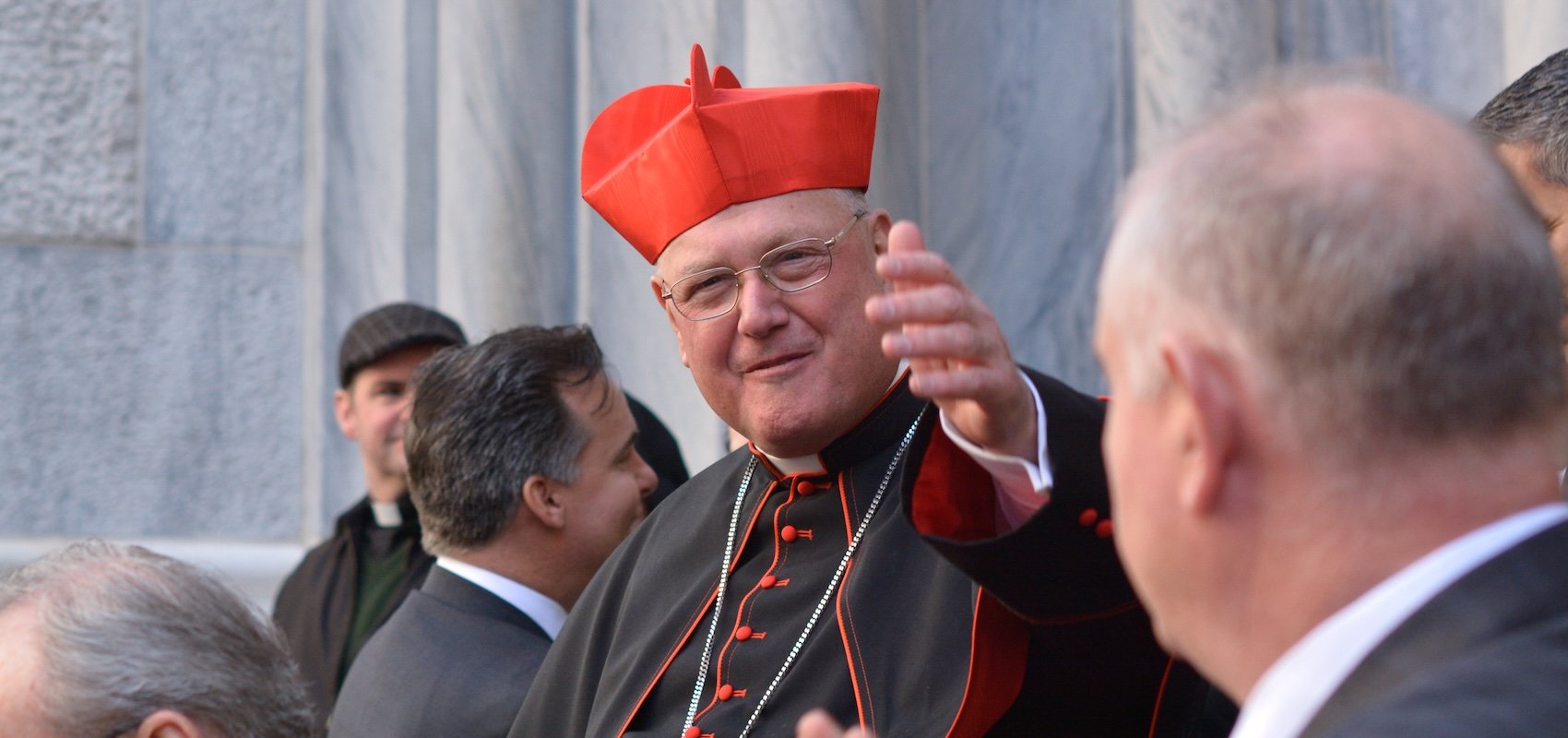
More than sixteen years ago, on the morning of his installation Mass at St. Patrick’s Cathedral in New York, an ebullient (when was he not?) Archbishop Timothy Dolan greeted me at full volume (when did he not?), “You will like the homily. I mention Richard!”
Fr. Richard John Neuhaus died in January 2009; Dolan’s appointment was announced in February, and he officially came to New York in April. It was a pity that their time in New York did not overlap. In a certain sense, Dolan was the extension into the 2010s and 2020s of “the Catholic moment” of which then-Lutheran Pastor Neuhaus had written in his 1987 eponymous book. Neuhaus, with The Naked Public Square published to wide acclaim in 1984, was then America’s leading religious intellectual.
His friend and frequent collaborator Michael Novak wrote of The Catholic Moment that Neuhaus had diagnosed a “vacuum in public religious leadership in the United States,” and called upon “the unique capacities of the Catholic Church to become the effective public leader of the Christian community, in the renewal of the American experiment.” Neuhaus exhorted Catholic leadership to “avoid the simplistic politics of the mainline churches,” and instead “draw upon its own informed intellectual tradition of reasoned authority and practical wisdom, for which the evangelical churches have as yet no equivalent.”
The late 1980s were a high time for emerging Catholic confidence. Neuhaus admired Cardinal John O’Connor of New York only slightly less than St. John Paul the Great in Rome. Novak was publishing in Crisis magazine—before First Things was founded—Mary Ann Glendon and George Weigel, both of whom would become in the 1990s principal expositors of John Paul’s thought. By the time Weigel was writing the authoritative biography of John Paul, Witness to Hope (1999), Fr. Richard had become a frequent visitor to Rome, lodging at the Pontifical North American College, where Msgr. Timothy Dolan was the rector, and being invited to dine in the papal apartments.
After the 2002 sexual abuse scandals broke, Fr. Richard returned to the theme of the Catholic moment. Had it passed, buried in the shame of priestly sins and crimes? In 2003 he gave “the Catholic moment” a more theological interpretation, no longer tied as much to his optimism in the 1980s. Yet he still had the sense of the difference powerful episcopal witness could make.
“We very much need bishops who are teachers of the fullness of the faith,” Fr. Richard wrote. “After more than three decades of confusion, contention, and conflicts that have long since become a bore to serious people, we are perhaps on the edge of genuinely receiving the Council. . . . If so, the Catholicism that is flourishing now and will likely flourish in the future will be believably and vibrantly Catholic.”
Had Fr. Richard lived longer, he might have been an ally to Dolan in that project as he was to O’Connor. But it was not to be.
Upon his retirement last week, Dolan was widely characterized as “larger than life.” He is that, certainly. But larger than life ought to be expected in the city that John Paul called the “capital of the world” when greeting O’Connor in the 1980s.
When O’Connor was archbishop of New York (1984–2000), the Jewish mayor, Ed Koch, would come to Midnight Mass. The two—who tangled at times—would write a book together, His Eminence and Hizzoner, about how they addressed issues of common concern despite differences. The mayors of New York during Dolan’s tenure were Michael Bloomberg, Bill de Blasio, and Eric Adams. Adams was at Dolan’s final Midnight Mass this week, but no one will be naming a bridge after him. One can hardly imagine Adams or the others effectively collaborating with the cardinal on a book, let alone policy. They were smaller than their office.
Dolan was raised in the 1950s Catholic culture of the St. Louis suburbs and lived through the ecclesial confusions and contentions of the 1970s. He was significantly shaped, however, by the ethos of the 1980s.
Dolan was in Washington at the beginning of the Reagan administration, then studying for his doctorate in American Catholic history. He returned at the end of the Reagan years for a five-year stint on the staff of the Vatican embassy in Washington. An avid reader of American history, there was no book on Reagan that he did not read. A serious historian, he could appreciate figures who bent history to their purposes, rather than being swept along by it. In the 1980s, John Paul and Reagan bestrode the stage with lesser roles played by still formidable personalities—Thatcher, Gorbachev, Kohl, Trudeau Sr.—and towering figures of moral witness in public life—St. Oscar Romero, Lech Wałęsa, Corazón Aquino.
Leaders who rise to, rather than shrink from, the stature of their offices are more difficult to develop in the digital age, but Dolan arrived in New York after the iPhone was launched. Still not using a computer—his homilies were written by hand on a yellow legal pad—he managed to master new communications technology with the oldest technique of all: having something significant to say, being able to say it in a simple and straightforward way, and saying it with a smile and, often enough, a laugh. One of Fr. Richard’s favorite words was “winsome”; that was his favored pastoral strategy, an approach Dolan favored too.
The smile and the laugh are not the only methods available. Cardinal O’Connor filled his office and then some, becoming the clear voice of the American bishops by sheer force of his indomitable energy and will. When he died in 2000, the mantle shifted to Cardinal Francis George in Chicago, a courageous intellectual leader very much in the mold of Pope Benedict XVI. Dolan inherited that role, exercising it according to his own abilities. He had his critics, though not as fierce as in O’Connor’s time. The smile and the laugh were literally disarming to many.
In 2004, five years before he would be appointed to New York, Fr. Richard invited Dolan, then archbishop in Milwaukee, to give the annual Erasmus Lecture. Chronicling the rise and decline of American “conciliarism”—which today would be called “synodality”—Dolan noted that “among younger priests and bishops there was a shift toward a vibrant theological orthodoxy,” and that while they “fully and enthusiastically committed to Vatican II . . . they worried about a loss of Catholic identity, moral laxity among lay Catholics, and generalized catechetical illiteracy.”
In the last year of the Polish pope’s life, Dolan spoke with hope about these “John Paul II bishops” who might more effectively, more winsomely, present the faith. He would count himself in their number.
Pope Benedict XVI would call Dolan to New York, to no one’s surprise. It was a surprise that three years later, when creating him a cardinal in February 2012, Benedict invited him to address the entire college gathered in Rome for the occasion. It was a rare honor, and Benedict assigned to him the theme of mission and evangelization, having already summoned a synod on the new evangelization for the following October.
Dolan consulted widely on the address. I suggested some material from Augustine and Newman, but cautioned that it might be considered a bit much to quote either of them in the presence of Benedict, a noted scholar of both. He took that as a challenge, and we made a friendly bet: If he quoted them in his speech, I owed him dinner.
When I saw him the following day, he announced—at full volume!—that he had done so. I was happy to discharge my debt, but whenever I visited New York he had always already accepted multiple events every evening. So he has yet to collect. Perhaps in retirement.
The most challenging thing in his address to the cardinals was not the theology or history, but rather a hint that his brother cardinals might not be sufficiently winsome. He framed it by recounting advice given to young seminarians when he studied in Rome.
“We thought he would give us a cerebral homily,” Dolan recalled about a Mass with Cardinal John Wright, prefect of the congregation for the clergy. “But he began by asking, ‘Seminarians: do me and the Church a big favor. When you walk the streets of Rome, smile!’”
“The missionary, the evangelist, must be a person of joy,” Dolan continued. “When I became Archbishop of New York, a priest told me, ‘You better stop smiling when you walk the streets of Manhattan, or you’ll be arrested!’”
Dolan never stopped smiling, laughing, and radiating joy. It was part of his personality, to be sure, but also a lesson he took from the confusions of the seventies and the new confidence of the 1980s.
“After the Council, the good news was that triumphalism in the Church was dead,” he told the cardinals. “The bad news was that, so was confidence!”
That confidence began to come back with John Paul and O’Connor and others, including Ratzinger himself at the doctrinal office in Rome. It was that confidence that would lead Fr. Richard to identify the Catholic moment in 1987 before himself becoming Catholic in 1990.
A year after that address to the cardinals, Benedict abdicated, and Dolan was part of the conclave that elected Pope Francis. Initially enthusiastic, Dolan soon was frozen out of the new Holy Father’s inner circle. Partly it was because Dolan was unmistakably a John Paul II bishop elevated by Benedict, and that was no longer the preference in Rome.
It was the “vibrant theological orthodoxy” Dolan spoke about in 2004 that sometimes put him at odds with Francis—not only the orthodoxy but the vibrancy. The preferred style of Pope Francis was not good cheer but chastisement—regarding abortion (“like hiring an assassin”), gender ideology (“ugliest danger” of our time), financiers (“this economy kills”), traditionalists (“backwardists”), seminarians (“little monsters”), defenders of doctrine (“throwing stones at people”), the arms industry (“merchants of death”), couples who choose pets instead of children (“selfish”). At his 2014 Christmas greetings for the Roman Curia, Francis lambasted them, diagnosing more than a dozen spiritual diseases from which they suffered. Dolan gave off the wrong vibe. Smiling was out, scowling was in.
In his last year as archbishop, Dolan installed a mural with larger-than-life-size figures in the entrance of St. Patrick’s. A panel that celebrates historic figures of Catholic New York includes four-term Gov. Al Smith, the first Catholic nominee for president in 1928. He insisted that Smith be depicted with a lit cigar. Whether Fr. Richard would have liked the mural, I can’t say, but he would have liked that detail, having smoked more cigars in a day than even Dolan does.
Smith was known as the “Happy Warrior”; an award called just that is given out at the annual dinner in his name. Dolan was that too, with the emphasis on the adjective more than the noun. It’s another pity that he turned seventy-five just before Pope Leo XIV was elected. While Francis liked to start fights, Leo emphasizes unity. A convivial, confident archbishop of New York is an asset in that regard. It will be the task of the new archbishop, Ronald Hicks of Joliet, Illinois, to follow in those footsteps, albeit not at the same volume. But the new man does begin with a nice smile.
Image by Thomas J. Hannigan, licensed via Creative Commons.

YOU MIGHT ALSO LIKE
Turned Away on Palm Sunday
In politics, diplomacy, war, or pretty much any field of human interaction, one must contend not only…
Timothée Chalamet Is Right About Art (ft. Suzy Weiss)
In this episode, co-founder and reporter for the Free Press, Suzy Weiss, joins Virginia and Germán to…
A Medieval Pilgrimage in Modern Assisi
When you go to the hilltop town of Assisi, you’re immediately struck by how medieval it is:…
