
This review will appear in the May 2026 issue.
Great Power Diplomacy:
The Skill of Statecraft from Attila the Hun to Kissinger
by a. wess mitchell
princeton university, 352 pages, $35
The primal scene of A. Wess Mitchell’s formidable Great Power Diplomacy is a crisis meeting in Sparta in 432 b.c. In the most militarized society on earth, Sparta’s king Archidamus II resisted the demands of the war hawks to go to the mat against Athens—which at the time was battling with Sparta’s client states. The hawks, no doubt busily tweeting grandiose statements and sporting virtue-signaling badges on their chests, demanded prompt and decisive action. Yet the king knew how many beans make five. Athens had more money, more men, and more ships. He offered a different strategy, less emotionally satisfying but more far-sighted. If war was possible, Sparta needed to be stronger, the better to wage it or deter it.
To increase its strength, Sparta would need time—a vital material commodity, which could be bought by dispatching envoys to conduct guarded, drawn-out talks with Athens, thus postponing hostilities while preparing armories, rallying allies, and filling the coffers. As Archidamus put it, they should “employ the interval in perfecting our own preparations. The means will be, first, the acquisition of allies, Hellenic or barbarian it matters not . . . [,] and secondly, the development of our home resources. If they listen to our embassy, so much the better; but if not, after the lapse of two or three years our position will have become materially strengthened.” At first, his message met resistance; after weeks, it was persuasive. And when Sparta and Athens eventually clashed, the diplomats’ work yielded a broader coalition and helped deliver victory. Diplomacy was not the antithesis of arms or conflict, but their necessary partner. Its purpose was not missionary (to alter the makeup of other polities) but pragmatic.
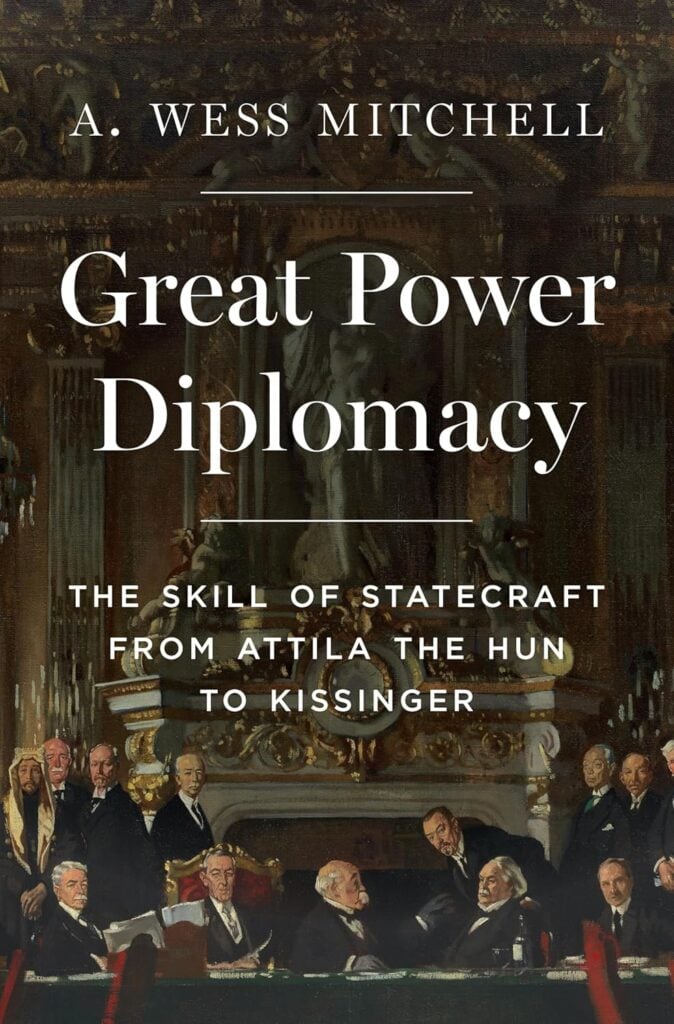
For Mitchell, a sharp historian, former diplomat, and cofounder of the Marathon Initiative think tank, Archidamus’s logic and sensibility reflect the essence of a craft that has lapsed in the West and been misunderstood in our time. Great Power Diplomacy is a poignant work. It delivers a precise and needed message: Diplomacy at its heart is the furthering of the national interest by means of negotiated compromise, conducted to rearrange power in space and time, with the central aim of concentrating strength and avoiding trials that exceed what the state can bear.
In Mitchell’s hands, and thanks in part to a taut, unsentimental prose style redolent of Niccolò Machiavelli, the very word “diplomacy” has, by the book’s end, taken on a tough and cold-eyed aspect. The contrast with modern usages is striking. Legalists deploy the word to refer to a different process: one of embedding states in a formal structure that will regulate interstate relations and obviate the practice of hard-power politics. Militarists regard diplomacy as a lesser adjunct to war-making, the velvet glove on their iron fist. Mitchell’s achievement is to use a panoramic survey of historic cases—from the Peloponnesian War, to Cardinal Richelieu’s seventeenth-century combinations with dreaded Protestant powers to contain the Habsburgs, to the Nixon–Mao rapprochement of the mid–Cold War—to rehabilitate diplomacy as a distinctive, coequal, and vital function of statecraft, something that neither “binding” international documents nor martial firepower can achieve on their own.
Though Mitchell’s narrative takes us only to the 1970s, his message is surely relevant to a superpower whose president at the time of writing seems intoxicated with strength. At the helm of a colossal but troubled state, Donald Trump needlessly picks multiple fights at once, turns predatory on committed allies, and expends scarce resources like a drunken sailor. He and his advisers launched the latest assault on Iran fancying it would be swift and decisive, presuming they were working with abundant capabilities—they are now openly daydreaming about settling accounts with Cuba—and a fragile enemy.
Results thus far have weakened America’s overall position: an oil price hike that enriches and empowers Russia, the distancing of allies, possibly the strengthening of Tehran’s internal hand, the expenditure of precious munitions and the bottling up of forces needed elsewhere, the reduction of American prestige through the demonstration of its power’s limits, and a catastrophic loss of life amongst the Iranians whose welfare Trump and his ministers sometimes emphasize, sometimes gleefully disregard. The White House’s official X account celebrates the war with frivolous memes. This is the antithesis of Mitchell’s message, the disastrous opposite of a power seeking to husband its strength or prudently mobilize allies. Diplomacy builds on a consciousness of limits and a spirit of gravitas. America’s erratic king does what he likes for primetime viewing.
Closer to this reviewer’s home, Mitchell’s message is needed in the U.K.’s Foreign, Commonwealth and Development Office. The ranks of the FCDO now include post-national cosmopolitan idealists. As direct experience shows, there are souls in that ministry of state who resist the core idea of a national interest to be pursued by a self-regarding state, and who view realpolitik as an outdated relic. Diplomacy for them is the art of discovering the good intentions of others. Avoiding war, on this view, is a matter of correcting misunderstandings rather than confronting clashes of interest. These minds, who mostly regret the British Empire and its evangelizing ways, also, ironically, treat diplomacy as missionary work. British partnership, they insist, must orbit around the promotion of good governance, human rights, and democratic reforms, as a handmaiden to virtuous international development projects, undertaken to convert others to enlightened market capitalism.
In this worldview, the diplomat is reduced to a moralizing preacher, rather than working as the hard-nosed bargaining voice of the state. As a Kenyan official once noted, “Every time China visits we get a hospital, every time Britain visits we get a lecture.” Legalism, too, abounds. As they see it, world courts and international statutes are self-evidently binding things that national interests must bow to, even though remorseless great powers obey them and ignore them at will, including those demanding that Britain cede sovereignty over Chagos. Fearful of a politicized, advisory opinion from the International Court of Justice, the FCDO’s formalistic minds reckon that the best way to secure the military base is to pay Mauritius—a close client of Beijing—for the privilege of leasing it back, and hope it proves to be a good-faith landlord. Good luck with that.
One result has been the degradation of the diplomatic services, the stripping away of regional expertise and technical knowledge. In the U.S., also, diplomatic posts too often work as political payoffs and rewards for donations or loyalty. It is reported that the lead U.S. special envoy, Steve Witkoff, in his accelerated prewar talks with Iran (which he juggled together with talks with Ukraine and Russia), misunderstood technical and factual details about Iran’s nuclear program. He claimed falsely that the IAEA had been unable to make inspections in Iran since Operation Midnight Hammer—in fact, it had made inspections—and that the IAEA-documented fuel Iran has stockpiled from its Tehran Research Reactor was “hidden.” Perhaps these errors were not decisive in propelling the U.S. to war. But they fed Trump’s dissatisfaction with the talks and his sense that there was no bargaining space. Diplomacy requires informed, undistracted diplomats.
Mitchell simply shows diplomacy being done, and done seriously, in the past. For him, history is not a collection of pat lessons in what to do next. It is a well of stories that help to make sense of the human condition—the diplomat’s condition—and that should serve as a “solvent against hubris.” To say it has landed at the right time is putting it mildly. The diplomat’s task is to confront power’s limits in the face of gathering threats, perhaps threats bearing down on multiple fronts. Traditionally, diplomats have deployed a range of methods. Strategies of conciliation, enmeshment, or isolation, if well executed at the right time, can help to postpone or prevent clashes, constrain rivals, and reduce the aggregate size of hostile forces to make them manageable.
This book assembles a record of adroit diplomatic maneuvers, at times played by calculating minds from a weak hand. Byzantine rulers buy off and send westward the Hunnic “wolves of the north,” exploiting their financial advantage and their useful absence of lush grassland for Attila’s horsemen. Venetians conciliate the Milanese in order to focus their energies on the Ottoman Empire. German Chancellor Otto von Bismarck conducts a delicate balancing act to avoid a two-front clash with France and Russia. Richard Nixon and Mao Zedong, by temperament and inclination ideological enemies, strike a bargain that eases Soviet pressure on behalf of China’s interests and scales down revolutionary hostility in Asia on behalf of America’s.
While warmly commending this book to one and all, this reviewer disagrees with Mitchell in one case: that of Adolf Hitler. In a counterfactual analysis, Mitchell suggests that Hitler might have been deterred and that several opportunities were lost to constrain Nazi Germany before the calamity of World War II. Yet Hitler and his outfit were dangerous and unusual precisely because they presumed eventual war, were ultimately undeterrable, and were hell-bent on a large-scale revanchist military adventure. Any retreats on their way to that dismal project were merely tactical. This was a regime that ran its economy into overdrive to maximize military preparation, and which gratuitously declared war on the United States even while locked in a struggle with the British Empire and the Soviet Union. Mitchell’s counterfactual imagines Britain and France pursuing a tighter alliance with Eastern European states in the 1930s. But at that time, a reluctant France was only halfheartedly configured to fight on its eastern flank and not at all beyond, while Britain had only a handful of divisions to commit to a land war in Europe. Such an alliance could hardly have moved Hitler to give up on his ambitions.
Mitchell also shortchanges Prime Minister Neville Chamberlain’s strategic predicament. He charges Chamberlain with naivety and insufficient balancing against the Nazi threat. Chamberlain’s utopian conceit that he could satisfy Hitler’s ambitions was wrongheaded, but there was also a steely and pragmatic Chamberlain. A little like Archidamus, he gained time and used it to undertake vital rearmament—“internal balancing,” in the language of international relations—and in a country where opposition to any rearmament was vocal.
Mitchell faults Chamberlain for not selecting an earlier war over Czechoslovakia, with its favorable terrain. This might be fair, but a short, sharp war that overthrew Hitler in 1938 would not have doused the flames of German hypernationalism any more than France’s occupation of the Ruhr in the 1920s did. And in the eyes of the United States—alas, then sympathetic to the principle of German ethnic reunion—Britain and France would be the aggressors. Any further clash might well have gone ahead without the material support from the U.S. that proved so crucial to the war that did happen. At least British diplomacy ensured that Hitler entered 1939 as the unambiguous aggressor. Appearances, as Machiavelli knew, matter as much as substance. None of this makes Chamberlain’s diplomatic judgments clearly right. Yet as Mitchell’s book repeatedly shows, history reveals how often statesmen face dilemmas with no simple way through.
Though the debate over the Munich Agreement will persist, it is a virtue of Mitchell’s Great Power Diplomacy that it turns attention back to these fundamental questions. “A soft tongue breaketh the bone,” goes the verse from Proverbs that opens the book. One day, our militaries will have to open fire less, if only diplomacy could get back its sinew.
