
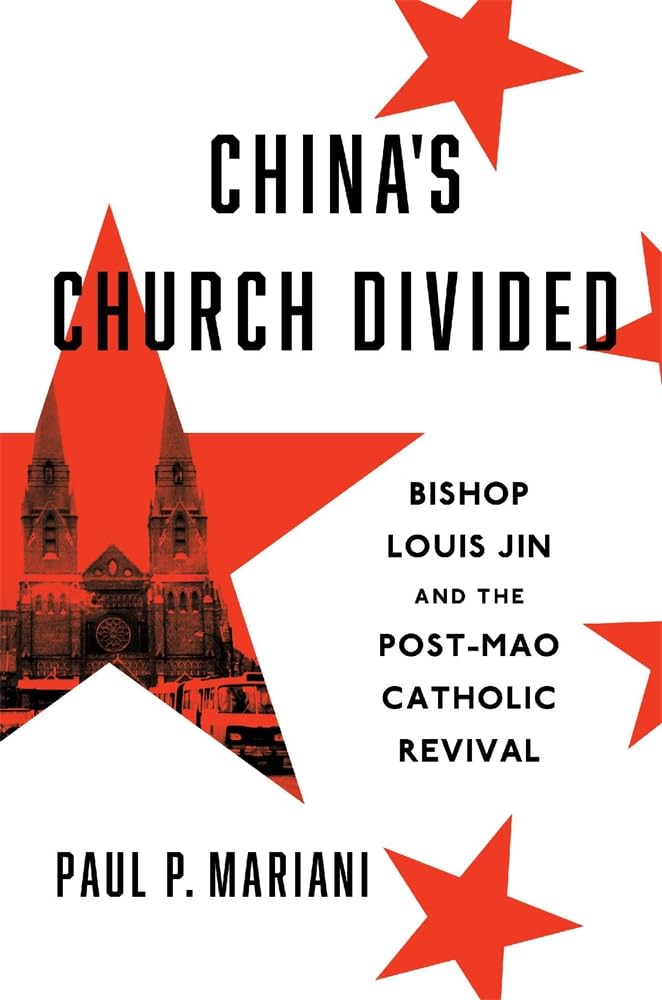
China’s Church Divided:
Bishop Louis Jin and the Post-Mao Catholic Revival
by paul p. mariani
harvard university, 352 pages, $49.95
Late in the evening of Thursday, September 8, 1955, Communist Party officials in Shanghai launched a mass arrest of Catholics, clergy, and laity who had resisted the Party’s ambitions to turn China’s Church against the pope. Among those who were seized was the rector of the Shanghai major seminary, a thirty-nine-year-old Jesuit named Aloysius Jin Luxian (1916–2013). Fr. Jin, a brilliant intellect who had graduated from Rome’s esteemed Pontificia Università Gregoriana five years before, was one of the most adamant opponents of China’s new Communist government. After his arrest, he languished for nearly two decades in prison until his parole in 1972.
The Party newspaper, the Renmin Ribao (People’s Daily), claimed in 1960 that Jin was guilty of “criminal activities,” such as cooperation with Bishop Ignatius Gong Pinmei’s (1901–2000) “counter-revolutionary and anti-government organization,” being “in league with imperialists and betraying his motherland,” and collaborating with “imperialists who under the cloak of religion plotted subversion.” His offenses were brusquely described as “crimes of a very serious nature.” By the 1980s, however, Jin Luxian had become the darling of the Party, a model Catholic who repudiated the Vatican for its “imperialist” attitudes and publicly asserted his support for a Chinese Church independent of Rome. By 1988, once a stalwart defender of the papacy and obedient to the Holy See, Bishop Jin had become a defender of the Party’s governance over both China in general and the Chinese Catholic Church.
Paul Mariani’s new book is about this protean Chinese priest, who has been described in turn both as the country’s most dishonorable traitor to his faith, and as the most effective savior of China’s—underline China’s—Catholic Church. I am not being hyperbolic when I describe Mariani’s book as the most evocative and accurate book to date on the contemporary Catholic Church in China. Mariani—a priest of the same order as Bishop Jin—is among the very few scholars who are both equipped to confront the languages required to research Jin’s ecclesial legacy in China and understand the Shanghai Church. He has also dedicated many years to mastering the vast scholarship that establishes the historical context of Chinese Catholicism.
Both Mariani and I knew Bishop Jin, and both of us were aware of his genius, his charm, and his unprecedented success at rebuilding China’s beleaguered Catholic Church in the early decades of the People’s Republic. It was Jin who persuaded the Party to return church properties to Catholic use, and Jin who built a new seminary that swiftly filled with young, enthusiastic men.
There is only one Catholic Church in China—most, if not all, of China’s bishops would admit that—but it is increasingly divided since the 2018 Sino-Vatican agreement, which continues to engender rifts in China’s Catholic community. Chinese Catholics report that the Vatican knows much, but understands little, about the Church in China. China’s underground bishops feel betrayed by the 2018 agreement, and the concord that once existed between the aboveground and underground communities continues to disintegrate slowly. After the Communist Party established the Chinese Catholic Patriotic Association in 1957 to conform to Communist principles, China’s bishops immediately divided into supporters and resisters of Party control over the Church. After the 1990s, the divisions began to heal; some underground bishops even started collaborating with aboveground bishops. But since 2018, China’s Catholics are again congealing into two separate communities. In some areas the underground Church has begun consecrating new bishops to protect the integrity of the underground Church and preserve the faith. Rome is losing track of how many bishops govern China’s Catholics.
The overarching question one asks, after reading Mariani’s exposé of the Party’s coercive policies toward religion in China, is whether Jin Luxian contributed as much to China’s Catholic division as he did to its material renaissance. Was he a heroic champion of the Church’s restoration, or a defector who built an edifice of success on lies and machinations? Having known Jin personally, I tend to lean in his favor, though this book provides precisely the kind of evidence and analysis that problematize any conclusions, mine included.
In one especially revealing passage, Mariani describes a 1986 speech the bishop gave in Germany. As Mariani recounts, Jin “gave a litany of church sins,” foremost among them the “unholy alliance between the Church and the colonial powers.” He added to this accusation that “Christianity was, therefore, a western religion for the West and not for China.” Chairman Mao’s ascent to absolute power over China in 1949, Jin argued, meant that China at long last had attained full independence and national self-respect. He praised China’s Catholic independence from Rome, arguing in various venues that China’s Church was finally liberated from Vatican “interference in the selection of bishops.” He consistently praised the Party’s role in engendering a “Sinicized” Church, and he did so by conjuring China’s long and difficult Catholic history, employing the most polished prose he could muster.
“Jin’s argument had some merit,” Mariani admits. China’s Catholics were governed entirely by non-Chinese bishops, even though Christianity had been established there as early as the Tang dynasty (618–907). But the bishop went too far in order to “attract sympathy from his progressive European audience.” He began to question settled doctrine in order to appeal to the more radical wing of the Church. Indeed, Bishop Jin was adroit at attracting the support of progressive thinkers within the Church. As Mariani reveals, Chinese clergy from his own order, such as Aloysius B. Chang, S.J., recognized Jin’s “incomplete ecclesiology” as a view that drew very selectively from Church history and theology to support his own reconciliation with China’s Communist authorities.
Another Jesuit Father, Camille Graff, also attacked Jin’s position as supporting China’s Communist “mirage” of religious freedom. Perhaps the most resolute critic was Jin’s Jesuit confrere and former friend, László Ladány, S.J. (1914–90), who complained that Jin’s sophistry had taken advantage of the naivety of the non-Chinese priests in his audience: “ignorant of the subtlety of Communist United Front tactics, [they] were only too ready to take the bait.” Bishop Jin still has his supporters today, among those who sympathize with China’s Communist Party and the Catholic Patriotic Association. But the number of bishops, priests, and scholars who are suspicious of Jin’s antics continues to grow. This is why, I suspect, Mariani has chosen to title his study China’s Church Divided.
Much of this book casts light on one of the great disagreements among Church-watchers of the post-1949 situation in China, which turns on whether the Church’s approach to China’s Communist Party should involve antagonism or friendship and openness. After the Jesuit president of Santa Clara University, William Rewak, S.J., went to China in the early 1980s as part of a delegation, Rewak wrote in his diary of these two options for viewing China’s Church under Communist control: “Some think they should be more aggressive in order to get behind the pleasant façades. Others say they should move carefully so as to build bridges and not start arguments.” Aggression or bridge-building: these are even today the two positions adopted by those who best apprehend the past and present of China’s Catholic realities. Bridge-building has been the Vatican’s preferred posture since 2018, but China’s ostensibly friendly response is best understood as a superficial gesture accompanied by consistent below-the-surface aggression.
Mariani remarks that “From the time he began considering collaboration with the government, Jin was a bundle of contradictions.” That is certainly true. Almost nothing about Jin was straightforward. He did not receive full canonical recognition as a bishop of the Roman Catholic Church until 2005, when Pope Benedict XVI accepted him into full communion with the Holy See. Before 2005, Jin was stubbornly satisfied with his status as a Party-sanctioned bishop who was not in communion with the pope. Whether he was merely putting on pretensions of “inner independence” from Rome is a disputed point, but by 2005 he was ready to reconcile with the Holy See.
Jin once told me in a private conversation, “I am both a serpent and a dove. The government thinks I’m too close to the Vatican, and the Vatican thinks I’m too close to the government.” Whatever he was, Jin managed to rebuild the Shanghai Church from ruin. His high position, however ambiguous, enabled him to accomplish what underground bishops could not. While Jin posted a flood of letters to Europe and the United States begging the wealthy for money, Gong and Bishop Joseph Fan languished in prison or house arrest. Jin received the support he requested from the very Western countries he excoriated as “imperialist” and “colonialist,” and with that money he constructed a commanding diocese of numerous faithful and a large Catholic footprint of brick and mortar.
In his incisive conclusion, Mariani sets Jin alongside two other bishops: Cardinal Ignatius Gong Pinmei and Bishop Joseph Fan Zhongliang, S.J. (1918–2014), bishops of the “underground” community. All three were arrested and held in Communist prisons. Only Jin joined China’s Catholic Patriotic Association and served as a mouthpiece of the Party’s views and policies. While Jin globe-trotted from country to country, Pope John Paul II made Gong a cardinal in pectore (secretly, “in the heart”) on June 30, 1979. Fan received his episcopal ring and pectoral cross as private gifts from the same pope. When Fan died in 2014 at the age of ninety-five, thousands more faithful paid homage to his body than did for Bishop Jin. Meanwhile, whereas the government allowed Jin’s requiem to be conducted at Shanghai’s monumental cathedral, Fan’s funeral Mass was relegated to a small funeral home.
Jin was better known across the globe, and arguably more popular among the Church’s progressive leaders, but Gong and Fan were vastly more popular among China’s Catholic population, a population more aligned with the “underground” community than those who attend Mass in sanctioned churches. Cardinal Gong and Bishop Fan held, and still hold, the affection of China’s faithful, mostly for their loyalty to the Holy See and their suffering for its sake. When the chief prosecutor visited Gong in prison just before his 1960 trial, he pressed him to denounce the pope. Gong’s response was uncompromising: “I am a Roman Catholic bishop. If I denounce the Holy Father, not only would I not be a bishop, I would not even be a Catholic.”
Mariani’s trenchant, deft study of the murky figure of Jin is the most precise and revealing book to date on the recent history of the Chinese Church. No other book, except perhaps Jean Lefeuvre, S.J.’s Les Enfants dans la ville: chronique de la vie chrétienne à Shanghaï (1956), provides more uncensored detail than China’s Church Divided.
Once, during a long visit with Bishop Jin in his Shanghai bureau, I handed him a gift I had brought from the archives of the Society of Jesus: an envelope containing several black-and-white photos of him in Shanghai before his 1955 arrest. Among the images was one with his spiritual father—the seminary rector Pierre Lefebvre, S.J. (1885–1955). Jin’s eyes immediately began to swim with tears. “These are precious treasures. I loved Father Lefebvre.”
He had not seen these images since he was a young Jesuit—before his prison sentence, and before his long years of navigating China’s Orwellian Communist bureaucracy. The faces on the prints jolted him momentarily out of decades of political maneuvering, back to a semblance of what he must have been like while he was a seminarian and youthful Catholic priest, before Chairman Mao, before China’s Catholic Patriotic Association, and before he had grown into the “slippery fish” (Jin’s own words) who slyly governed Shanghai’s Catholic diocese.
Mariani is a masterful scholar and narrator who has depicted Jin Luxian as the urbane, convoluted, and multidimensional man he was. But let us give Bishop Jin the final words. “God only knows where I always placed my loyalty, and his judgment is dearer to me than the justice of men.”
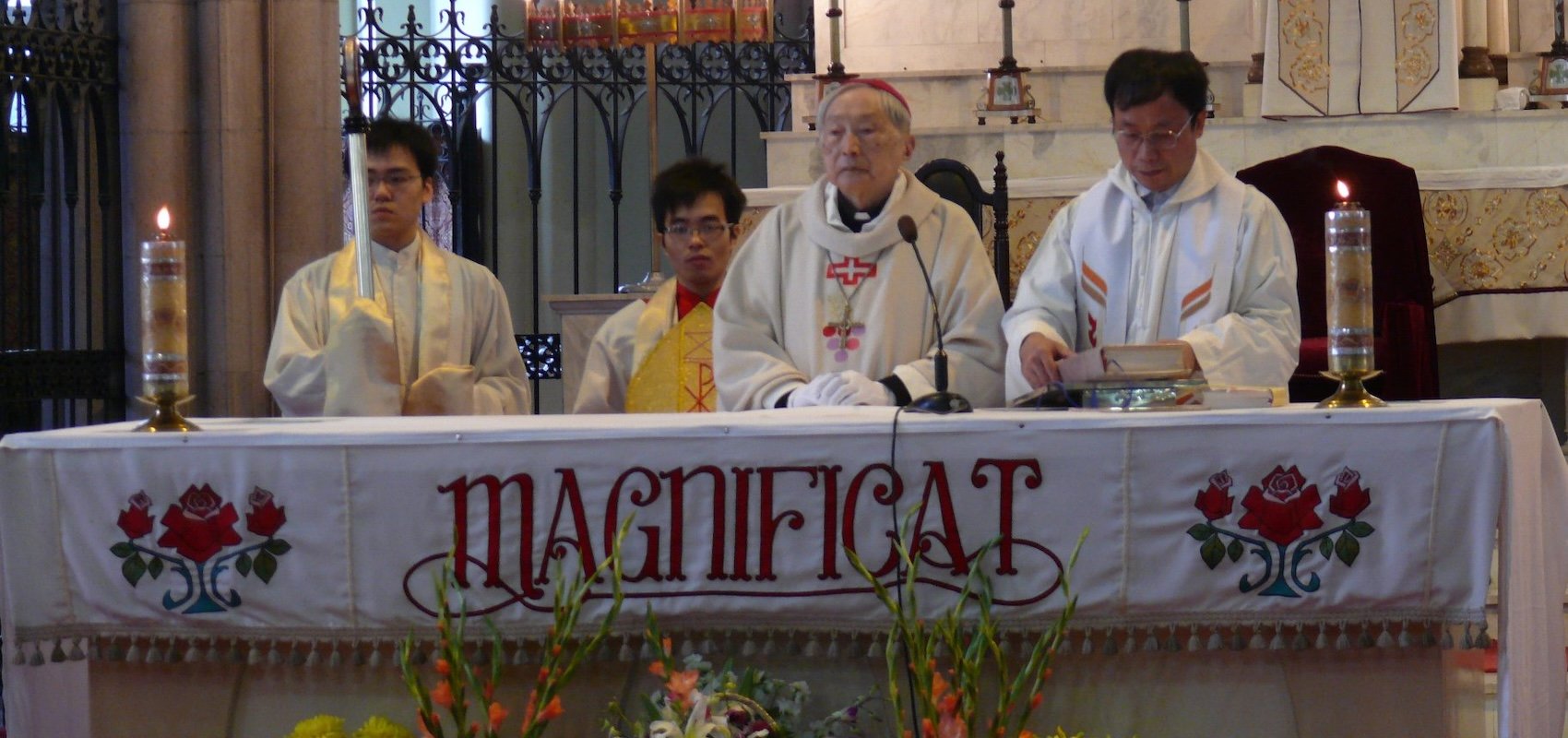
Image by Peter Potrowl, licensed via Creative Commons. Image cropped.

YOU MIGHT ALSO LIKE
Turned Away on Palm Sunday
In politics, diplomacy, war, or pretty much any field of human interaction, one must contend not only…
A Medieval Pilgrimage in Modern Assisi
When you go to the hilltop town of Assisi, you’re immediately struck by how medieval it is:…
Via Crucis, 2026
The Way of the Cross—and the third, seventh, and ninth stations in particular—has been an especially appropriate…
