Rain was falling as we reached camp on that first night, and I was questioning my choices. When you walk two dozen miles in a day, every muscle hurts. I entered the tent to squeeze in among forty or so other women on bare ground. All around me were people who had come on this pilgrimage—a sixty-mile walk from Paris to the Cathedral of Notre Dame de Chartres—four, five, even seven times. I couldn’t imagine why.
These were my thoughts, fifteen hours and twenty-four miles into the Chartres pilgrimage. But a pilgrimage is incomprehensible apart from its end. I and twenty thousand other pilgrims were doing something that drew us into another realm, a realm where pretenses are stripped away.
The cathedral at Chartres sits on a hill—a high place, perhaps even a thin place, which was a spiritual site long before the arrival of Christianity. There has been a church there since the fourth century, and the current Gothic cathedral has changed little since its completion in 1252. For a thousand years, pilgrims have venerated the Sancta Camisa, a piece of the Blessed Virgin’s tunic.
The current iteration of the pilgrimage takes place each year over Pentecost weekend. The revival began with the French writer Charles Péguy, an unlikely candidate given his struggles with and intermittent practice of the Catholic faith. But when his son fell ill, he pledged to the Virgin that he would make pilgrimage to Chartres if the boy recovered. His son got well, and he completed the pilgrimage several times before he was killed on the battlefield in 1914. Interest continued for the next decades as Péguy’s students, friends, and admirers made the trek. In the 1980s, the traditionalist Catholic group Chrétienté-Solidarité made the pilgrimage a rallying point for the preservation of the Latin Mass, and numbers increased dramatically.
Today, the pilgrimage draws thousands of mostly young people from all over the world. The atmosphere is something like Coachella meets a crusade. The pilgrims are arranged in groups called chapters. French scouts in their tweens and teens populate a large number of the chapters. In my chapter, hailing from all over the Anglophone world, participants were between the ages of seventeen and forty. The traditional Mass is celebrated each day; the rosary is chanted in Latin; talks are delivered about the precarious state of the pre-1962 rites. Some pilgrims have come because of their deep love of the Church’s old rites, others for the physical challenge. For me, the circumstances simply aligned, or were aligned for me.
I love tradition and beauty as much as the next Catholic Zoomer, but I can’t say that my attendance at the Traditional Latin Mass has been regular. All I’ve ever wanted out of the Mass is for those who celebrate it to act like it is what we say it is. Novus Ordo Catholic that I am, I have a hard time refuting the argument that the old ways are, overall, a more fitting practice of the Catholic faith. Submerged in traditional Catholicism for three days, I remember that I dislike the disputes over these liturgies, not the liturgies themselves.
As I confront the realities of camping that first night, I reflect on the fact that a pilgrimage is out of place in today’s world. Modernity, secularism, popular forms of Protestantism, and diluted Catholicism all say that it’s medieval and superstitious to believe that undertaking hardship somehow wins us favor and graces from God. And yet here we all are. The soul understands that there is a divine economy, whereby Christ changes our sufferings into grace. And he offers ways for us, in his mercy, to participate in his glorious triumph on the cross. During that night, my mat pools with water, and I make a half-hearted prayer that the pounding rain should stop, but the request is blocked: “You will endure discomfort,” a small voice says. “But you will not be hurt.”
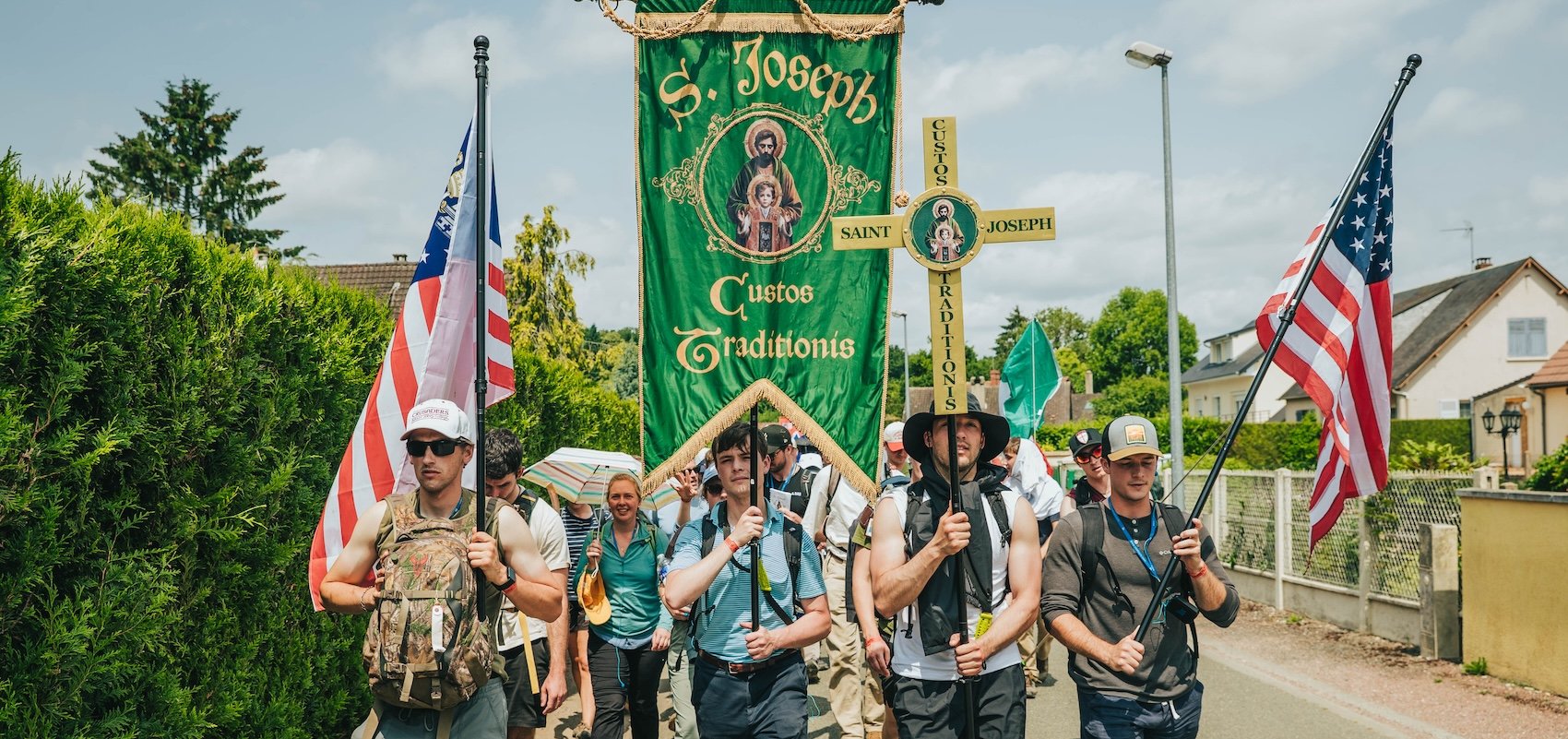
Pentecost morning dawns with a red sun and a fresh sky. Each chapter carries a cross, a banner proclaiming its patron saint, and its national flag. My chapter’s green banner with a gold cross showcases St. Joseph, Guardian of Tradition (custos traditionis, distinct from Traditionis custodes). Though wet with rain, every flag raises our spirits; we are the Church Militant.
The second day is easier than the first. The walking is broken up by a long, solemn Mass in the middle of a field, with Bishop Athanasius Schneider presiding. I’m sure it is beautiful, though I can’t see a thing from my vantage as I relish the sun and rest. In normal life, Mass can feel like the only time our spiritual muscles are working. But this moment in the heavenly sun seems to anticipate the rest at the end of the journey, the end that the Mass itself provides for us in anticipation of our final rest in him.
The logistics of moving a three-mile-long column dictate a quick, steady pace. When gaps open, you run to close them. It’s best to stay close to the cross that leads the chapter. There is little time to do anything but keep going. A bathroom break can mean falling behind. The urgency of keeping up: What better to remind us of the pleasures and supposed necessities that distract us from the one thing needful?
Pilgrimage highlights our need for companions. I wouldn’t get far without my fellow travelers. Trads sometimes have an odd reputation, but the friends I have met are the very best Catholicism has to offer. They are dedicated, interesting, sociable people, many with fascinating lives both within and beyond the faith. Some are graduate students; others are involved in their churches through music ministry or altar serving. Some of the men are discerning the priesthood.
Protection of the old rite is an element of the Chartres pilgrimage. One of the leaders says that right worship leads to right belief, which leads to right culture. And yet, though everyone here likes the Latin Mass, few are Latin Mass–exclusive. One man tells me he doesn’t feel it is right to drive an hour and a half to the closest Latin Mass when there is a reverent Novus Ordo right down the street.
Near the end of the second day, the twin spires of the cathedral appear on the horizon. We kneel to chant a Salve in thanksgiving. The evening is clear and fair as the French scouts high-five us into camp. Now that I have forty-six miles behind me, my feet are sore, but I’m cheerful. Only fourteen miles to go. I have grown to love the journey.
The final day brings a surge of energy. We sing every hymn in our booklet when the line stalls in an open field. We pass around electrolyte packets. The men insist that boxed red wine, poured straight from the bag into their mouths, is a cure-all, but I abstain. We round a corner, and the cathedral emerges from the plain—as startling as the elevation of the host at the Latin Mass. The cathedral grows larger on the horizon, but it teases us by seeming to stay at the same distance as we keep marching. Finally, we are in the suburbs of Chartres, and then at last climbing the hill. We kneel to receive a blessing from the bishop. Seeing our American flags, he tells us to pray that the United States will be a country of peace.
The final Mass is an ordeal in its own right. The pilgrims overflow the cathedral, and most of us have to remain in the square outside. Kneeling on gravel with no shade, I don’t know that I’ve ever participated less in a Mass than I do in this one. But the march of the banners into the cathedral stirs me. The organ sounds the traditional hymn of the pilgrimage: Chartres sonne, Chartres t’appelle (“Chartres is ringing, Chartres is calling you”).
The next morning, my chapter and a few others celebrate one more Mass. In past years, this Mass has occurred in the crypt of the cathedral. Due to conflicts with the bishop over the celebration of the Latin Mass, we have to use a different church in Chartres. After communion, I weep, overcome with the beauty of the liturgy. The Mass is more than beautiful. It is beautiful like the surface of the ocean: just a glimpse of the forces underneath. There is more going on than we see and feel. It’s an opportunity to stop questioning and rest in the mystery. On a simpler note, I am relieved that I—and we—were granted the strength to finish, no worse for wear. The last three days have given new life to Paul’s declaration, “I have finished the race” (2 Tim. 4:7).
But my reflections are interrupted: As the final hymn begins, a man starts screaming and groaning, in the throes of a demonic manifestation. My hands go cold. Medical professionals run up to help and are turned away. I keep singing the refrain, calling on the Blessed Virgin to enter “chez nous”—our house. The man’s companions seem unflustered. This sort of thing can happen in such a spiritually charged environment, I suppose. There be dragons yet.
Shortly afterward, I climb the steps of the cathedral on my knees. I venerate the veil of Our Lady and feel her sanctity. I give her the burdens I have been carrying. The cathedral stands for the heavenly Jerusalem, to which we should be on pilgrimage throughout our lives. God willing, I had just completed a miniature version of my life’s course. Christians view the Exodus as a blueprint for the spiritual life: Called out of sin and complacency, we face trials and purgation in the desert of this life, and only then enter into the promised land. This story is repeated in the lives of the patriarchs and prophets, from Abraham to John the Baptist, and culminates in the life of Christ.
It is common, on these journeys, to imagine oneself abandoned just when God is really very close—think of the Israelites worshiping the golden calf as Moses receives the Commandments, or Elijah’s journey in the desert just before the theophany on Mount Horeb. One of my faults is to judge my relationship with God on the basis of my emotions. If I don’t feel comforted, I assume that God is distant. The pilgrimage reminded me that the spiritual life has an objective element. It makes the invisible journey of life visible, the destination and the help along the way present and tangible.