
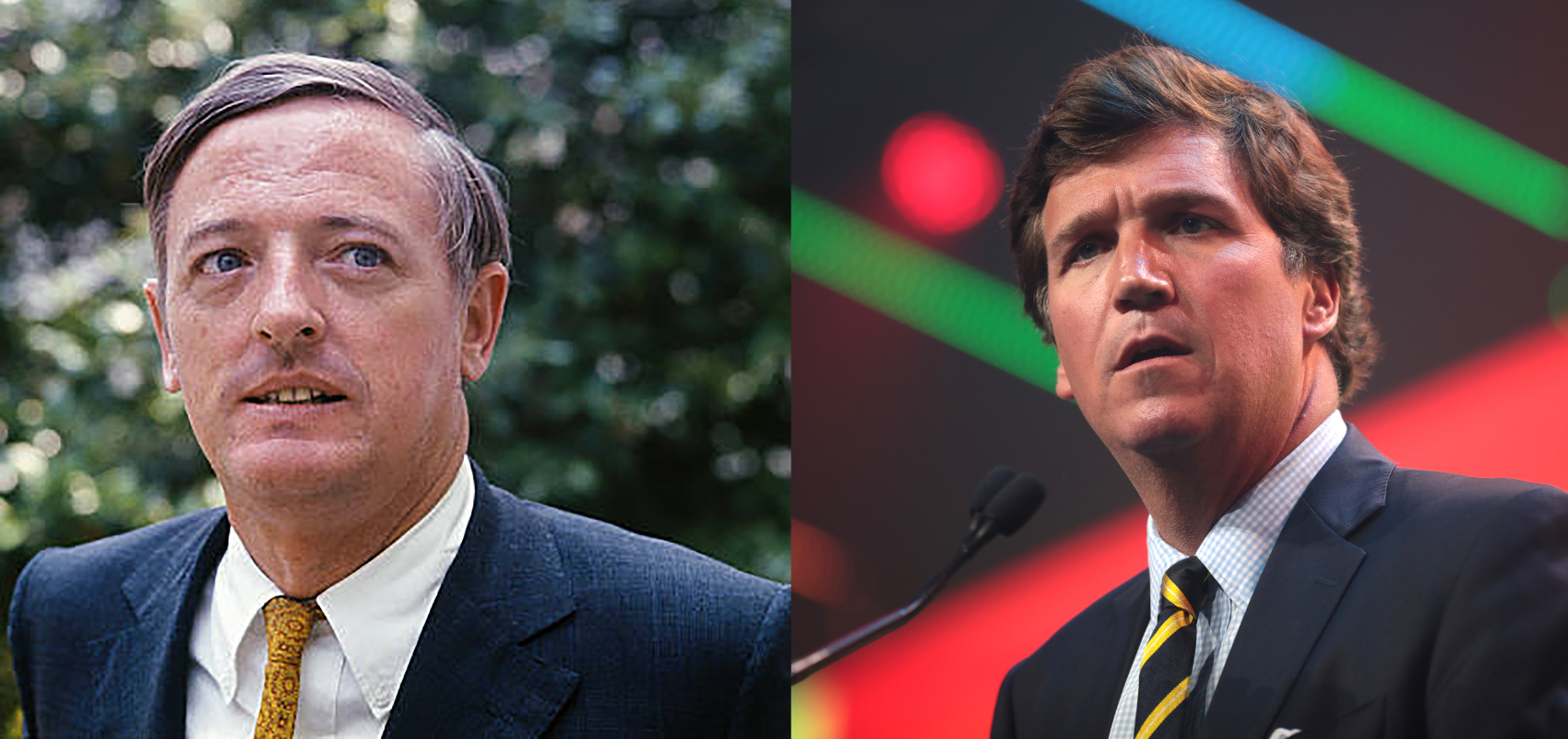
The battles raging on the right since Tucker Carlson’s interview with Nick Fuentes are not new. They are a continuation of a conflict that goes back more than thirty years, to the era when conservatives faced watershed questions about what conservatism would mean in the post-Reagan and post–Cold War world. Controversies over anti-Semitism marked this debate from the very beginning.
The battle lines were drawn in the late 1980s and early ’90s between “paleoconservatives” led by Pat Buchanan on the one side and “neoconservatives,” whose leading figures were in many cases Jewish ex-liberals, on the other. They were at odds not only over foreign policy in general and America’s relationship with Israel and involvement in the Middle East in particular, but also over immigration, economics, and attitudes toward modernity and American history. They also had different interpretations of conservatism’s own history and meaning.
In the years before World War II, the American right had rallied to the banner of “America First,” which stood for keeping the U.S. out of the European conflict. The Japanese attack on Pearl Harbor and Hitler’s subsequent declaration of war on America in support of his eastern ally put an end to the America First Committee and right-wing “isolationism.”
When that war ended with the Soviet Union in control of half of Europe and communism gaining ground in Asia, an anti-communist internationalist form of conservatism sprang up in place of the right’s former skepticism of foreign engagements. Once the Cold War itself was over, one thing immediately stood in the way of any potential reversion to the right’s earlier character. Saddam Hussein’s Iraq invaded and annexed Kuwait, creating a regional crisis in the Middle East. Did America’s commitments in the region—moral as well as strategic—require our military intervention?
This was a question that obviously touched on America’s relationship with Israel, a subject of intense concern to the neoconservatives. Many had moved to the right in the first place over the preceding twenty years because of the countercultural New Left’s turn against Jews and Israel. Black radicals, for one, often saw Jews as exploiters at home and Israel as a white colonial state abroad.
Norman Podhoretz, editor of the leading neoconservative magazine Commentary; his wife Midge Decter; and others in their circle were prepared to fight as hard against the “isolationist” right that might abandon Israel as they had fought against the anti-American, anti-Israel, and anti-Semitic left. David Frum, a Jewish Canadian who had begun writing for neoconservative-friendly publications such as the American Spectator, was a key player in these battles as well. Allied with the neoconservatives were a number of hawkish liberal Jewish writers at the New Republic and in the pages of the New York Times.
The leading advocate for an “America First” foreign policy at this time—and indeed up to the day he ended his syndicated column a few years ago—was Pat Buchanan, who had already come to take a dim view of the neoconservatives and their liberal-media allies. Buchanan had been just three months into his role as White House communications director under Ronald Reagan when, in May 1985, the president delivered a speech at a West German military cemetery that touched off a firestorm of controversy.
There were Waffen-SS soldiers among those buried at the Bitburg cemetery. Reagan had been misinformed that American servicemen were also laid to rest there. By the time the truth became known, Reagan thought it too late to back out of his appearance—there was Cold War diplomacy involved—and he focused his remarks on reconciliation, condemning the SS but not ordinary German soldiers, saying: “There were thousands of such soldiers to whom Nazism meant no more than a brutal end to a short life. We do not believe in collective guilt. Only God can look into the human heart, and all these men have now met their supreme judge, and they have been judged by Him as we shall all be judged.”
The media at the time treated Reagan’s Bitburg remarks rather like liberal media in our day treat Donald Trump’s remarks in Charlottesville, Virginia, about “very fine people on both sides” of the debate over Confederate monuments. Many Jewish groups also deplored what they took to be the president’s equivocation about the evils of Nazism. Buchanan found the attacks on Reagan outrageous.
He was also aware that neoconservatives, who in many respects still held sensibilities formed during their days on the left, had been involved in controversies with more right-wing intellectuals who were friends of Buchanan’s. Paul Gottfried, M. E. Bradford, and other “paleoconservatives”—many of them writing for Chronicles magazine—considered the neoconservatives liberal interlopers conducting a hostile takeover of the conservative movement.
There had been clashes between neocons and paleos over Bradford’s nomination by Reagan to head the National Endowment for the Humanities in 1981, at a contentious meeting of the Philadelphia Society in 1986, and over immigration in 1989—with the last pitting Fr. Richard John Neuhaus, who was sympathetic to the neoconservatives but working for the think tank that published Chronicles, against writers and editors at the magazine strongly opposed to mass immigration. (That clash set in motion events that would lead to Fr. Neuhaus’s founding of his own magazine— First Things.)
As America debated going to war with Iraq in 1990, Buchanan saw the neoconservatives and other pro-Israel factions as warmongers. He declared on The McLaughlin Group talk show: “There are only two groups that are beating the drums . . . for war in the Middle East—the Israeli Defense Ministry and its amen corner in the United States.”
Later he would name syndicated columnist and longtime New Republic writer Charles Krauthammer, the New York Times’ A. M. Rosenthal, defense policy maven Richard Perle, and Henry Kissinger (a foe of Buchanan’s from their days in the Nixon administration) as specific fomenters of war. All were Jewish. The war would be fought, he said, by “kids with names like McAllister, Murphy, Gonzales, and Leroy Brown.”
Rosenthal, Podhoretz, and others accused Buchanan of blatant anti-Semitism. Yet Buchanan had Jewish defenders, including Robert Novak, Paul Gottfried, and the anti-interventionist libertarians Murray Rothbard and Leon Hadar. (Although the Buchananite wing of the right was anti-immigration and opposed to free trade, some prominent right-leaning libertarians were also against mass immigration and prioritized antiwar foreign policy over free trade—though some opposed the North American Free Trade Agreement anyway for not being free-trade enough.)
The neocons and paleos had opposing worldviews, not just different opinions about Israel. Given their personal, professional, or family backgrounds in liberal politics, neoconservatives often saw paleoconservatives the same way liberals saw the right as a whole—as nativists, isolationists, racists, and anti-Semites.
But the feud also has to be understood in terms of personal friendships. This is how to view William F. Buckley Jr.’s role in the right’s anti-Semitism blow-up of the early ’90s. The book Buckley produced on the controversy, In Search of Anti-Semitism, is not what it is commonly remembered as by either side. Buckley was not looking to excommunicate any of his friends, even as he couldn’t ignore other friends who insisted that he do so. The book is a testament to his agony.
It, and the novella-length essay of the same title that preceded it in National Review late in 1991, is misremembered as having pronounced Buchanan an anti-Semite. Even at the time, many took its verdict that way. Yet Buckley rebuked them for doing so. National Review, with Buckley’s assent, actually endorsed Buchanan against George H. W. Bush in the 1992 New Hampshire Republican presidential primary, mere weeks after Buckley’s essay had appeared. Would Buckley and his magazine have endorsed someone he believed to be an anti-Semite?
Yet what Buckley wrote in the essay was easily open to misinterpretation: “I find it impossible to defend Pat Buchanan against the charge that what he did and said during the period under examination amounted to anti-Semitism, whatever it was that drove him to say and do it: most probably, an iconoclastic temperament.”
Buckley was perfectly capable of expressing himself unambiguously. Why didn’t he do so?
When Podhoretz, writing in Commentary, took Buckley to task for his evasive language and claimed it amounted in the end to a condemnation of Buchanan, Buckley responded (in his In Search of Anti-Semitism book) by explicitly rejecting the claim that what his “essay really said, pure and simple, [was] that Buchanan was an anti-Semite.” He added: “One finds it odd how much . . . happier some people are to believe that someone is really evil, when there is the alternative, intellectually respectable, of believing instead that that person misbehaved.”
Buckley had no intention of purging Buchanan from the conservative movement. What he attempted, and failed to deliver, was a compromise, a way of ruling the language Buchanan had used out of bounds without damning Buchanan himself. No one was satisfied by this—Buchanan felt betrayed by someone he had looked up to and considered an ally in the conservative cause; Buchanan’s accusers felt Buckley had suffered a failure of nerve and moral clarity.
Buckley was not close to Buchanan, although they had been friendly acquaintances. He saw more of Norman Podhoretz and A. M. Rosenthal socially in New York. He had other friends and family members on both sides of the Buchanan question. He didn’t want to choose among them. He wanted to bring them together—even going so far as to propose to a relative on Buchanan’s 1992 campaign language the candidate could have used for a formal apology. Buchanan thought he had nothing to regret and nothing he might say would satisfy his opponents anyway.
One of the most valuable features of Buckley’s book is the correspondence it collects concerning the controversy, with letters from prominent (and not-so-prominent) figures on both sides. The book, like the 1991 essay, includes Buckley’s thoughts on several other cases of alleged anti-Semitism as well, the most important being that of Buckley’s friend and National Review colleague Joseph Sobran.
Sobran had a syndicated column in which he often expressed opinions more controversial than might be found in National Review, particularly regarding Jews and Israel. In one, he even praised a flagrantly anti-Semitic and racist publication called Instauration—though Buckley noted Sobran later withdrew his endorsement of this magazine that was also anti-Catholic and pro-abortion.
Buckley did not rush to cancel Sobran over incidents like this: Sobran remained a senior editor at National Review for years afterward. Again, Buckley sought compromise: He got Sobran to agree that he would read to Buckley anything he wrote about Israel for his syndicated column before he published it. That arrangement didn’t last long, but Buckley continued to publish his friend. Eventually, as Sobran’s intense disagreements with his National Review colleagues on foreign policy and Israel accumulated, he was told he would no longer be allowed to write on such issues and was stripped of his role as a senior editor. In the end, he was dismissed altogether. Sobran had been as frustrated by his successive chastisements as Buckley was by Sobran’s incorrigibility.
Sobran would die in 2010, his health long in decline, in part because he was complacent about managing his diabetes. He was a brilliant writer who suffered from self-destructively bad judgment and cast-iron stubbornness. When Buchanan was about to launch the American Conservative magazine as a vehicle for paleoconservatism, he and editor Scott McConnell wanted to rehabilitate Sobran. But as McConnell recalls:
A couple of months before our first issue I read in The Forward that Joe was slated to speak at a Holocaust denial congress. I called Pat immediately, and he agreed that this was both sad and deplorable. We separately called Joe on his cellphone, reaching him at the airport headed for David Irving land, and entreated him not to go. He was defiant, declaring his right to speak where he wanted. He told me the whole thing would soon blow over. Of course it wouldn’t and didn’t, and there really was zero chance that we would publish any writer who used “questions” about the Holocaust as a polemic against Zionism or Jews or anything of the sort. Sobran had made himself unacceptable to us, and that was the end of it.
Buckley recognized Sobran’s trajectory long before. He resisted canceling him nonetheless, and though Sobran ultimately was expelled from National Review’s graces, Buckley made a point to reconcile with him toward the end of both men’s lives. (Buckley died in 2008, Sobran two years later.)
If Buckley was reluctant to cast Sobran away, Norman Podhoretz was keen to expand the ranks of the proscribed. He not only wanted Buckley to adopt a harder line (and a clearer one) against Buchanan, he wanted Russell Kirk read out of the conservative movement for saying, in a 1988 lecture at the Heritage Foundation, “Not seldom it has seemed as if some eminent Neoconservatives mistook Tel Aviv for the capital of the United States.” Kirk, for his part, was happy to align with Buchanan: He served as Michigan chairman of Buchanan’s 1992 presidential campaign.
Some conservatives long for a modern Buckley to decide today’s controversies, but Buckley was unable to settle those of his own time, which is why they are still with us. Buckley’s conservatism was that of the Cold War—although he had begun as an America Firster, as Sam Tanenhaus documents well in his recent biography. The clash between neoconservatives and paleoconservatives is an engagement in a much older conflict between liberalism and conservatism—about the meaning of America and political modernity itself.
Image by Gage Skidmore, via Creative Commons. Image cropped.

YOU MIGHT ALSO LIKE
The Oscars’ Unlikely Tribute to Motherhood
On Sunday night, while accepting her Academy Award for Best Actress, Hollywood star Jessie Buckley spoke lovingly…
Goodbye to the Postwar Consensus
The debates of the past year or two surrounding the Second World War have exposed fault lines…
How Activism Gets Funded (ft. John Sailer)
In the latest installment of the ongoing interview series with contributing editor Mark Bauerlein, John Sailer joins…
