
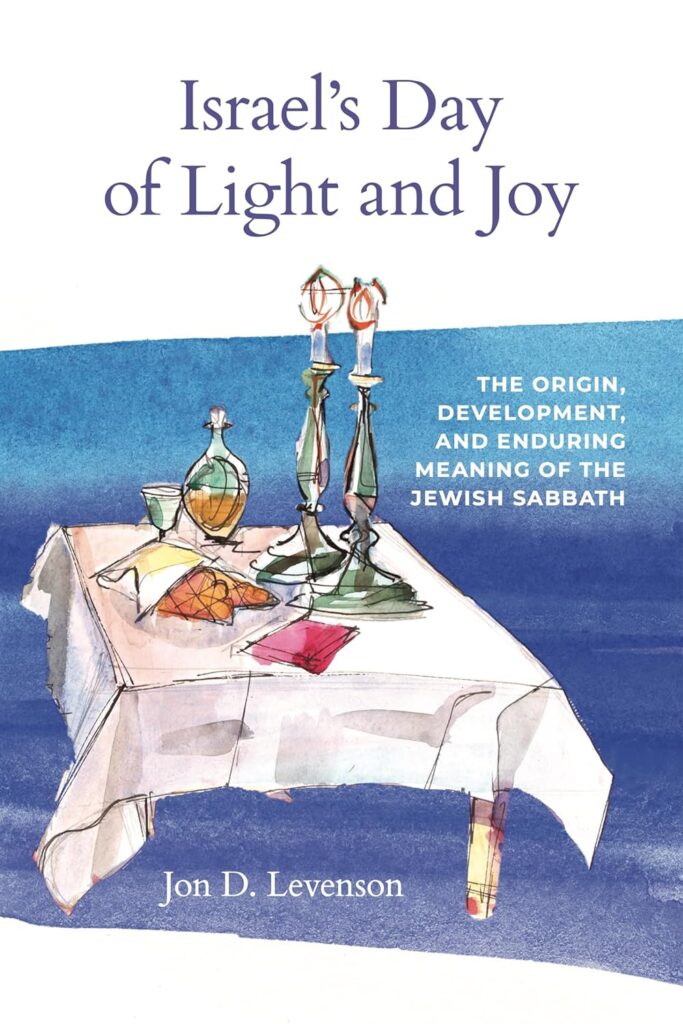
Israel’s Day of Light and Joy:
The Origin, Development, and Enduring Meaning of the Jewish Sabbath
by jon d. levenson
eisenbrauns, 296 pages, $24.95
The Sabbath is making a comeback. Across the West, that most singular and ancient of weekly phenomena—a day marked by the absence of market forces, digital devices, and the manic demands of professional productivity—is enjoying a curious renaissance. The notion that modern individuals desperately need systematic respite from the matrix of expectations and neuroses imposed on them by their world is no longer marginal. Perusing the smorgasbord of self-help gurus, parenting manuals, mindfulness retreats, and decluttering guides, one constantly encounters paeans to the digital detox, frequently termed a “tech Sabbath.”
That highly successful people in the twenty-first century are rediscovering the power, beauty, and necessity of a millennia-old biblical custom will come as a surprise to everyone except those who already observe it. For those of us fortunate enough to live our lives within this propitious rhythm, the only surprising thing about this rediscovery is its belatedness. The blessings of the weekly Sabbath, aptly described by Talmudic rabbis as “one-sixtieth of heaven,” require no elaboration beyond direct experience. The Sabbath’s power has been evident for millennia. Jews across the centuries have undergone every tribulation and oppression dreamt up by humanity. Yet every week, for twenty-four hours, they have returned—liturgically and psychologically—to a state of numinous tranquility. They have rested, they have remembered, and they have affirmed their allegiance to a world in which time itself can be sanctified and the future redeemed. When Ahad Ha’am, a decidedly non-religious Zionist thinker, remarked that “more than the Jews have kept the Sabbath, the Sabbath has kept the Jews,” his exaggeration was, at most, slight.
Given the antiquity and centrality of the Sabbath to both the Jewish and the Christian traditions, it is unsurprising that a number of modern authors have sought to explicate and re-enchant this weekly institution. Perhaps the best-known effort in this vein is The Sabbath (1951), by the neo-Hasidic philosopher Abraham Joshua Heschel. That slim volume, overflowing with fabulously poetic aperçus, invited its readers to taste eternity in the guise of sacred time. As a psychospiritual tour of the Sabbath’s “palaces in time,” it has yet to be surpassed. Honorable mention must also be made of Erich Fromm’s To Have or to Be? (1976), in which the psychoanalyst’s coruscating insights illuminate the Sabbath’s role in counterbalancing the acquisitive instincts of a disenchanted world. Yet our moment, characterized by a profusion of information and an impoverishment of wisdom, demands a reconceptualization of the Sabbath that is both spiritually sensitive and intellectually rigorous, attuned equally to the history and to the phenomenology of this remarkable institution.
Stepping into this role with characteristic erudition and eloquence is my eminent mentor Jon D. Levenson. In an academic world increasingly defined by methodological parochialism, Levenson’s work has always stood apart. He has the rare capacity to harvest from a wide range of academic fields—history, theology, biblical criticism, rabbinics, and philosophy—in service of extensive and penetrating considerations of enduring theological questions. Levenson writes with exquisite religious sensibility, conveying a sense not only of the outer forms of religious praxis but also of the strivings, emotions, and aspirations that accompany them. Israel’s Day of Light and Joy is vintage Levenson, evincing the breadth of scholarship, felicity of articulation, and twinkle-eyed wit with which he has reigned over seminar rooms and lecture halls for many decades.
The early chapters address a set of questions concerning the origins of the Sabbath itself. How and when did this institution arise? Does it appear consistently across the canon of the Hebrew Bible, or are there variants, slowly converging toward coherence? Do analogues exist in other ancient cultures? Levenson leads the reader across the landscape of accepted scholarship, even dipping a toe in the waters of speculation.
His most salient claim is that the šabbāt of the Hebrew Bible may have originated in connection with a Babylonian full moon festival (šabattu), becoming synonymous with the “seventh day” only through a lengthy process of theological convergence and calendrical standardization. He reminds us that the seven-day week itself is a non-natural phenomenon. Unlike the day (solar rotation), month (lunar cycle), and year (earth’s revolution), the seven-day structure appears sui generis. Its only general analogue in the ancient world exists within the Greco-Roman astronomical system, with each day being governed by a celestial body (hence the name of our modern seventh day, derived from “Saturn’s Day”).
Yet for all such similarities, Levenson’s most forceful point is the uniqueness of the theologically freighted biblical Sabbath. Ordained from the start as a moment of sanctity and transcendence, it has no true parallel in any ancient civilization. It is no mere “Day of Rest” (although cessation from work is important), nor is it a tribute to the powers of the planetary spheres that were once invested with deterministic power. Such a pagan cosmology, in Bertrand Russell’s arresting formulation, views humankind as “a small thing in comparison with the forces of Nature,” a pitiable slave “doomed to worship Time and Fate and Death, because they are greater than anything he finds in himself.” The Sabbath stands as a ritualized repudiation of inexorable temporality. The Sabbatical observer declares his faith in a vision of the cosmos in which humanity is not an isolated speck adrift in indifference, but a covenantal being of irreducible significance, bound from inception to God, community, and creation. This paradigm shift, foundational to the biblical revolution, is ratified every week by the imbrication of a non-natural unit of sacred time within an otherwise cosmological calendar. This jarring break functions as a subtle yet transformative simulacrum of the Bible’s insistence on mankind’s unique dual status: as a being confronted at once by both the majesty of a powerful universe and the sovereignty of its all-powerful author.
Levenson devotes much time to comparing Jewish and Christian approaches to the Sabbath, particularly around the question of legal regulation. Rabbinic tradition, from its earliest texts, surrounds the Sabbath with a latticework of prohibitions, customs, and finely wrought distinctions. The act of ceasing from labor, it turns out, requires extensive and exhaustive attention. For many Christian interpreters, this has seemed paradoxical, if not absurd. For how can a day of spiritual liberation be reduced to a list of technicalities? At its worst, this rabbinic normativity is caricatured as a monument to desiccated Pharisaism, overcome by the liberating spiritualization of Christian grace.
Levenson rejects this caricature. Following a venerable line of halakhic thought, he argues that it is through law—precise, enforceable, and shared—that the Sabbath achieves its character. To observe the Sabbath is not merely to embrace a state of mind, but to enter into a communal choreography of rest. The laws of governing the Sabbath, correctly conceived, cannot be dismissed as mere crabbed legalism. Far from hindering spiritual praxis, they underwrite it. This tightly guarded and defined form of rest also safeguards the socio-ethical component of this institution, compelling as it does kings and paupers, seigneurs and peasants, humans and animals, to return to a prelapsarian state of freedom and fellowship. This radically egalitarian state becomes possible only within a matrix of normative constraint. If Heschel rhapsodized about the Sabbath’s “palace in time,” Levenson reminds us that these marvels of spiritual architectonics require floor plans.
As elsewhere, Levenson’s work here demonstrates a deep sympathy with rabbinic interpretations of the biblical texts, as well as with their traditionalist heirs in the medieval and modern canons of Jewish scholarship. Levenson’s competence in these frequently difficult textual traditions, and his sensitivity to their subterranean theological subtleties, are uncommon for a biblical scholar and, indeed, are lacking in some modern theologians. This sympathy leads him not only to oppose the classic Pauline approach to the Sabbath, but also to point out the lamentable failure of various reformist denominations of Judaism to preserve the “essence” of the Sabbath while eviscerating its legal frameworks. Some may view these commitments as a flaw in his analytical approach. Others will count them as a strength and a welcome counterbalance to the pervasive misapprehension that rabbinic hermeneutics are inimical to sound scholarship and reasoning.
The chapter with the greatest contemporary relevance—and the chapter this reviewer wishes could have been more extensive—is this book’s final one, which details the challenges posed by the Sabbath to modernity, and vice versa. Levenson notes that, for Orthodox Jews in particular, the Sabbath now functions as a weekly act of defiance against the instrumentalization of human life. The refusal to use technology, to conduct commerce, or to attend to digital devices forms a profoundly countercultural posture, a theological protest against the mechanization of existence. Highlighting and entrenching Heschel’s observations, Levenson notes that various forms of the “secular Sabbath” bear only the palest semblance to the genuine article. True Sabbath is not a tool for a more efficient Monday. It stands as a reminder that human life and dignity are ends in themselves, imbued with the eternity of the divine image and the attendant obligation to tend to those parts of our lives and personhood that cannot be priced on the market, yet have worth beyond number. In an age of overstimulation, the Sabbath is a rare opportunity to step off the treadmill that claims so much of our time and attention, and dedicate ourselves to restoring our tranquility, dignity, and, ultimately, our humanity.
To be sure, Levenson’s work is hardly the final word on the Sabbath. Some of his historical claims invite further scrutiny, and his alignment with rabbinic traditionalism will perhaps alienate some of his readers. The extent to which the Jewish Sabbath is truly equipped to function as a counterweight to the excesses of twenty-first-century life is a subject that demands more extensive reflection. Yet this book’s great strength is in its aspiration: It dares to treat the Sabbath as neither a museum artifact nor an ethereal phantasm, but as a vibrant historical, theological, and moral institution, with the power to alter individual and communal rhythms of life.
To understand the Sabbath is to grasp something elemental about Jewish history, biblical anthropology, and the metaphysics of time itself. It is to encounter a vision of life in which the world is not merely a field for toil but a garden of repose, to be received in humility and joy. Levenson’s luminous work offers us the best starting point yet for such an encounter. Israel’s Day of Light and Joy is a book worthy of the day it honors.

