Hollywood released quite a few movies about Jesus in the 1960s and ’70s. Not all got rave reviews, and historians would likely say that few of them represent accurately what life was like in first-century Palestine. Only one Hollywood film was made during this time about Muhammad (and none has been made since): The Message, by the Syrian-American director Moustapha Akkad, better known for producing the Halloween horror franchise.
Akkad’s film can compete with any of the Jesus movies for (overly) dramatic acting and sentimentality. It was initially titled Muhammad, Messenger of God. Five days before its 1976 release in London, Akkad received threats from anonymous Muslims. They had heard a rumor that the film showed Muhammad himself, something many Muslims consider forbidden. The rumor was false, but to dispel it Akkad changed the title at the last moment.
The film, which stars Anthony Quinn as Muhammad’s uncle Hamza, has all the sweeping music, long pauses, and British accents of the Jesus movies. In a number of ways, however, it is completely unlike King of Kings or The Greatest Story Ever Told. To begin with, Muhammad is never seen or heard from in the movie (nor are any of his wives or close companions—one sees the famous sword of his cousin Ali in a fight, but never Ali himself). Many scenes have Anthony Quinn, or someone else, looking straight into the camera and talking to Muhammad, but the audience never hears Muhammad’s responses.
In addition, Akkad went to the considerable expense of filming the movie twice: first with English-speaking Hollywood actors (the boxer Muhammad Ali is said to have asked for the role of Bilal, a companion of Muhammad, but was turned down), and then with Arabic-speaking actors (mostly from Egypt). A replica of Mecca was built in Morocco, although the Moroccan government stopped the production before filming was completed. The film was finally finished in Libya thanks to the sponsorship of Muammar Gaddafi.
The Message was a box office flop. Akkad’s team spent $700,000 building their set of Mecca in Morocco and $17 million overall (more than $1 million went to Quinn), but the film made only $5 million. Today, however, it is a favorite of many Muslims for its positive depiction of Islam. Almost everything in The Message is meant to show how much better things became in Arabia when Islam replaced paganism.
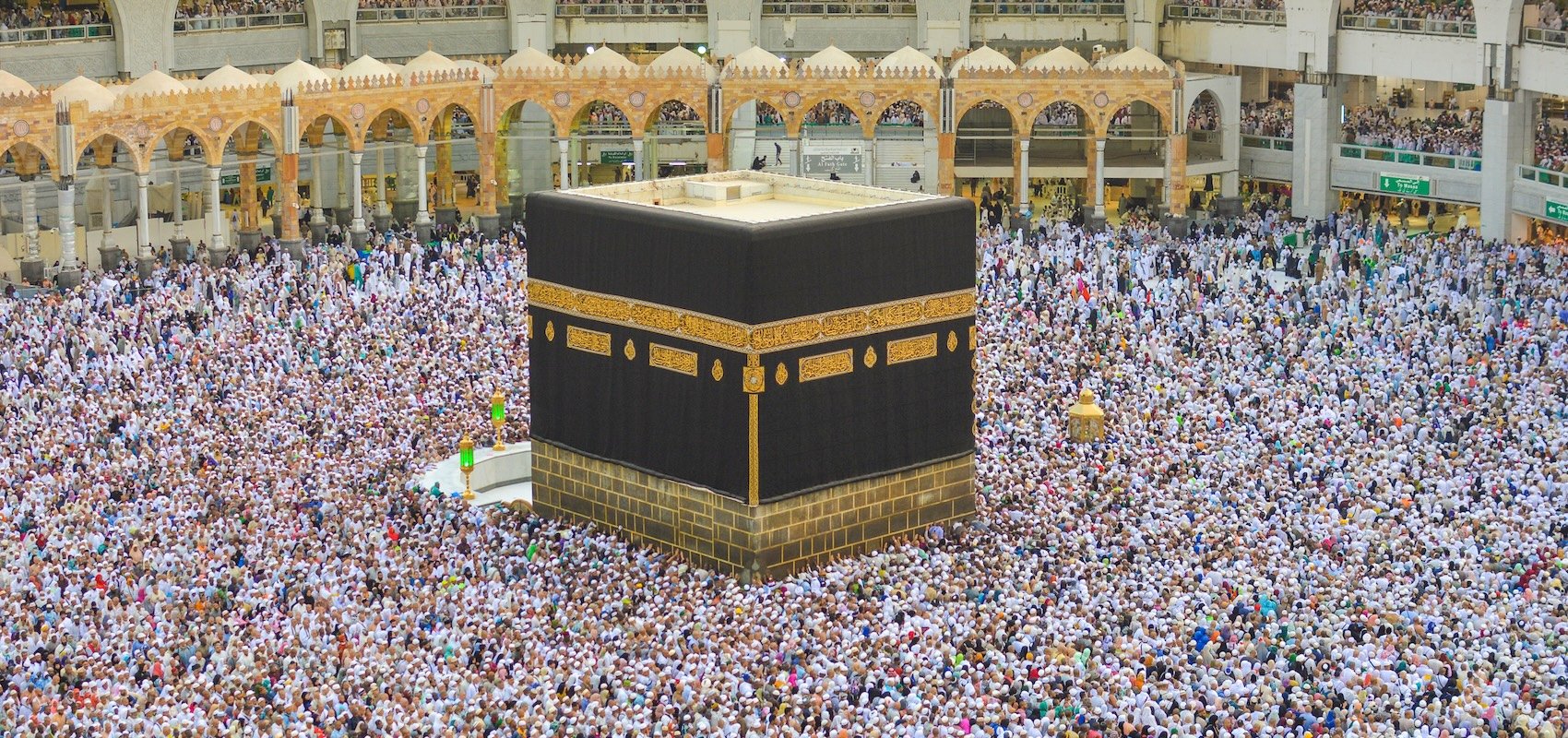
The film opens with Arabian horsemen delivering letters from Muhammad to the Byzantine emperor Heraclius and other world leaders, inviting them to embrace Islam. It then cuts to opening credits (including a declaration that the movie has been approved by the famous Islamic center of learning Al-Azhar). The story itself begins in the heart of Mecca: We see a busy marketplace with stone buildings, including the Kaaba itself, in a small desert town. We hear the deep voice of the narrator:
Six hundred years after Christ died, when Europe was sunk in the dark ages and everywhere the old civilizations were falling, Muhammad was born in Mecca in Arabia. Mecca was then a rich trading city ruled by its merchants, whose wealth was multiplied by a unique privilege: They housed the gods. Every year, at the time of the great fair, the desert priests brought their idols and the images of their gods into the custody of Kaaba. Once the most holy shrine of Abraham, the Kaaba had now become a house of idolatry, hosting no fewer than 360 different gods.
The first conversation in the film is between a Meccan leader known as Abu Sufyan and his companion. They look out from a high point at an idol being brought to the Kaaba, and a group of devotees wiping blood on another idol. When his companion tells him, “This year the gods are gold!” Abu Sufyan responds: “When you put the gods and profit together, you sit very pretty between!” The camera pans to the distance, and a caravan is seen arriving with camels. Abu Sufyan orders his companion to slaughter animals for them, explaining: “Mecca should keep her name for hospitality.” Next we see, rather suddenly, a poet standing on a raised platform with an eager audience all around. The poet, speaking with an upper-class British accent, praises Abu Sufyan in verse: “All revels and all songs begin, / when Abu Sufyan invites the poet in.” Abu Sufyan tosses a bag of coins to him.
This opening scene hits on more or less all the standard ideas about Muhammad’s Mecca. Western scholars, the “Orientalists,” largely accepted and repeated these stories (as long as they did not involve miracles or other sensational details). According to these ideas, at the dawn of Islam Mecca was a pagan city. The Kaaba had been built centuries earlier by Abraham and his son Ishmael (who traveled to Mecca from Canaan) as a shrine to God, but their descendants fell into polytheism and filled the building with idols. Mecca was the center of a vast trading network; its merchants traded in something, presumably spices (though we seldom hear which spices). Mecca’s caravans brought goods north to Syria and south to Yemen over the desert sands. The pre-Islamic pagans thus were greedy, idolatrous, and immoral all at once. (They are said to have buried their daughters alive.) But they were not entirely bad. Their civilization, remembered with the Arabic term jahiliyyah (“the era of ignorance”), also had a vibrant culture of poetry. They valued literary eloquence. So it is all the more impressive that they could not match the eloquence of the Qur’an when Muhammad began to proclaim his divine revelations.
How well does this image of Mecca stand up to the data of the Qur’an? It’s not an easy question to answer, since the Qur’an is a book with few details or descriptions. It is composed as a scripture, to be recited in a liturgical or ritual recitation. The Qur’an is written in rhyme and has many messages about God and humanity, but little information about the world around Muhammad.
Still, there is one thing that is visible in the Qur’an but completely missing from the Mecca of The Message: Christianity. The Qur’an—in the parts concerned with Muhammad’s time in Mecca and in those concerned with his time (the last ten years of his life) in Medina—frequently speaks of Christians and Christianity. And yet, according to The Message, and indeed according to traditional Islamic literature and many Orientalists, neither Mecca nor Medina had Christian communities. The only Christians to appear in The Message are the far-off Byzantine emperor, and the Ethiopian ruler and his court across the Red Sea.
Christians do appear in the traditional Islamic biography of Muhammad. The biography of Ibn Ishaq (d. 768), for example, tells the story of how Muhammad, as a boy, travelled to Syria with his uncle Abu Talib. On the way, a Christian hermit stopped their merchant caravan, insisted on seeing the boy, and found a “mark of prophethood” on his back. When Muhammad had his first revelation at the age of forty on Mount Hira outside of Mecca, he came down from the mountain and, in shock and confusion, sought the counsel and confirmation of his wife Khadija. She expressed her belief in the authenticity of his experience and consulted her cousin Waraqah ibn Nawfal, said to be a Christian. Waraqah declared: “Holy! Holy! Verily by Him in whose hand is Waraqah’s soul, if thou hast spoken to me the truth, O Khadija, there hath come unto him the greatest namus who came to Moses aforetime, and lo, he is the prophet of this people. Bid him be of good heart.” (The word namus is likely from Greek nomos, “law.”)
Reports about Muhammad’s career as a prophet include occasional meetings with Christians. He sent a group of his followers to Ethiopia, and some narrations report that the Christian leader of Ethiopia, called the Negus in Islamic sources, also visited Muhammad in Medina (and converted to Islam). A delegation of Christians from the southern Arabian city of Najran is also said to have met Muhammad in Medina. Muhammad allowed them to pray in his mosque but also debated with them about Christ and even challenged them to some sort of ordeal. The Christians backed down, acknowledging secretly among themselves that Muhammad was a prophet, and accepted the status of dhimmis (tolerated or protected people) before departing for home. A Persian named Salman is said to have converted from Zoroastrianism to Christianity before making his way to Medina, meeting Muhammad, seeing the “mark of prophethood” on Muhammad’s back, and converting to Islam. All of these accounts have Christians openly or secretly acknowledging that Muhammad is a prophet. Presumably this was a way of modeling how “good” Christians should respond to Islamic claims about the new prophet.
According to the traditional biographical story, Muhammad did meet Christians—but not in the context of a Christian community in Mecca or Medina. All of these reports of Muhammad’s meetings with Christians involve a lone individual such as Waraqah or Salman, or Christians who lived outside of Arabia (or at least outside the Hijaz, Muhammad’s region)—such as the hermit, the Negus, or the delegation from Najran. But why does this matter? Where’s the problem?
The problem is with what the Qur’an says about Christians. The Qur’an not only speaks about Jesus, or about priests and monks; it also speaks to Christians. Various qur’anic passages are responses to Christian arguments, or bits of advice to Muslims on debating Christians. In other words, it seems very possible that there were Christians around the qur’anic author making arguments for the truth of their faith, and challenging the claims of the new community.
Surah 5:72 declares:
They are unbelievers who say, “God is the Messiah, Mary’s son.” For the Messiah said, “Children of Israel, serve God, my Lord and your Lord. Verily whoso associates with God anything, God shall prohibit him entrance to Paradise, and his refuge shall be the Fire; and wrongdoers shall have no helpers.”
Now it is possible that this sort of doctrinal critique of Christians (put in the mouth of Jesus himself!) is only theoretical—perhaps the Christians who “said” this sort of thing were far, far away. Maybe they were in Syria, Ethiopia, or Constantinople. But it also possible that they were close by, and the Qur’an’s author is worried about the influence they might have on his new community.
Earlier in this chapter we find another statement attributed to both Christians and Jews. Again, the Qur’an offers advice on how a Muslim should respond: “Say the Jews and Christians, ‘We are the sons of God, and His beloved ones.’ Say: ‘Why then does He chastise you for your sins? No; you are mortals, of His creating; He forgives whom He will, and He chastises whom He will’” (5:18). The logic is pretty simple: You, Jews and Christians, are suffering misfortunes (perhaps defeats at the hands of Muslims). If you were God’s beloved ones, he would not allow this to happen to you.
These kinds of verses suggest that the qur’anic author was responding to sectarian pressures. There was, it seems, an open religious marketplace in Mecca and Medina. The qur’anic author was seeking to make space for his new community in this marketplace. No doubt both Jews and Christians, who agreed that the age of prophecy had come to an end, were skeptical about the claims of a new prophet.
The idea that there were Christians in Mecca and Medina, despite their absence from the traditional Islamic story, is the central argument of my new book, Christianity and the Qur’an. It will not go unchallenged, since generations of scholars have accepted the tradition that Mecca was pagan and Medina had three Jewish tribes (at least, until they were eliminated) but no Christians. And yet, from a historical point of view, it would be surprising if there were not Christians in these cities by the seventh century. We know from the records of various ecclesiastical synods, from the Arabic names of Christians in pre-Islamic chronicles and in theological texts written in Greek and Syriac, and from pre-Islamic Christian Arabic rock inscriptions, that many Arabic speakers had become Christian by this time. Christianity was expanding in the East throughout late antiquity. Some imagine that the late antique Eastern Church was decadent and corrupt, worried only about fights over Christology or the ornate vestments of priests and bishops. The truth, however, is that the Eastern Church burned with zeal for missions.
Many Eastern scripts, including Armenian, Georgian, and quite possibly Arabic, were developed by Christian missionaries who were eager to write the Gospels, the Psalms, and liturgical texts in the languages of the peoples they were evangelizing. Princeton professor Jack Tannous, author of The Making of the Medieval Middle East, has emphasized how significant the missions of the Eastern Church were during this period, stretching into Nubia in Africa and all the way east to China. Is it likely that the missions did not reach Arabia? Mecca and Medina are much closer than Nubia and China to the Christian heartlands of the Middle East.
That Jews and Christians were indeed debating with the new believers at the time of the Qur’an’s composition is evident from a series of verses that seem to model how one should deal with them. Surah 29:46 tells the new believers how to debate with Christians:
Dispute not with the People of the Book save in the fairer manner, except for those of them that do wrong; and say, “We believe in what has been sent down to us, and what has been sent down to you; our God and your God is One, and to Him we have surrendered.”
Surah 3:64 similarly opens with the declaration: “Say: ‘People of the Book! Come now to a common word between us and you.’” This verse is sometimes used as an example of religious compromise or agreement, as though the call for a “common word” were a call for some sort of theological meeting of minds. The open letter of a group of Muslim leaders, written in response to Pope Benedict’s 2006 Regensburg address, was given the title A Common Word. The authors, insisting that “the future of the world depends on peace between Muslims and Christians,” saw this verse as a guide to achieving that peace: Muslims and Christians could agree on a “common word.”
The problem with the letter, or at least with its title, is that the Arabic of this qur’anic verse may not actually denote a “common” word (that is, something Muslims and Christians agree on) but rather a “balanced [or reasonable] word” (Arabic sawa’). If one reads further, it becomes clear that this “reasonable” word is the Islamic teaching about God and, implicitly, not the Christian teaching about God. The verse continues: “that we serve none but God, and that we associate not aught with Him, and do not some of us take others as Lords, apart from God.”
I do not mean to call into question the importance of the letter from the Muslim leaders. The authors did seek out a positive dialogue with Christians, and indeed they quote frequently from the New Testament. But the right reading of the “common word” verse reveals again that the qur’anic author was working in a sectarian milieu, concerned with countering and undermining Christian arguments, and counseling believers about how they should act when they got into debates with Christians. Notably, the end of Surah 3:64 gives some debate advice (once again): “And if they turn their backs, say: ‘Bear witness that we are Muslims.’”
The very next verse of Surah 3 seems then to offer to Muslims a suggestion, or an example, of another topic on which they can debate with Christians (and Jews): “People of the Book! Why do you dispute concerning Abraham? The Torah was not sent down, neither the Gospel, but after him. What, have you no reason?” (3:65).
These days people like to speak about the “Abrahamic religions” and say things like “Abraham is the father of Judaism, Christianity, and Islam.” This qur’anic verse, however, does not speak of commonality, and certainly not of “Abrahamic religions.” Instead, it stakes an exclusive claim to Abraham. Paul in Romans 4 presents Abraham as an example of the importance of faith, as he was deemed righteous by God by believing, not by observing the Mosaic law (which had not yet been revealed). In Surah 3 the author insists that Abraham was submissive (muslim, in Arabic), and neither a Jew nor a Christian. How could he be a Jew or a Christian, Surah 3:65 suggests, if Moses and Jesus lived after him? Surah 3:67 puts things more plainly: “No; Abraham in truth was not a Jew, neither a Christian; but he was a Muslim and one pure of faith; certainly he was never of the idolaters.”
While the Qur’an alludes here to both Judaism and Christianity, other passages bespeak a particular concern about Christianity, or rather about Christian apologetic arguments. The Qur’an, for example, tells the story (known in Christian tradition from the Infancy Gospel of Thomas) of Jesus bringing a clay bird to life with his breath (3:49). This story in Christian tradition is designed to show Christ’s divinity: God created Adam from dirt and brought him to life with his breath; Jesus created a bird from dirt and brought it to life with his breath. The qur’anic author, as though eager to take the sting out of the Christian apologetic argument, has Jesus himself say that he does this miracle only “with the permission of God.”
Not everything in the Qur’an is polemics and apologetics. There are a few remarkable passages that reflect, in a positive way, the presence of Christian communities in the immediate vicinity of the qur’anic author. Surah 22:40 declares: “Had God not driven back the people, some by the means of others, there had been destroyed cloisters and churches, oratories and mosques, wherein God’s Name is much mentioned. Assuredly God will help him who helps Him—surely God is All-strong, All-mighty.”
This verse points to the presence not only of churches, but also of monasteries or cloisters (the Arabic word, sawami‘, likely comes from the Ethiopic term for a monk’s cell). Even more, it speaks of them as good places, places where “God’s name is much mentioned.”
This is not the only such passage in the Qur’an. One of most beloved verses is the “Light Verse,” which seems to describe God with a sort of parable. The parable of the Light Verse may be based on imagery associated with a church or a monk’s cell:
God is the Light of the heavens and the earth; the likeness of His Light is as a niche wherein is a lamp (the lamp in a glass, the glass as it were a glittering star) kindled from a Blessed Tree, an olive that is neither of the East nor of the West whose oil well nigh would shine, even if no fire touched it; Light upon Light; God guides to His Light whom He will. And God strikes similitudes for men, and God has knowledge of everything (24:35).
The Light Verse is frequently found in calligraphic Arabic on the walls of Muslim living rooms, or carved into the lamps that hang from the ceilings of mosques. Its references to a burning lamp, to oil, and to an olive tree are intriguing and mysterious. Since the verse is famous for its own sake, it is not always connected to the verses that follow. But that is precisely where the Light Verse is explained:
In temples God has allowed to be raised up, and His Name to be commemorated therein; therein glorifying Him, in the mornings and the evenings, are men whom neither commerce nor trafficking diverts from the remembrance of God and to perform the prayer, and to pay the alms, fearing a day when hearts and eyes shall be turned about, that God may recompense them for their fairest works and give them increase of His bounty; and God provides whomsoever He will, without reckoning (24:36–38).
The light of the Light Verse, these verses explain, is a reference to the light, or the lamps, found “in temples” (literally, “houses”) in which God’s name is commemorated and glorified, in the morning and the evening. The men who live in these houses, or temples, do no commerce or trade. Who could these men be? There is no Islamic sabbath, when Muslims stop all work in order to glorify God, and there is no Islamic monasticism. (A famous hadith has Muhammad say: “The monasticism of my community is the jihad.”) These men who live in houses that God “allowed to be raised up,” and who pray to God, “in the mornings and the evenings,” and who are not concerned with commerce, are almost certainly Christian monks.
In some passages, then, the Qur’an insists on the importance of churches and monasteries (22:40) and seems to present monks as an example of faithfulness to God (24:36–38). In other passages the Qur’an challenges Christian teaching and even anticipates specific arguments for Christ’s divinity. In other words, the qur’anic author wants his audience to emulate the piety of Christians, but not accept their teaching. Both sorts of passages offer evidence that Christians were not on the margins of Arabia when Islam began to emerge in Mecca and Medina. They were in Mecca and Medina.
This insight means that we should rethink the early history of Islam. It does not mean, of course, that Muhammad was secretly Christian or that Muslims have misunderstood his message. On the contrary, the Qur’an clearly has a negative assessment of Christian theology. It offers a different view of God and of his relationship with the world, centered on its claims about Muhammad. The qur’anic author was aware of Christians in his audience and was intent on making the case to them that a new prophet, with a new message, had been sent by God. Nevertheless, the world in which Islam emerged was not pagan. It was a Christian world.
This understanding helps us to ascertain better the task before the Qur’an’s author. Christians (and Jews) in late antiquity believed that God would send no new prophet. The Qur’an is a scripture meant to counter this belief, to make space for a new prophet in the religious marketplace of late antiquity. Accordingly, when students of Islamic studies consider what the world of the first Muslims was like, they should not think of pagans smearing blood on idols. They should think of Jews and, especially, of Christians.
Image by Adli Wahid, licensed via Creative Commons. Image cropped.