
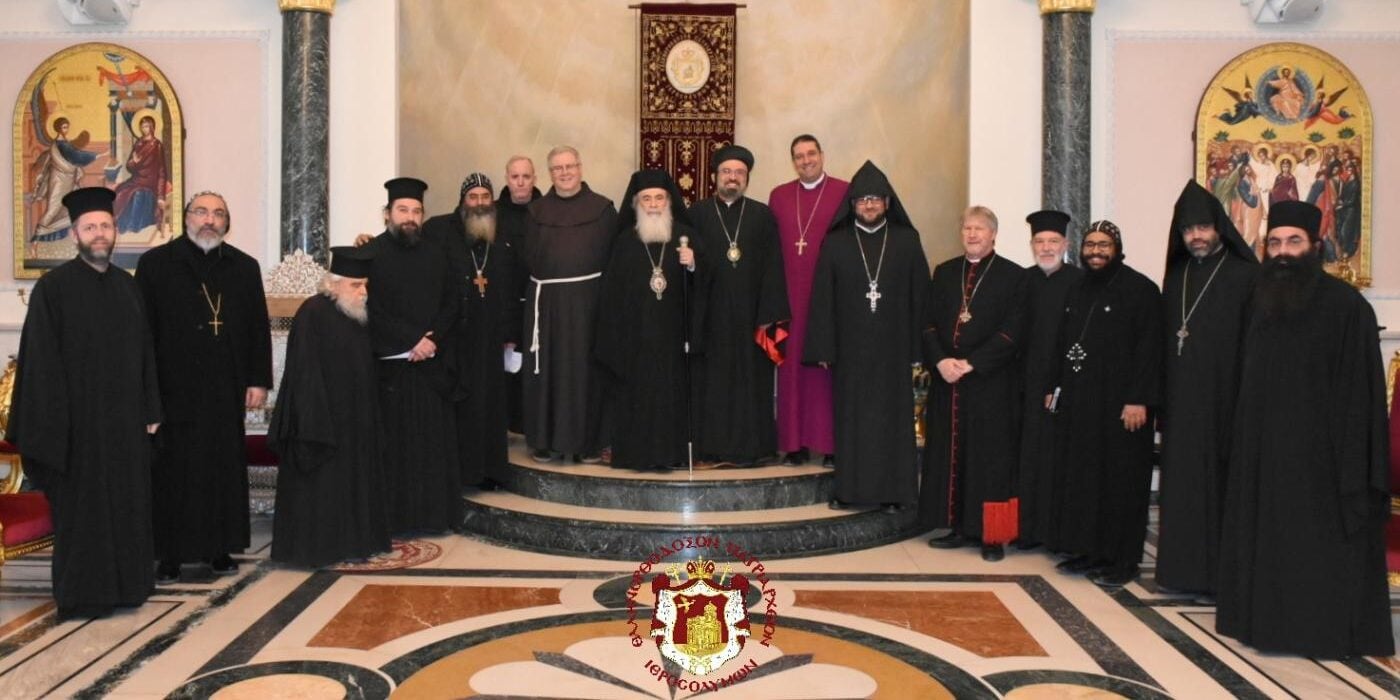
On January 17, the Patriarchs and Heads of Churches in the Holy Land, including the Latin Rite Roman Catholic Church, issued a statement condemning “Christian Zionism.” The statement advances three claims: first, that the Patriarchs alone represent the “historic churches” and Christian communities of the Holy Land; second, that certain “local individuals” promote damaging ideologies, particularly Christian Zionism; and third, that these ideologies have found support among political actors in Israel and abroad, thereby threatening the Christian presence in the Holy Land and the wider Middle East.
The concerns raised are serious and, in important respects, legitimate. Yet the statement’s imprecise terminology and unexplained omissions weaken its effectiveness and risk obscuring the very issues it seeks to address.
There are also puzzling features of the document itself. The signatories are not listed and not all the Churches have published the statement on their official websites. This contrasts with a similar statement issued by the Patriarchs in 2006, which was signed, more carefully framed, and explicitly directed against extreme forms of Christian Zionism—those that undermine the possibility of a just peace between Israelis and Palestinians. That earlier statement at least suggested that not all Christian Zionisms were identical.
The core concerns of the 2026 statement are legitimate. The current Israeli government includes religious Zionist figures such as Itamar Ben-Gvir and Bezalel Smotrich, who claim that Gaza and the West Bank belong to Israel and who envision the departure of Palestinians from these territories. Were such views to prevail, the likely outcome would be the disappearance of Arab Christian communities from the occupied territories. (Christian populations within Israel proper remain relatively stable.) These religious Zionist ideologies tend to make little distinction between Christian Arabs and Muslim Arabs. Their strand of Jewish religious Zionism, drawing on the theology of figures such as Rav Tzvi Yehuda Kook, is also explicitly hostile to Christian presence in Israel.
These concerns are intensified by the influence of American Christian Zionists, especially in the United States. Their political reach is substantial, and the appointment of a Christian Zionist such as Mike Huckabee as U.S. ambassador heightens fears that Jewish religious Zionists and foreign Christian Zionists together exercise disproportionate influence over policy affecting local Christian communities.
Yet if this alignment is the central concern, the statement raises questions it does not address. Why does it single out Christian Zionism while remaining silent about political Islamist ideologies that also seriously threaten Christian life and institutions across the region? Further, it falsely presumes all Christian Zionists hold the same theological and political views.
Figures such as Ihab Shlayan, an Armenian Christian Israeli Zionist, long-serving IDF officer, and chairman of The Israeli Christian Voice, illustrate the complexity the statement overlooks. Or the Jewish Catholic Zionist Yarden Zelivansky, also an IDF member who established the Association of Hebrew Catholics in Israel. Shlayan is connected to Israeli and American political actors but has not been endorsed by Armenian Church authorities. He may be resented for appearing to speak on behalf of Christian communities. This could explain the statement’s vague reference to unnamed “local individuals,” but it also underscores the diversity concealed by the term “Christian Zionism.”
This leads to the central difficulty: The term “Christian Zionism” is used far too broadly. It presents a flattened and misleading picture of a diverse phenomenon. There are many Christian Zionists, myself included, who reject extremist political agendas and support a two-state solution (but are open to other models). They are deeply concerned about the survival of Palestinian Christian communities, whether threatened by Israeli policies or mainly by the rise of political Islam. There are Anglican Zionists, like Gerald McDermott, who, like me, reject evangelical dispensationalism and work within a post-supersessionist theology. To classify all Christian Zionisms as “damaging ideologies” is both poor theology and obscures the big issues.
A second major omission is the statement’s silence regarding Jewish–Christian theological developments, particularly post-supersessionist teaching within Churches represented by the Patriarchs themselves. By saying nothing about the Jewish people or about the theological legitimacy of Jewish attachment to the land, the statement risks alienating Jews and Christians committed to post-supersessionist theology. It leaves unanswered a fundamental question: Is there any legitimate place for Israel at all, or is Zionism—Jewish or Christian—understood solely as a project of colonization and empire-building? This silence is especially striking given that the Latin Church formally recognizes the State of Israel and consistently supports a two-state solution grounded in natural law.
The situation in the Holy Land is complex and fragile. The statement rightly identifies genuine dangers facing Christian communities. But by employing imprecise language, overlooking crucial distinctions, and leaving key theological and political questions unresolved, it misses an opportunity for genuine peacemaking and bridge-building. Instead, it risks generating unnecessary controversy—fireworks that distract rather than illuminate—at a moment when clarity, nuance, and careful dialogue are urgently needed.

YOU MIGHT ALSO LIKE
Turned Away on Palm Sunday
In politics, diplomacy, war, or pretty much any field of human interaction, one must contend not only…
Via Crucis, 2026
The Way of the Cross—and the third, seventh, and ninth stations in particular—has been an especially appropriate…
A Medieval Pilgrimage in Modern Assisi
When you go to the hilltop town of Assisi, you’re immediately struck by how medieval it is:…
