
When Technoblade, a popular Minecraft streamer, announced his cancer diagnosis in August 2021, the outpouring of support was immense. Though millions of viewers had never met him in person, they felt as if they had. “Does anyone else get that grief still?” asked a much-read Reddit thread a few years after he died. One commenter wrote that, even though he rarely watched Technoblade, the grief was real. The world would never be the same again.
Parasocial relationships—one-way, screen-mediated, ersatz intimacies—are shaping Gen Z in ways we are only beginning to understand. From the rise of finstas (secondary Instagram accounts where users post more personal, unfiltered content) to ceaseless online commentary lamenting the paucity of real-life relationships, it’s clear that Gen Z craves authenticity and connection. And yet members of Gen Z are more likely than those of older generations to bail on commitments and reflexively distrust the very peers they long to connect with. This simultaneous craving for, and retreat from, the real is symptomatic of a crisis of belonging produced by dependence on digitally mediated communication.
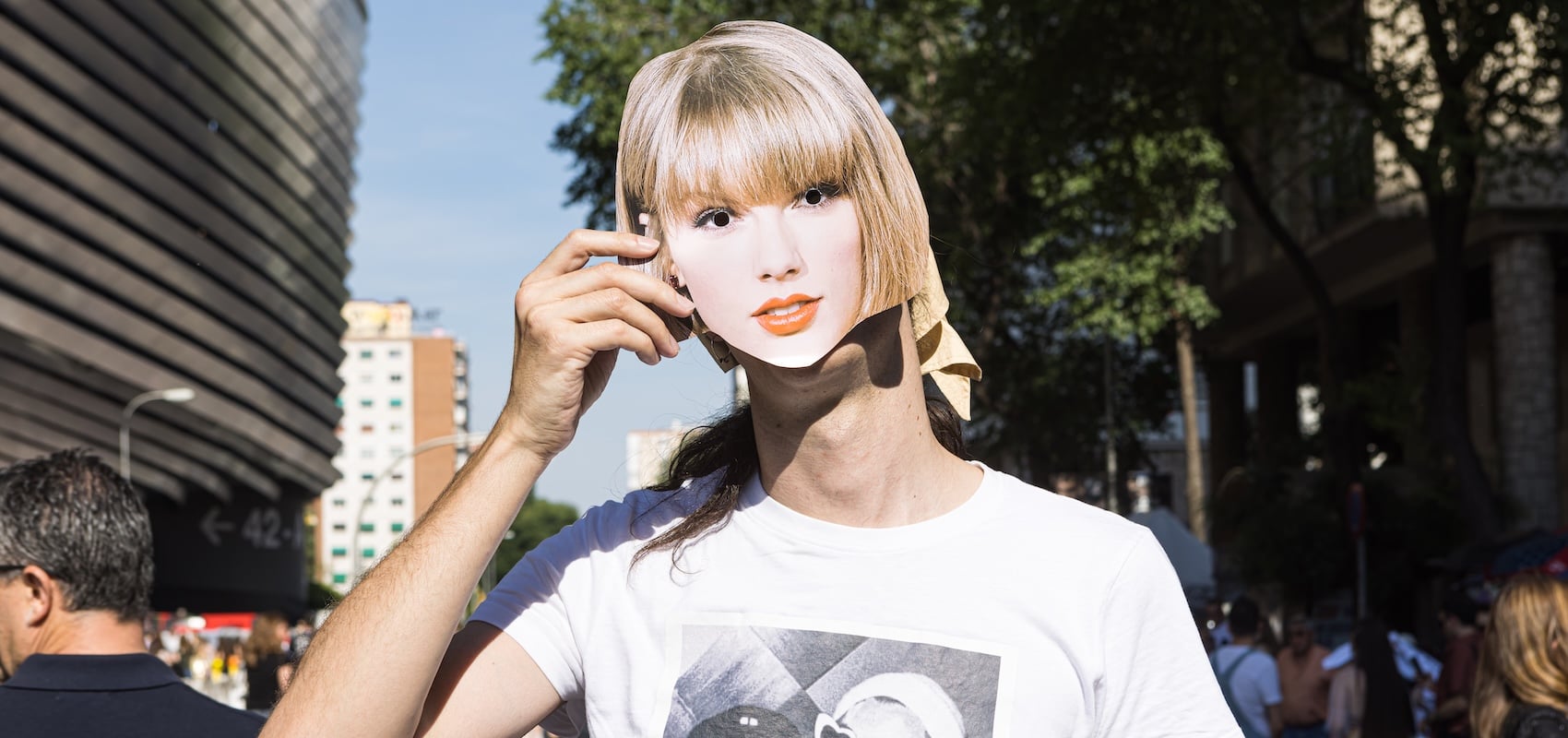
In 1956, Donald Horton and R. Richard Wohl observed that modern mass media creates the illusion of face-to-face intimacy with performers (“personas”). The persona cultivates familiarity with his audience, becoming a friend, counselor, and model to people who have never met him. Today, “parasocial” dynamics are visible in livestream culture, where creators simply hang out together in front of an audience, or in the devotion of Taylor Swift’s fans, who, having never met her, nonetheless feel they know her intimately. Artists like Swift achieve this effect through personal storytelling, offering identity and exclusivity, and exhibiting a deep desire to work hard for their fans. For fans who are socially isolated, this illusory intimacy produces what Horton and Wohl call “extreme para-sociability,” the condition in which the parasocial becomes a substitute for real relationships, rather than merely a supplement.
Jean Baudrillard’s account of “hyperreality” helps to explain the context in which parasocial dynamics readily develop. The mass media images we consume begin as reflections of reality but come progressively to distort it; reality recedes behind a mask of images, until only the images remain. Hyperreality, he argues, emerges from a world of ever-increasing information and ever-diminishing meaning. The dynamic is cybernetic: The system’s outputs are recycled as inputs. Misrepresentations of reality inform our actions, which are then, together with the world they produce, misrepresented in media, thereby informing our future actions (and the future media we consume). Each cycle of feedback deepens the substitution of reality with simulacra.
Hyperreality, which emerged together with mass media, is the environment in which parasocial relationships become possible. Social media, however, supercharges hyperreality, thereby metastasizing the parasocial. The loss of real meaning inevitably translates to the loss of real relationships. Gen Z’s desire for intimacy coincides with its desire for authenticity. But intimacy requires trust, which entails risk. Parasocial relationships involve no risk at all. Indulging in them makes us ill-equipped for the messiness of real relationships, which require us to accept, even to love, differences.
Digitally mediated communication flattens the visible markers of hierarchy, distance, and difference—age, authority, physical presence, social position—that structure real-world relationships. Online, the distance between a fan and a celebrity, a young man and a political commentator, a teenager and a popular streamer, appears to collapse. This is an illusion. But because hyperreality is cybernetic, the illusion is fed back into the system and begins producing real effects. The felt collapse of distance conditions us to expect that distance—social, hierarchical, relational—doesn’t really exist. And when that expectation is carried offline, it corrodes the actual structures that make genuine relationships possible.
We lose our calibration for authority, for earned trust, for the kind of deference that makes mentorship and genuine community possible. We bring to our actual friendships and communities the same leveled, frictionless expectations we’ve developed online, and real relationships, which require patience, obligation, and discomfort, feel deficient by comparison. Loneliness and isolation deepen. And so we return to the hyperreal with even greater need for connection, investing more of ourselves in the parasocial—which further degrades our capacity for the real. Is it any wonder that digitally native Gen Z is the loneliest generation on record?
According to research by Eric Kaufmann, only 8 percent of Americans under thirty-five trust other people, and only 8 percent trust the government. This erosion of trust is partly traceable to well-documented institutional failures—the Iraq War, the 2008 financial crisis, COVID, the collapse of legacy media’s credibility, higher education’s false promise of upward mobility. More alarming than the loss of institutional trust is the loss of interpersonal trust. Individual trust isn’t something you can just have; it’s built, slowly, through the friction of real relationships. When most of one’s relational life is conducted through a digital ecosystem that performs closeness without cost, that building process never really begins.
The consequences are concrete. Gen Z has become low-commitment: Plans are easily canceled, obligation is regularly subordinated to personal comfort, and the cultivation of “authenticity” often trumps the demands of friendship. At work, the rise of “quiet quitting” reflects a lack of meaningful connection to employers and colleagues. In the short run, parasocial relationships cost nothing, making the cost of real relationships seem prohibitive. In the long run, however, the cost couldn’t be higher, for both individual and society.
Kaufmann’s research on the audiences of figures like Nick Fuentes and Candace Owens bears this out. The people drawn to conspiratorial populism are rarely ideological extremists. A disproportionate share is young, nonwhite, and socially dislocated. Members of this “floating conspiracy vote,” as Kaufmann calls them, are drawn parasocially to media personas savvy enough to fill the vacuum left by the collapse of communities and mainstream institutions.
The answer to parasocial belonging is not reaction but reorientation—a deliberate recovery of the conditions that make genuine relationships possible. In other words, we need to touch the Church. The Church can’t merely be a venue for loose participation. It needs to be tangible—a real-life community connecting with real-life people.
This is where the Church, at its best, offers something the digital ecosystem structurally cannot: intergenerational community. The importance of this cannot be overstated. When a twenty-five-year-old sits in a congregation alongside a seventy-year-old, when younger men are mentored by older men and younger women by older women, something is happening that is genuinely countercultural: The feel for hierarchy is being restored. Real difference becomes tangible. Sociologically, this amounts to “touching grass,” recalibrating the self in relation to others.
When I was a new Christian in college, there was an eighty-year-old man who would take me fishing in the heart of the Adirondack Mountains. Those were some of the most formative times in my development. He offered perspective from a life well lived, and enabled me to process outside of the digital simulation.
In this light, the tendency of young believers to seek out congregations that “feel” authentic or offer the right aesthetics can prevent them from experiencing intergenerational depth. It imports the consumerist logic of the parasocial into the one institution best equipped to resist it. Even high church liturgy—the formalism of which more concretely connects worshipers across time—can be consumed as a product if we exit the moment it ends.
If Gen Z is to experience real belonging, it must first recover its necessary conditions: presence, obligation, difference, and time. These are not programmatic solutions. They are the natural features of genuine community—features that the hyperreal systematically obscures and that only intentional, embodied, intergenerational life can restore.
Parasocial belonging is not going away. The personas know how the game is played, and they play it well. But as Gen Z discovers the limits of the simulacrum, the Church has an opportunity to offer what no algorithm can manufacture: the real thing.
Image by David Benito / Getty Images Entertainment via Getty Images.
