
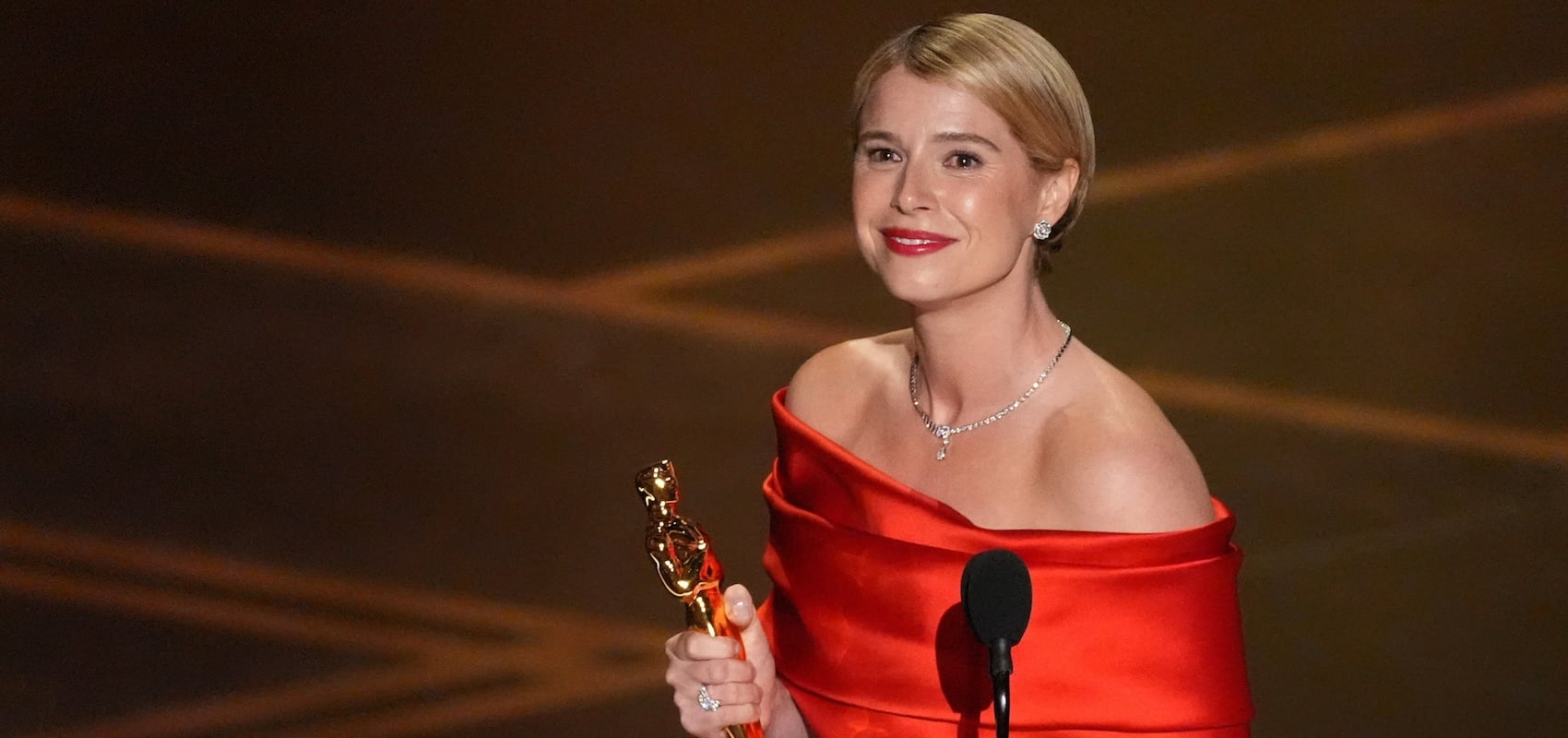
On Sunday night, while accepting her Academy Award for Best Actress, Hollywood star Jessie Buckley spoke lovingly of her baby daughter who had “no idea what was going on” and was “probably dreaming of milk.” She told her husband that she loved him and wanted to have “20,000 more babies” with him, and ended her speech by dedicating the award to “the beautiful chaos of a mother’s heart.” The audience whooped and cheered.
The moment was striking. In 2020, when actress Michelle Williams stood on a similar stage at the Golden Globes to receive an accolade for her performance, she used the opportunity to celebrate her abortion for allowing her the opportunity to advance her career. The message was clear: You can either hold a baby or a trophy.
That narrative has been perpetuated in the media for decades. When motherhood is mentioned, it’s often to spotlight the very worst moments that parents can face in the trenches. Recently, a widely-read The Cut article titled “I Regret Having Children” featured stories from mothers who openly questioned whether they would choose parenthood if they could go back in time. Around Mother’s Day in the U.K. this month, a BBC article amplified voices saying that motherhood can feel like “a trap you can’t escape.”
This emerging focus on maternal struggle is not necessarily unwarranted. The early years of parenting can be isolating and difficult for many, and addressing this reality is important in order to help women find the support they need. Up to 15 percent of new mothers suffer from postnatal depression. Nobody is diminishing the real impact motherhood can have on one’s sleep, one’s sense of control, one’s career. But when isolated stories of women at their lowest moment become the dominant cultural narrative of what “being a mother” is like, the narrative becomes unhealthily imbalanced.
That imbalance didn’t arise in a vacuum. Powerful cultural forces have long called for adults to extend adolescent frivolity into their twenties and thirties and downplayed the social value of raising children. In 2013, Time magazine’s cover story showcased the “Childfree Life,” which presented life without children as a form of liberation and self‑actualization. That messaging cut across media, shaping a cultural script in which motherhood was framed as an impediment to autonomy.
Sex and the City, for example—one of the most influential cultural texts of the late 1990s and early 2000s—showcased four glamorous, high‑achieving New York women living hedonistic, self-focused lives without children. When motherhood entered the narrative, it was purposefully mocked as a comedic tool to underscore the glamour and freedom of the other women, unburdened by a baby.
In societies where motherhood is primarily portrayed as a drain on ambition or a source of identity loss, it should surprise no one that birth rates dip well below replacement levels. The U.S. fertility rate rests around 1.6 children per woman (below the replacement rate of 2.1), and in much of Europe the figure is lower still—around 1.2 to 1.5 in countries like Italy and Spain. This year, the U.K. will likely, for the first time, see more national deaths than births. Across the West, women typically say they would like two or more children, but social mores and cultural pressures often postpone or cancel those hopes, resulting in most women having fewer than they want.
Demographic research makes clear that financial incentives alone do not reverse these trends. Hungary, for example, spends roughly 5 percent of its GDP on family subsidies and other financial incentives to promote childbearing, yet fertility rates remain stubbornly below replacement. What drives reproductive decisions is culture: whether society communicates that raising children is meaningful, prestigious, and central to adulthood. Where motherhood is admired, birth rates are higher; where childlessness is glorified, birth rates fall.
Falling birth rates can have catastrophic consequences by creating an aging population, putting pressure on the economy to provide for the needs of the elderly without the broad productive shoulders of a younger generation. But the benefits of having children aren’t only societal. Married mothers are nearly twice as likely to report being “very happy” compared to single, childless women, and are half as likely to report being lonely. While career accolades may satisfy in early life, few wish to reach their deathbed surrounded only by shiny trophies. Children are one of the greatest assets to invest in in life, with the care invested at the start being repaid in kind at the end.
That’s why a moment like Buckley’s speech matters. It doesn’t erase the complexity of motherhood, but it does affirm motherhood as something worthy of public admiration. In a media cycle too often fixated on the hardships of parenthood, giving motherhood a podium is a much‑needed rebalancing, a gesture of cultural respect for the work that literally sustains our civilization.
Image by Chris Pizzello/Invision via AP
