
The great boxing spectacles of the past—the Thrilla in Manila (1975) and the Rumble in the Jungle (1974)—were never merely athletic contests. They were cultural dramas staged on global terrain. Rumble in the Jungle, in particular, captured a transforming American moment at the height of the civil rights era. For Muhammad Ali, the bout in Zaire was not simply a payday but a moral narrative: a reclamation of identity, geography, and historical meaning.
Boxing has long carried this symbolic weight. Max Schmeling’s fights with Joe Louis in the 1930s came to embody the struggle between Nazi Germany and democratic America. Geography mattered as much as the fighters themselves; Ali’s journey to Africa was as important as the punches he threw. Boxing’s stages have always amplified its myths.
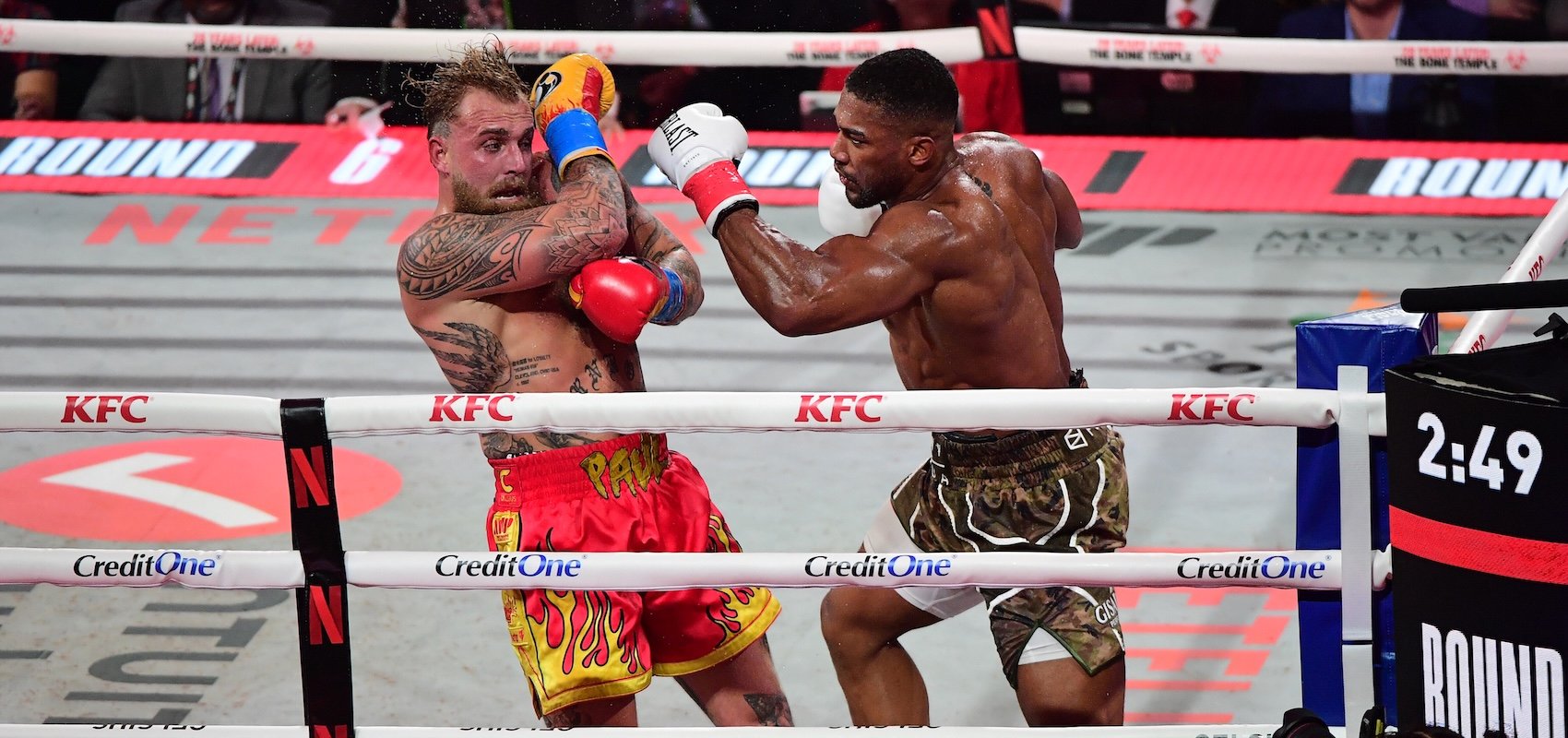
Against that backdrop, the recent Jake Paul–Anthony Joshua bout, streamed live on Netflix, could be called The Madness in Miami, or, with equal accuracy, The Money in Miami. YouTube sensation Jake Paul was the star attraction. Crossover bouts have become a reliable financial mechanism, and this one was no exception. Netflix’s subscriber ambitions alone justified the investment. Boxing has always been blunt about economics; boxers are “prizefighters.” Unlike athletes in salaried sports, boxers negotiate their livelihoods bout by bout, so money talk never leaves the frame. Gambling promotions saturated the event. Paul gifted himself a custom Ferrari Purosangue before the fight. None of this was peripheral to the spectacle; it was the spectacle.
The athletic stakes were modest. Few doubted Joshua’s victory. The intrigue lay only in how long Paul would last, and whether he could survive the scheduled rounds. The matchup lacked the narrative tension of Ali–Foreman or Holyfield–Tyson. What was striking instead was the muted atmosphere in the city itself. The hype for Paul–Joshua existed less in the streets than online, signaling a transformation in how public events now circulate.
Geography matters here in another sense. Miami is not merely where the Florida Athletic Commission licensed the bout. It is a city that epitomizes flamboyance, glitz, and influencer culture. Over the past decade, Miami has become the unofficial capital of the social-media generation, a place where aspirants curate identities through nightlife, bayfront vistas, and highly Instagramable neighborhoods like Brickell and Wynwood. Visibility itself functions as currency. Miami fuses entertainment and finance in a distinctly twenty-first-century form of American capitalism.
Jake Paul is the exemplary figure of this new economy of fame. For those outside his generational cohort, his appeal can seem opaque. Juvenile videos, brand partnerships, and energy drinks nonetheless translated into boxing notoriety through victories over faded names and a shrewd grasp of algorithmic attention. Mocked by critics as “Fake Paul,” he embraces the label. “YouTubers run the world,” he insists. “We are the new modern-day A-list celebrities.” Paul’s self-myth also speaks to a changed world of work. When legitimacy is harder to inherit from institutions, it must be performed, narrated, and monetized. For young men facing narrowing pathways, Paul offers a seductive promise: relevance without apprenticeship.
Influencer boxing emerged from this logic. Paul’s brother Logan popularized the form through a rivalry with British streamer KSI, converting digital antagonism into a monetized physical contest. These crossover bouts reveal something enduring about boxing. Even in an era dominated by MMA, boxing remains the symbolic arena for resolving disputes. In a culture saturated with callouts and feuds, it functions as ritualized resolution. Boxing also retains an aesthetic language; Ali’s “float like a butterfly, sting like a bee” still lingers in cultural memory.
Traditional boxers have had to adapt. Self-promotion is not new, but today’s fighters must maintain an entire aesthetic ecosystem. Anthony Joshua, despite emerging from a grittier North London milieu, has been drawn into this economy.
On fight night, the Kaseya Center revealed how spectacle has changed. Audience members filmed themselves. The event was as much about being seen as seeing. Influencers dominated ringside. Strangers shouted for selfies. The bout itself was anticlimactic. Joshua dismantled Paul with ease, sealing the mismatch with a trademark straight right. The crowd’s response was not triumph but relief. Seriousness briefly returned the moment violence asserted itself, and just as quickly dissipated. Yet the knockout was not the end of Paul’s story. He emerged with a broken jaw, titanium plates, and an X-ray proudly displayed online. Defeat became content.
That, finally, was the madness in Miami: a spectacle in which money does not correct irrationality but fuels it, and where what mattered was not the fight itself but its digital afterlife. The fight was over. The content, it was clear, had only just begun.
Sipa USA via AP
