
A year after I became a Catholic, when my teenaged son was thinking about college, we visited Georgetown University in Washington, D.C. In the days and weeks following my adult baptism, schism had been much on my mind. It was only after my reception into the Catholic Church that I became acutely conscious of the great crack in Christendom. It was only once I was inside, and had undergone the inevitable separation from my Protestant family and friends, that I really understood that there was an outside.
By the time we traveled to Washington, this painful preoccupation had faded. Georgetown was a disappointment, but we visited the museums and monuments, including the Lincoln Memorial on our last night in the city. It was late when we visited, the grounds were deserted, and the solemn grandeur of the perpetually illuminated memorial was a revelation. But even more revelatory was my reaction to the chiseled writing on the limestone wall. With my sensitivity to the problem of schism seemingly behind me, I was unprepared for the devastation I felt when I read the dedication—IN THIS TEMPLE / AS IN THE HEARTS OF THE PEOPLE / FOR WHOM HE SAVED THE UNION—and realized there had been no comparable person in Christendom.
In the year 1500, in Stourton Castle in Staffordshire, England, a third son was born to Sir Richard Pole and his wife, Margaret. A Plantagenet like his mother, and cousin to the reigning Henry VIII, young Reginald stood almost as close to the throne as the king himself, a double-edged privilege that would prove fatal to the Poles in the future. But in the early years of Henry’s reign, which augured stability and peace, the two families were bound by strong ties of affection. Reginald’s mother was a close confidante of the queen, as well as Princess Mary’s godmother and governess, and Reginald, whose father died when he was five, regarded his vigorous cousin with something like hero-worship. As for the king, he treated his young kinsman with indulgent affection, subsidizing his education at Oxford and later in Italy.
From an early age, Reginald was intended for the Church, but though he showed aptitude in that direction, he was a long time committing himself. His was a prolonged adolescence, underwritten by royal patronage and prestige. Despite the strong influence in his early life of men like John Colet and Thomas More, and despite the ominous contemporary challenges to the unity of the Church in Germany, Pole in his twenties was the kind of young Italian dilettante Erasmus dismissed as “more interested in literature than piety.” This began to change, however, when Henry, having showered his young protégé with the usual ecclesiastical preferments, looked for payback in the form of support for his divorce.
Playing for time, or perhaps genuinely unsure, Pole acceded to the king’s initial demands. In Paris, he was part of a successful diplomatic effort to enlist the faculty of the Sorbonne on the side of the king’s “great matter.” But Henry wanted more. In 1530, having recalled Pole to England, he offered him the archbishopric of York on condition that he declare his support for the divorce. A decisive meeting followed, during which Pole found himself literally speechless—an impediment he later attributed to divine Providence—and then, contrary to his intention to propose a compromise, he blurted out his opposition to the whole affair. Both men were shocked—the intensity of their shock testifying to the strength of their bond—and the king quit the room in a cold rage, leaving Pole in tears.
A few years earlier, testing the pliancy of the aristocracy, Thomas Cromwell, Henry’s notorious enforcer, asked Pole what he considered the most important quality in a statesman, to which Pole earnestly replied: concern for his sovereign’s honor. Ridiculing Pole’s idealism, Cromwell told him to read Machiavelli, which Pole did and pronounced the author of The Prince “an enemy of the human race.”
Now Pole put his idealism to work. He wrote a long, carefully reasoned letter to the king, explaining his opposition and buttressing his concern for Henry’s honor with politically astute observations and predictions. The letter was eloquent enough that Thomas Cranmer, when he read it, said that if it were shared with the people, “it were not possible to persuade them to the contrary.” In the same letter, Pole asked permission to resume his studies in Italy, but the king, uncertain how best to neutralize Pole’s influence (keep him close, or send him away?), delayed his decision for almost a year. In the end, he let Pole go, and even reinstated his allowance, perhaps with an idea of buying his silence.
So Pole returned to Italy, to Padua where he had been happy in his youth, and eventually to Venice. He would not set foot in England again for more than twenty years.
In Italy, in the 1530s, Pole was increasingly drawn into the great theological debates of the age, including the controversy over justification, or the right relationship between faith and good works. It is important to remember that Martin Luther was not an anomaly in his generation, but only an extreme interpreter of a question that was preoccupying the whole of Christendom. If, in the history of the Church, there have always been individuals who suffer from scruples, agonize over moral choices, and even despair of their salvation, in sixteenth-century Europe this was a collective condition, a general crisis of spiritual anxiety set in motion by a Church that for too long had emphasized works at the expense of faith—the agency of the individual at the expense of an interior dependence on God—as if men had not only to earn but in some cases even to buy their salvation. The pressure this distorted theology placed on the individual Christian, a pressure aggravated by the same Church’s catastrophic dereliction of her pastoral duties, triggered across Europe a determined search for reassurance, and effectively opened the door to Protestantism. But committed Catholics, too, suffered the same anxieties and sought out the same remedies. Encouraged by John Colet and Erasmus, Lefèvre d’Étaples in Paris and Juan de Valdés in Spain, concerned individuals gravitated to small groups to pray and read the Scriptures together, with a special emphasis on the letters of St. Paul.
When Pole moved to Venice, he became part of just such a small group, a circle of reform-minded Catholics which included Gasparo Contarini, the Venetian statesman who would become the point man for Catholic reform in Italy; Gian Pietro Carafa, the future Pope Paul IV; and the abbot of the Benedictine monastery in whose gardens the group gathered. The intellectual stature of these clerics and laymen notwithstanding—picture a small, contemporary Bible study, half of whose members would shortly be made cardinals of the Church—the goals of the group were less intellectual than spiritual. Fundamentally, what Pole and his contemporaries were seeking was personal assurance of the saving mercy of Jesus Christ, the one sure solvent for the anxieties of the age. In the case of Contarini, who had undergone a crisis comparable to Luther’s, relief had come at the hands of a sensitive priest in a confessional, a resolution that explains Contarini’s unshakeable devotion to the sacraments, and his firm conviction that the Church could be reformed from within.
Pole’s breakthrough experience was less obviously ecclesial. A monk known to us only as Mark facilitated “a release from bondage,” “nurtured [Pole] in Christ,” and “[separated] human works from divine, redirecting everything to its one source.” If one wishes to make sense of Pole’s approach to Church reform in the future—his idealism or naivete, depending on one’s point of view—one has only to refer back to these watershed, charismatic experiences. From this point on, the Holy Spirit was never an abstraction for Pole, but a living, breathing Person capable of reinvigorating and redirecting an entire life.
Meanwhile, in England, Henry had annulled his marriage to Katherine, married Anne Boleyn, and broken with Rome, setting himself up as head of the English church. Never rash in his judgments, and concerned for the safety of his family, Pole remained silent on these developments. But privately, it was impossible for him not to compare the so-called reformation in England—a cynical power grab motivated by lust and greed—with the idealistic, soul-searching movements he was familiar with in Italy. Whether the men he now spent time with were committed to reforming the Church or tempted to leave her, all seemed to him motivated by genuine consternation over her condition, as well as by sincere, urgent questions about salvation and the true means of obtaining it.
It probably didn’t hurt either, as Pole’s disillusionment with Henry intensified, that Contarini and Carafa, both of whom were old enough to be Pole’s father, were filling a place in his emotional life that had long been occupied by Henry himself.
But if Pole, in his thirties, was finally growing away from the king, the king was not done with Pole. Maddened by his silence, Henry demanded again, through intermediaries, Pole’s approval of his affairs, and again Pole delayed, until the news came that changed everything: the beheadings of John Fisher and Thomas More. In the aftermath of the murders, Pole’s temporizing came to an end. Horrified by Henry’s butchery (“You have destroyed the best men of your kingdom, not like a human being, but like a wild beast”), he wrote a letter to the king that turned into a three-hundred-page book, charging Henry with his crimes, urging him to repent, and, if he should not repent, threatening to petition the pope to excommunicate him and the English nobility to rebel.
But the letter was not only a personal attack on the king. It was also a trenchant analysis of Henry’s politics and a passionate defense of papal primacy, issues Pole had been turning over in his mind for a long time. It is no accident that the common title of the missive is De Unitate, or De Unitate Ecclesiae (On the Unity of the Church), given that, from this point on, concern for the unity of Christendom would become the defining passion of Pole’s life. Whether or not he was familiar with the patristic adage that schism leads to heresy—an adage borne out in England when Henry’s son, Edward, succeeded him—Pole would have agreed with it. The Church, he now believed, needed to be united as well as reformed, and indeed, only in unity would real reform be possible. The dedication in the Lincoln Memorial makes the same case, prioritizing Lincoln’s preservation of national unity over his opposition to slavery. Because if the American South had successfully seceded, by what authority could the North have prohibited slavery in her territories? Similarly, if men leave the Church, how can she preserve them in truth? Once schism has been accomplished, the time for persuasion is past. When Henry separated his people from the Church, even before outright heresy came to power in his country, he opened the door to every kind of lawlessness, from the plundering of the monasteries to the undermining of the succession itself. The truth of these matters, Pole insisted, had been manifested by the deaths of Fisher and More. Martyrs to Church unity and the papal authority that guarantees it, they were God’s letter to England: “Writings from the finger of God . . . written not with ink but with blood.”
Once the letter was sent, consequences swiftly followed. Within three months, Pole and his Venetian companions were called to Rome, where the newly minted Cardinal Contarini charged them with producing a seminal document on Church reform. A month later, with the pope overriding his objections, Pole himself was made a cardinal and a legate to England, where a serious challenge to Henry’s schism was gathering momentum in the North.
The legation, for the time being, turned out to be a dead letter, as the Northern rebellion was put down and Pole tried and failed to return home, prevented by European politics and the necessity of eluding Henry’s kidnappers and cutthroats. When Cromwell read De Unitate, he swore he would make its author “eat his own heart,” and when he failed to lay hands on Pole himself, he and Henry took their revenge on Pole’s family. Pole’s oldest brother and a brother-in-law were beheaded, accused of plotting to marry Reginald to Princess Mary and put Mary on the throne. Pole’s mother survived Cromwell, whom Henry executed 1540, but in 1541 she, too, was beheaded, accused of the same intrigue as her son. Short of a martyrdom like More’s, the price Pole paid for his principled stand could hardly have been higher. An orphan now as well as an exile, he was also, so long as Henry lived, a hunted man.
Increasingly, in the years that followed, the Church was Pole’s home. In 1541, he was made governor of a papal state and moved to Viterbo, where he and his circle became known as the spirituali, a group that saw no contradiction between loyalty to the institutional Church and a radical, Pauline understanding of grace. The outcome the spirituali prayed for and worked toward was the integration of the orthodox elements of Lutheranism into the life and teaching of a purified Church, an eminently reasonable outcome in their view, given that, in Pole’s succinct phrase, “heretics be not in all things heretics,” or as Contarini had written as far back as 1537, many vehement Catholics, “believing that they . . . contradict Luther, actually contradict St. Augustine, Anselm, Bernard [and] St. Thomas.”
When Contarini died in 1542, Pole became the group’s de facto leader and a spiritual counselor to many, including wavering individuals whom he persuaded to remain in the Church. A conciliator by nature, whose mind worked in syntheses (fides in caritate, “faith expressing itself in good works,” was a favorite phrase), in the years leading up to the Council of Trent he came up with his own mediating formulae. He counseled one troubled mentee, for example, “to believe that she could only be saved by faith, but to act as if she could only be saved by works.” Ploughed up by his own sufferings, and all too familiar with the tragic consequences of schism, Pole was both a respecter of consciences and a loyal son of the Church. But though he was beloved by those closest to him, and revered by many at a distance for his integrity and virtue, he was also, as positions hardened and the rupture in Christendom deepened, regarded with suspicion by a potent few, a minority that eventually included his friend and mentor, Carafa.
It was in Viterbo that Pole’s leniency first came under attack, with some in the College of Cardinals accusing him of harboring heretics and others muttering that too few people had been put to death during his governorship. In the verdict of one historian, it was Pole’s misfortune to be a conciliator in an age increasingly uninterested in conciliation. But to be fair to his detractors, by the 1540s in Europe there were strong reasons for concluding that a reunion of Christians was no longer possible. At an ecumenical colloquy in Regensburg in 1541, Catholic and Protestant delegates actually came to an accommodation about justification, but then failed to agree about everything else: the priesthood and the sacraments, the saints and the contemplative life. To an observer capable of reading the writing on the wall, it was not doctrine per se but the Church herself that was the real sticking point—the question “of whom this doctrine should be learned.” Here, Pole lamented in hindsight, “begins the greater trouble and dissension in religion.”
A year after Regensburg, the spirituali suffered an even more devastating blow: the apostasy of two of their own, popular preachers whom they had trusted to hold the line against heresy in Italy. When Peter Martyr Vermigli and Bernardino Ochino abruptly fled over the Alps, anyone less idealistic than Pole would have been forced to reconsider his position. But Pole, still committed to the soft power of patience, refused to relinquish his dream of unity. The Inquisition may have been reestablished, with Carafa as its head, but until the Church officially decided the disputed issues, surely the question of heresy remained open? Between hardline Catholics and rebellious Protestants, with individuals on both sides suspecting him of disingenuousness, Pole remained noncommittal. Unwilling to back a solution that excluded the Lutherans, he was waiting for the Church to speak, on the record, at a General Council.
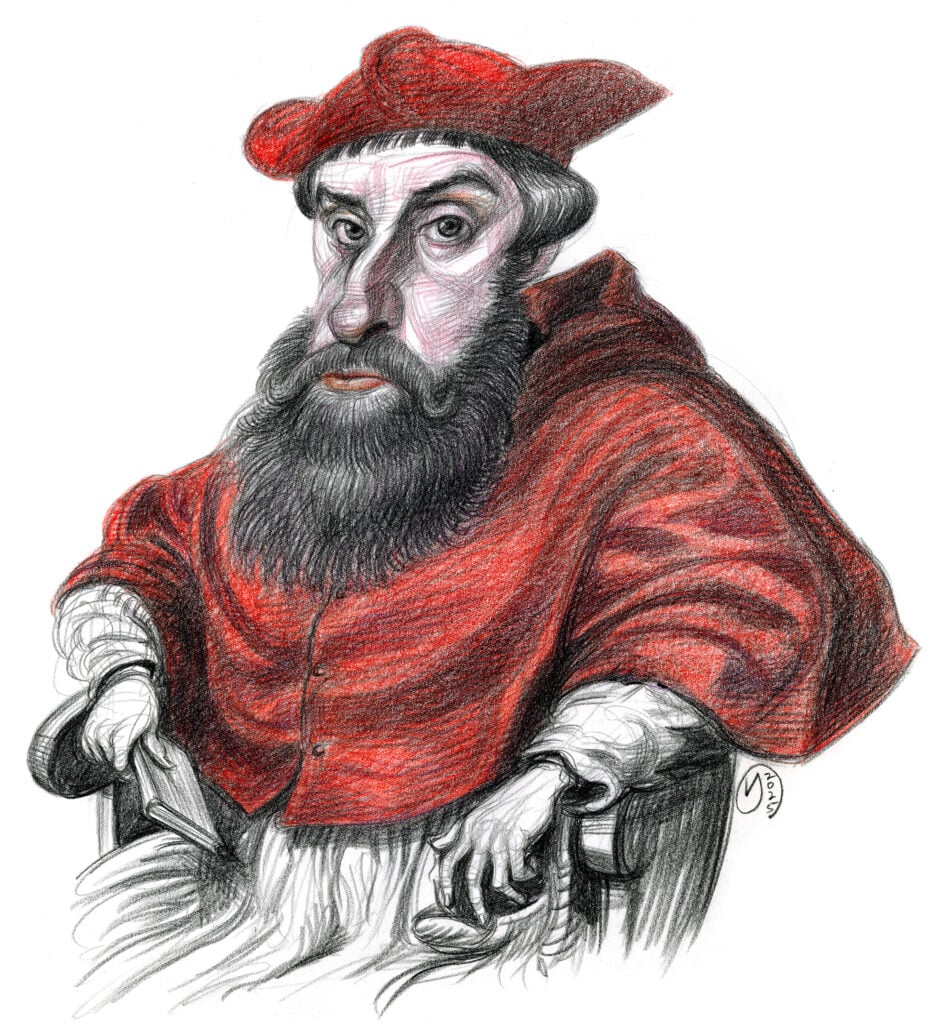
The wait was long. Not until December 1545 did the first session of the council on which Pole had fastened all his hopes finally assemble at Trent, and when it did, simply getting there posed the usual challenges for Pole. With Henry’s assassins still on his trail, he had to send a decoy ahead, disguised as a cardinal, while he himself took an alternate route.
On arriving, Pole was disheartened by the size of the gathering. Trent was supposed to be an assembly of the universal Church, to speak on momentous matters, yet here were only four cardinals, four archbishops, and twenty-six bishops! More to the point, where were the Lutherans? In Pole’s view, to address the issue of justification without first listening to the Lutherans was to court catastrophe. But in the meantime there was an even more fundamental problem he was determined to address. As one of the three papal legates in charge of the council, Pole presided over its opening, and in January a speech he had written was read aloud by a secretary, a speech that deserves to be as famous as Campion’s Brag.
The council’s first order of business, Pole had written, must be repentance, “an unveiling of our sins,” with the assembled leadership taking responsibility for “the very evils we have been summoned to mend.” All of the evils in question—the spread of heresy in the untilled fields of the Church, her scandalous pastoral failures, and even the endless, futile wars between the emperor and the French king—Pole laid at the hierarchy’s feet, blaming all on “our ambition, our avarice, and our cupidity.” Judgment had begun with the house of God, he warned, and without heartfelt repentance, the council would end in failure. Why? Because only on a penitent Church would the Holy Spirit descend, and bring about the reforms and reunion they were incapable of bringing about by themselves . . .
Expecting the usual platitudes and blandishments, and certainly not expecting such a passionate exhortation from the usually reticent Pole, the council was transfixed. There was silence, and then all stood and began to sing Veni Sancte Spiritus (Come, Holy Spirit), and for a brief moment, Pole must have allowed himself to hope that his warning had been heard. But the moment passed, business as usual resumed, and his appeal went unanswered.
In the weeks that followed, Pole persevered in the council’s business, influencing an important early decision on the interdependence of Scripture and tradition. But as the time approached for the question of justification to be taken up, with the Lutherans still absent, his health broke down. He carried on a little longer, imploring the council in June to consider the issues impartially, to listen to the Lutherans or at least read some of their works, and to pray ever more earnestly for the guidance of the Holy Spirit. But after this last, desperate appeal, having received from the Vatican permission to withdraw on account of his health, he left Trent and did not return.
Some historians, treating of Pole’s illness, have taken it at face value. Others have accused him of feigning and peevishness. Still others, while acknowledging the reality of his collapse, have used words like “psychosomatic” and “nervous breakdown.” But if Pole’s illness was psychosomatic, it was psychosomatic not only in the usual sense of the term. In Pole’s sensitive constitution, larger disturbances than personal disappointment were clearly at work. It might be most accurate to say that what was happening in Christendom was expressing itself in Pole’s person, even as the sin of schism—in Christ’s words to St. Faustina describing his suffering on the cross—“tore at [Christ’s] Body and Heart.” Whether Pole and his circle were right about the possibility of reunion is beside the point. Undoubtedly they were wrong, and things had gone too far to be retrieved—even if the Lutherans had been invited to the council, they would probably not have attended—but that would not have made the inevitable outcome any less devastating. Whatever was making Pole sick, it affected his heart, and left one side of his body—his left eye, shoulder, and arm—virtually paralyzed.
Interestingly, Pole’s close friend Alvise Priuli also suffered a breakdown at this time, leading one to wonder whether there were others who were similarly afflicted. Were there many ordinary Christians, in other words, caught between men like Carafa and Luther, who suffered, in their unrecorded lives, the traumatic disintegration of Christendom? One of the many reasons for becoming acquainted with Pole and his circle is the visceral reminder they afford us of the momentousness of schism: what it was like to live through it and, for some, like the spirituali, to have to find a way to go on living, on its other side.
The years following the council were difficult for Pole. His health improved but was never the same. Always obedient to the Church, he submitted to her decrees and eventually embraced them wholeheartedly, but the process of interior reconciliation cannot have been easy. Meanwhile, close friends died and opponents flourished. At the conclusion of a papal conclave in 1549—a conclave during which Pole came within one vote of the papacy and could have accepted the office by acclamation if he had not, characteristically, refused “to come in by the back door”—Carafa violently attacked him for his supposedly heretical opinions, an attack Pole easily refuted, but that left him shaken and depressed. His essential loneliness, he wrote later, was strongly brought home to him during that conclave, where he found himself surrounded by men with whom he had little in common, “neither country nor kindred.” Henry had died in 1547, but with Edward on the throne, a militant Protestantism was in power in England, and in any case, an attainder for treason and a warrant for Pole’s arrest were still in force. Relieved of the Viterbo governorship in 1551, and increasingly distant from the Curia, he disappeared for a time, only to turn up eventually at a Benedictine monastery on Lake Garda, where he is believed to have been discerning a vocation.
Only then, when his worldly career seemed to be coming to an end, did the unthinkable happen: Edward died, and Mary came to the throne. It was an outcome so improbable that Pole and many others judged it inexplicable apart from God’s will. After Edward’s death, his circle in London controlled the Tower, the Armory, the Treasury, and the Great Seal. They had put the Protestant Jane Grey on the throne and had the resources to defend her, while Mary, fearing for her life, had fled north with a few household servants. She was essentially alone in East Anglia, as the central government assembled an armed force of more the six thousand men to apprehend her.
Only the English people, at this point, could have put Mary on the throne, which they did, in a breathtaking reversal. At a time when the crime of sedition was punishable by the cruelest of deaths, gentry and commons alike rallied to her cause. The details of the shift in fortunes make for exhilarating reading, but for our purposes, the point is that Catholicism was not dead in England. On the contrary, in the country at large, Protestantism had failed to take root, and the joy that greeted Mary’s accession—the crowds that followed her to London, the feasting and the bonfires in the streets—were “hardly credible,” in the words of one ambassador. “From a distance the earth must have looked like Mount Etna,” another wrote. “I am unable to describe to you, nor would you believe, the exultation of all men.”
It was a joy that embraced Pole, too, when he finally made his way home. When he landed at Dover, more than a year after he was reappointed legate to England—the emperor was orchestrating Mary’s marriage to his son and feared Pole’s interference—his progress to London resembled a triumphal procession. As he traveled, Parliament repealed the Act of Attainder against him, and within days of his arrival a delegation representing “the whole body of the realm” declared the country “repentant of the schism” and asked to be received again “into the bosom and unity of Christ’s Church.” Accordingly, on the feast of St. Andrew, with the new king and queen and a representative assembly kneeling before him, Pole formally absolved England of “all heresy and schism . . . in the name of the Father, and of the Son, and of the Holy Ghost.”
This happened at night, by torchlight, and again, the surging crowds in the streets, the tears and the joy, strained credulity. For Pole personally, the ceremony was undoubtedly the high point of his life. Not only had his country returned to the Church, he himself had been the instrument of her return. Moreover, his very instrumentality was the kind of ecclesial, sacramental charism he had sacrificed home and family to defend. If he had died that night, he would surely have died a happy man.
Instead, with the sacrament of reconciliation behind them, Mary’s and Pole’s real work began: the work of reversing the damage done to the Church under Edward. In his six years in power, in one of the largest government confiscations of private property in English history, churches and cathedrals had been stripped, altars pulled down, statuary and stained glass shattered, crucifixes and books ritually burned. The entire repertoire of sacred music had been swept away, vestments and consecrated vessels destroyed. The task of reconstructing the material world of Catholic worship was overwhelming, but there were political challenges as well—what to do, for example, about Church properties that had passed into private hands under Henry—and spiritual challenges above all, especially the need to educate and rehabilitate a demoralized clergy. Ever mindful of the scandalous capitulation of the episcopate under Henry, Pole wanted a new kind of bishop—resident, pastoral, loyal to the pope, and orthodox—and a new kind of priest. He wanted sound preaching and effective catechesis, especially on issues dividing Catholics and Protestants. He wanted seminaries and vocations, and a return of tithes and First Fruits to the Church. Most of all, he wanted England’s return to orthodoxy to be an inspiration to a Christendom in disarray. If he had failed to prevent the breakup of the Church as a whole, he hoped to reverse the effects of schism in his own country. This was the opportunity England had been given, he exhorted Parliament in his first address: to be an example to other nations and a beacon of hope in discouraging times.
Indeed, what he and Mary accomplished in four years—with her Spanish husband often abroad, Mary met daily with Pole—was nothing short of astonishing. By the end of the reign, all of Pole’s projects were in hand: seminaries established and universities recalled to the faith, new bishops appointed and Catholic worship everywhere restored. The material restoration alone—the refashioning of crucifixes and books, vestments and sacred vessels—was an impressive achievement, if largely concealed from us by subsequent iconoclasm. Even the public burnings of outspoken heretics, the one horrifying stain on the regime, were effective, viewed as part of a larger, multi-pronged campaign to discourage dissent. In his revisionist history, Fires of Faith, which refutes dismissive assessments of Mary’s reign, Eamon Duffy goes so far as to call the burnings inevitable, since, with good reason, the regime identified hardline Protestantism with sedition.
But then why, if everything was going their way—hardcore heresy in retreat and vocations to the priesthood surging—did Pole and Mary fail? The simple answer is that Mary died, and Elizabeth reversed the restoration. But if Mary alone had died, Elizabeth, when she attempted to overturn what Mary had done, would have faced a formidable opponent in Pole, a man of sterling virtue who enjoyed widespread support, and in 1556 had been made archbishop of Canterbury. Not even Mary’s poor health and childlessness discouraged Catholics in those days, with Pole regarded as a strong defense against future reversals. It was not simply Mary’s death, in other words, but Pole’s death, coinciding with hers, that spelled the end of the Catholic restoration in England.
But there is more to say on the subject, because not only did Pole and Mary both die, they died on the same day. Secular historians pass over the startling coincidence as a curiosity, but for the Christian, believing as he does that God’s providence is the true driver of history—“All times belong to him and all the ages”—it is impossible to avoid an impression of divine judgment. Those burnings, in other words, that we are sometimes encouraged to excuse—280 all told, in less than four years—are we really to suppose that God approved of them? And even if it is true that no ruler of the time countenanced competing religions in his realm, and no pastor doubted that his first duty was to protect his flock from contagion, might not Reginald Pole have turned out to be the exception to those rules? Pole, after all, had resigned from the Inquisition because he could not approve of its methods. He was famous—notorious in some circles—for his patience and gentleness. He was a man who knew how to keep his own counsel and resist the pressure of his peers—a man of sorrows, accustomed to loneliness and misunderstanding. Moreover, like the Protestants whose strengths he appreciated, he was a man of the Scriptures, his thought permeated by the Bible, who might have countered the conventional wisdom that one brazen heretic can pollute a whole polity with the parable of the yeast in the dough, which proposes an opposite, if slowly fermenting, triumph of orthodoxy. He would have been familiar, too, with the parable of the wheat and the tares, which forbids premature uprootings and assigns the burning of the tares—the burning!—to the angels at the end of the age. Alone among his contemporaries, Pole had qualities that might have enabled him to rise above the brutal exigencies of the age, and when he did not, it is as though God simply said, No, not in this way will my Church be restored. Indeed God, who always takes the long view, was content to wait three hundred years for Catholicism to return to England, and then only as a minority religion.
Some early commentators, beginning with John Foxe, portrayed Pole as a bystander and blamed the burnings on Mary alone, but subsequent scholarship rendered that position untenable. More recent historians, while acknowledging Pole’s complicity, insist that there is no real contradiction between early and late Pole, and attribute the apparent discontinuity to the different responsibilities assumed by Pole along with hard power. Others have pointed out that the heretics Pole confronted in England were very different from the anguished waverers he had been accustomed to counseling in Italy. By the time he came home, English Protestantism was organized and defiant, publicly blasphemous and often violent: Animals dressed as priests were strung up in the streets, a preacher was knifed at Paul’s Cross and a priest attacked with a machete during Mass, and there were widespread outrages against the Eucharist. Horrified by the violence, and the belligerence that seemed to him devoid of all humility and charity, Pole may have judged his earlier self naive, and so resigned himself to the harsh measures the times prescribed.
But there are other possible explanations, which are part of a larger story. In the years following the first session of Trent, as the Inquisition gained strength, it turned its attention to the remnant of the spirituali. Ever since Viterbo, Pole had been suspected by certain clerics. But once the Church had officially spoken on the issues, at a time when “development of doctrine” was a formula far in the future, individuals who had come to the council with views the council subsequently condemned, found themselves subject to a retroactive, intensifying persecution. Rumors about Pole multiplied and spread, malicious fictions probably fanned by Carafa. On the advice of the pope, Pole chose not to defend himself, until, one Lenten evening in 1553, he and Carafa unexpectedly crossed paths in a church in Rome. A two-hour conversation followed, at the end of which Carafa declared himself convinced and confessed that he had been mistaken. Afterwards he assured his colleagues on the Inquisition that Pole was blameless.
In the aftermath of the reconciliation, it is Pole’s emotional reaction that is revealing. From the poignant intensity of his joy and relief—relief at being exonerated, and joy at being received again into the good graces of Carafa’s friendship—we can infer how great his suffering had been. Clearly, years of defamation and loneliness had taken their toll. In England a year later, when he found himself in an unaccustomed position of power, there may have been many reasons for his pursuing the policies he did, but psychological and emotional reasons were surely among them.
Pole was no coward. He had lived for years under a sentence of physical death. But after a lifetime devoted to promoting the unity of the Church, his own unity with her was now seriously imperiled. In 1557, after Carafa had become Pope Paul IV, he turned on Pole again, in a half-crazed, murderous frenzy reminiscent of Henry VIII. Revoking Pole’s legation, he tried to extradite him from England in order to feed him to the Inquisition, and failed only because Mary refused to let Pole go.
For Pole, the situation would have been unbearably familiar. (“Two men,” he wrote incredulously, in a long letter to Carafa, “I worshipped . . .”) But this time the sordid drama was playing out in the Church itself, with the reigning pope—the earthly father above all earthly fathers—determined to excommunicate him. And how did he defend himself? In the same letter to Carafa in which he compared him to Henry (a letter he never sent, because “Thou shalt not reveal the nakedness of thy father”), Pole defended his orthodoxy by pointing to his campaign against heresy in England, a campaign, in his words, entirely devoted to the protection of the faithful.
No longer, in other words, was Pole the person standing in the breach, trying to mediate antagonisms, accused by Protestants of being a Nicodemus (one who acknowledges the truth only by night) and by Catholics of being a secret Protestant. After long years in exile, he was home, with his own people: a late-life experience of belonging that may have affected him, and his decision-making, more than he knew. Certainly, in England, he became more like everyone else, not by choosing sides exactly, because in fact he had always chosen the Church, but by pursuing policies that made it perfectly clear which side he was on.
The irony is that when he became more like everyone else—when he set limits to what would be tolerated and pursued the worldly strategy of the burnings—he died. In this conclusion, there is something reminiscent of Moses, who, for a far less significant failure of fidelity—yet a failure of the same kind, a failure to manifest God’s holiness to the people in his charge—was prevented from entering the Promised Land. Pole, too, in England, died on the near side of a metaphorical Jordan, prevented from seeing any of the fruits of his labors.
He did not live to see, for example, the exemplary fidelity of his bishops, who, at the price of their freedom, exactly reversed the arithmetic of the episcopacy under Henry. When Henry demanded fealty, all but one bishop apostatized; under Elizabeth, all but one stood firm.
Nor did he live to see the influence of his reforms in England on the future of the Church as a whole. Ideas that were first entertained in a small Bible study in Venice ended by inspiring the final sessions at Trent. So many of the hallmarks of post-Tridentine Catholicism that we take for granted—seminaries above all, but also a strong papalism and an anchoring reverence for the Eucharist—were nurtured under Pole, in a country Eamon Duffy called “a laboratory for counter-reformation experimentation.”
From subsequent generations, too, Pole’s achievements have been concealed. Compared with the posthumous notoriety of Henry VIII—a main character in an endless churn of Tudor entertainments—Pole’s posthumous reputation resembles an unmarked grave.
In fact, he is buried in Canterbury Cathedral, in the chapel of Thomas Becket, another saint like Thomas More who, for speaking hard truths to power, went out in a remembered blaze of martyred glory. Though he spoke truth with the best of them, Pole was not martyred. His assassins having missed their mark, he had to live on and on in the very different, fractured world his king bequeathed him. If he had been murdered, he would probably be counted a saint, having been spared the difficult decisions he faced in England.
But if he died an apparent failure, his legendary charity compromised and his dream of a Catholic England indefinitely postponed, he died at peace. Not even the news of Mary’s death and all it portended disturbed the tranquil resignation of his departure. In the anonymity of his afterlife—the quiet obscurity to which he has been consigned—there is something like the contemplative life he might have chosen, had the choice been his. Instead, in obedience, he tried to do what was asked of him. Now, at leisure, he contemplates what followed, in the strong light of the just judgments of God.

YOU MIGHT ALSO LIKE
Turned Away on Palm Sunday
In politics, diplomacy, war, or pretty much any field of human interaction, one must contend not only…
Timothée Chalamet Is Right About Art (ft. Suzy Weiss)
In this episode, co-founder and reporter for the Free Press, Suzy Weiss, joins Virginia and Germán to…
A Medieval Pilgrimage in Modern Assisi
When you go to the hilltop town of Assisi, you’re immediately struck by how medieval it is:…
