
This article is adapted from a sermon given at a recent All Hallows event produced by Higher Word, an all-Christian orchestra performing works by great Catholic composers.
How many stars can you name in the night sky? Polaris, probably, maybe a few others from astronomy class—Merak, Rigel, Betelgeuse. Not many more. But there are trillions and trillions of them, and even if we escape the light pollution of our cities and get a clear look up, what we see is just the smallest section of the heavens, a universe of light hidden from our sight.
The saints are the same way. Beyond the few we can name lies “a great multitude, which no man could number” (Rev. 7:9), a crowd to which the Church urges us to lift our eyes from the darkness of this earth and ponder the glory of God shining out in so many human lives. There are so many saints, such that we must set aside a day to commemorate them all because we lack sufficient days in the year even for those whose names we know.
What unites the saints? Every saint is driven by the desire to live Christ Jesus. “The Word became flesh and dwelt among us” (John 1:14). And the Word continues to become flesh through grace. Yesterday, today, and forever, Jesus wishes to live his life, wishes to play “in ten thousand places, / Lovely in limbs, and lovely in eyes not his.” The saints together live one life, the life of Jesus. They follow Jesus with their very lives.
“Follow Jesus.” Worn down by use, perhaps the phrase has lost its force. What does it mean that the saints followed Jesus? It means they followed him in the way they thought, the way they chose, the way they spoke, where they went, what they did—everything about them given over to that one Life that vivified them. “To me life is Christ” (Phil. 1:21). The saints followed Jesus with everything they had. They let him shine out, let their hearts be set on fire with the same purpose that burned in his heart.
What was that purpose? Why was the Word made flesh? “No one has ever seen God. The only Son, God, who is at the Father’s side, has revealed him” (John 1:18). Jesus Christ came to make the Father known, and that is the goal of the saints. “Let your light so shine before men, that they may see your good works and give glory to your Father who is in heaven” (Matt. 5:16).
Think of the stars, of every pinpoint in the dark sky, as a testament to the goodness of light itself. The little-quoted prophet Baruch praises the Lord, “before whom the stars at their posts shine and rejoice. When he calls them, they answer, ‘Here we are!’ shining with joy for their Maker” (Bar. 3:34). That is the story of every saint. All of them are aglow with the same purpose, but all are so different: Augustine, tortured for years over his inability to leave lust behind; Maria Goretti, who died before she was a teenager because she would not compromise her purity; Mary Magdalene, from whom Jesus cast out seven demons; Imelda Lambertini, who died at age nine from sheer bliss after receiving her First Communion. So different, yet so alike.
It is astounding to consider that the one life of Jesus Christ has such pluripotent force when infused into the souls of men and women, expressing itself in such different ways. It is beautiful to contemplate, and it is encouraging, for it means that maybe even my life can shine for the glory of God, and that—though it be true that it costs no less than everything—I need not radically rip myself apart for that to happen.
In the adoration chapel of the parish at which I serve is a mosaic of the Divine Mercy. There are pieces of gold, black, gray, red, blue, brown, white—but together they form one image. Saints are pieces in a mosaic. They have surrendered whatever their life is to the Holy Spirit’s artistry. Maybe one life is no more than a little gray piece in a corner, but that little piece is taken up into the work of showing the face of Jesus Christ to the world. Wherever we are, however we find our lives to be, we can seek to glorify God, proving St. Irenaeus right yet again: “The glory of God is man fully alive.” “Not to us, O Lord, not to us, but to your name be the glory” (Ps. 115:1).
In the Prayer after Communion for the Roman Catholic Church’s Solemnity of All Saints we hear, “We adore you, O God, who alone are holy [sanctum] and wonderful in all your saints [sancti]” (my emphasis). There is a beautiful interpenetration of lives in the life of a saint. “Whoever loves me will keep my word, and my Father will love him, and we will come to him and make our dwelling with him” (John 14:23). Christ takes up his dwelling in the hearts of his holy ones and so gives glory to God.
What do the saints say to us? “Follow!” Saints show us the true horizon of our lives. It is so easy to make failure, to make pain, to make death a horizon at which our sight terminates. It is so easy to live trapped in this world, trapped by this choking atmosphere. But the saints punch through the atmosphere, the stars shine from heaven to show us our true horizon and say, “Come follow us! Come beyond. Come further up, come further in!” The saints give us hope, hope in the face of darkness, hope in the face of suffering, hope in the face of confusion, anxiety, pain, loss, betrayal, sin. They give us hope that “the light shines in the darkness, and the darkness has not overcome it” (John 1:5).
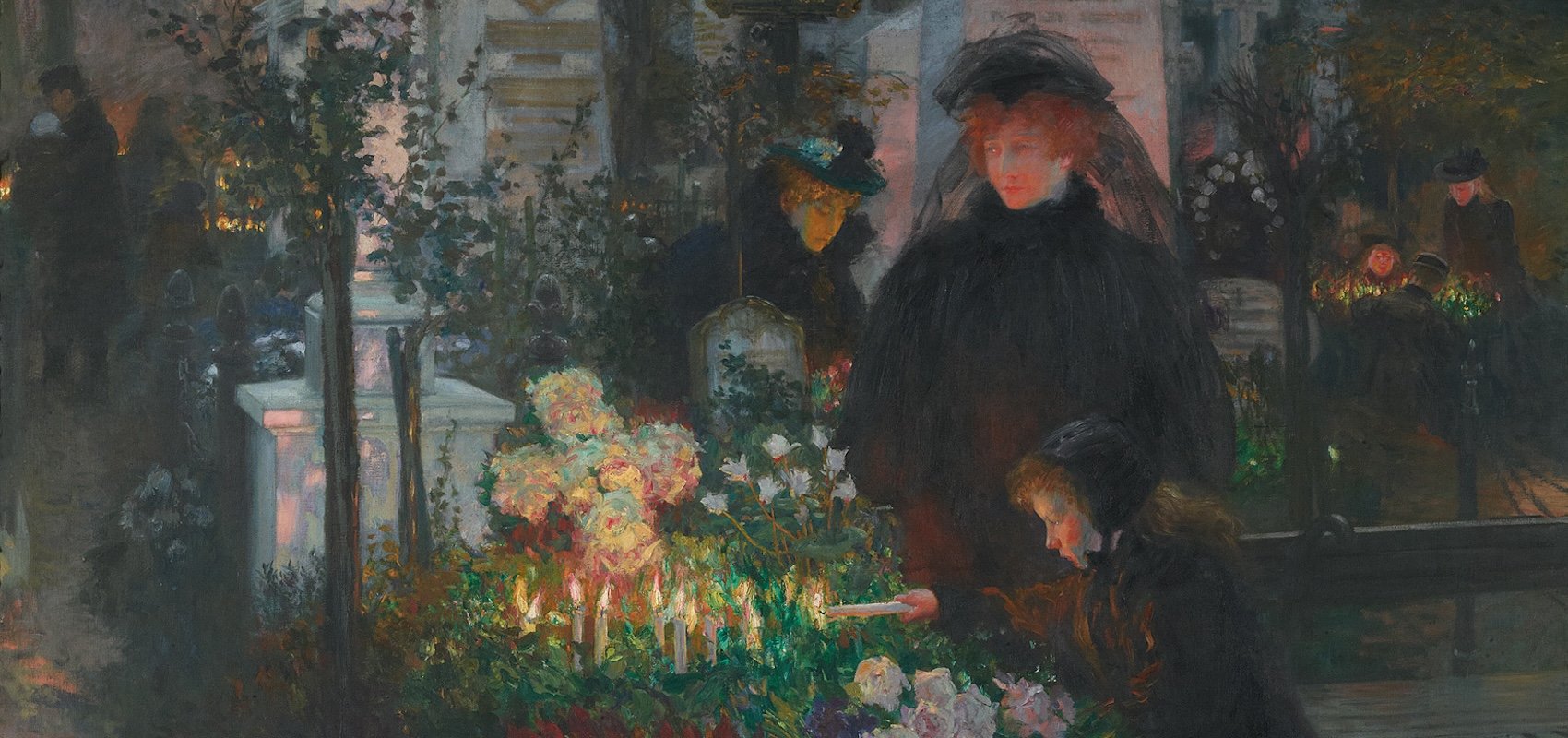
Christian hope is not individual. It must always be a hope not only for myself but for others. “This is how they will know that you are my disciples, that you have love for one another” (John 13:35). If we experience the hope of the light of Jesus Christ, we must let that overflow into hoping for others. All Souls follows immediately after All Saints. I can only speak for myself: I do not think I will go straight to heaven. I know myself too well. I think I will rely on the prayers of others while I am being purified, while the window of my soul is being cleaned so that the light of God can shine through perfectly. We are not walled off from each other at death. With death, life is changed, not ended. Love is changed, not ended. We continue to help one another: when we pass a cemetery and say a prayer; when we have Masses said for one another; when we remember those who have gone before and lift them up to God, trusting them to his mercy, asking for his healing power, knowing that in the end, all souls in purgatory will be all saints. In the end, every Christian soul saved by Jesus Christ becomes a star shining in the firmament, shining with joy for its Maker.
All holy men and women, saints of God, pray for us.
