
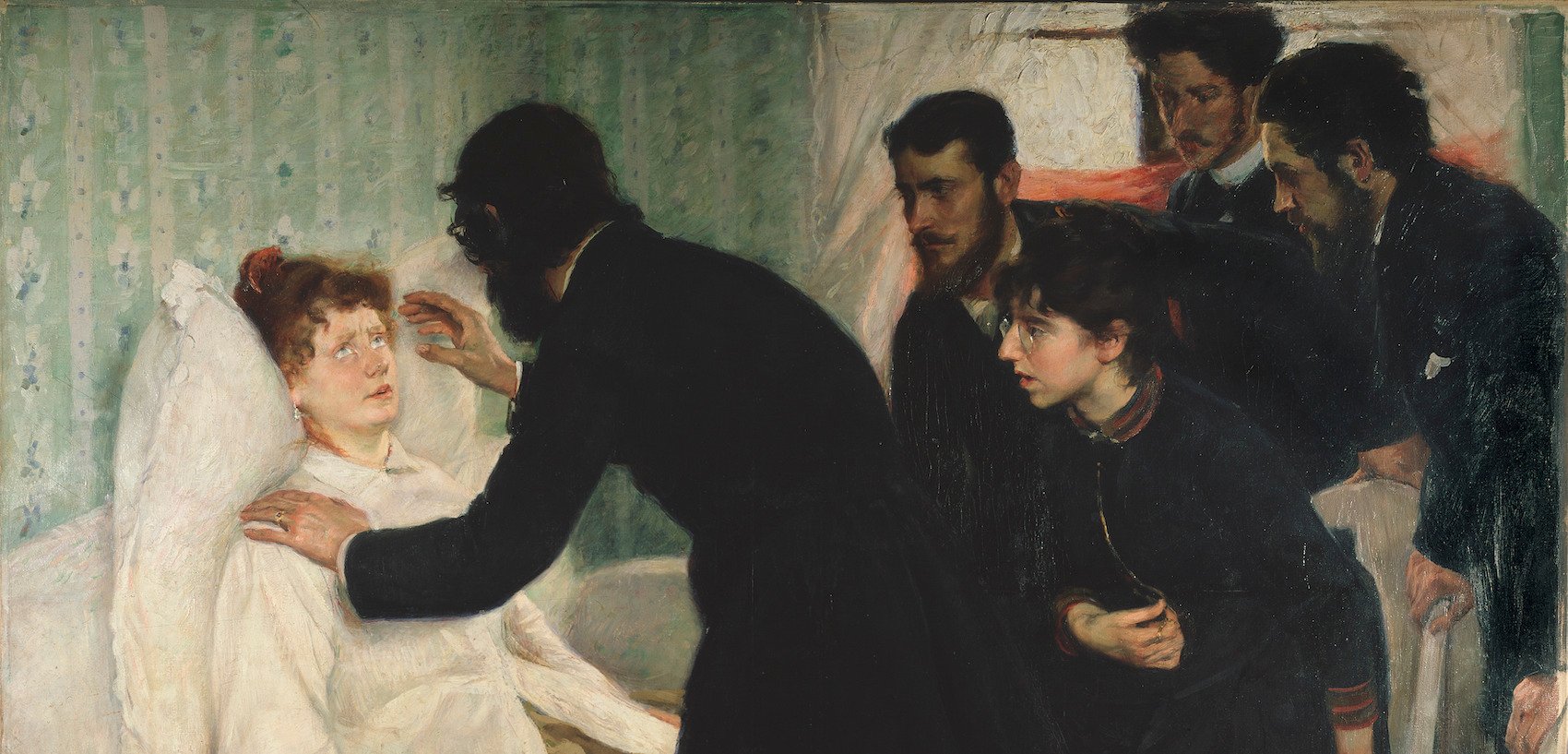
In October 1905, Papus, a French occultist, performed a solemn ritual amid the marble and gold of the Alexander Palace. Emperor Nicholas II and his wife, Alexandra Feodorovna, waited in silence as the sorcerer summoned the shade of Nicholas’s late father, Emperor Alexander III. Suppressing his dread, Nicholas asked his father whether he should fight the liberal movements threatening the monarchy. “You must at all costs suppress the revolution now beginning,” his father replied, “But it will return.”
This episode comes from the diaries of Maurice Paléologue, the French diplomat who served in imperial Russia. How accurately Paléologue conveyed what happened within the palace walls that day remains unclear, since he was only repeating rumors. Yet the fact that tales of intimate “encounters” between the emperor and the dead were circulating through Russian society signaled that members of the tsar’s inner circle were leaking court secrets.
It was hardly a secret that Nicholas II and his wife, Alexandra Feodorovna—though devout Orthodox Christians—were drawn to mystical practices: séances, table-turning, communion with prophets and holy fools. Grigori Rasputin was only one of many court mystics with whom Nicholas and his family surrounded themselves.
In more than a century since the Great Revolution of 1917, scholars have examined the fall of the Romanovs from many angles. Undoubtedly, the empire’s entry into the First World War and the subsequent economic consequences were major catalysts. The emperor’s authority had also been gravely weakened by the First Revolution of 1905, which forced Nicholas to sign the “October 17 Manifesto” establishing a legislative body, the Duma, and guaranteeing a range of civil liberties. This, of course, came on the heels of the disastrous Russo-Japanese War of 1904.
Nicholas II’s personal traits have drawn considerable scholarly attention. Yet his and his wife’s fascination with mysticism often appear at the margins of discussions about the complex origins of the 1917 revolution. Their mystical practices, which followed European fashions, ran counter to Orthodox tradition; but the real tension lay less in religion than in the ways their beliefs, and the spiritualist company they kept, shaped imperial policy. This eroded the crown’s prestige during a time of social and military crises, leaving the monarchy vulnerable to revolution. The imperial family’s obsession with magic and spiritualism is thus key to understanding the last emperor’s downfall, as well as the spirit of the Russian Empire in its twilight.
Like many cultural trends, the fashion for spiritualism and esoteric practices came to Russia from the West. By the mid-nineteenth century, the Russian aristocracy was deeply westernized: Knowledge of French, German, and English was widespread, and travel abroad was popular. Science and philosophy deferred to Western authorities; the nobility and the urban elite readily adopted European trends in clothing and leisure. Trust in the official Church had weakened by the beginning of the twentieth century, fueling interest in new forms of spirituality.
The Decadent movement exerted a tremendous influence on the cultural life of fin de siècle Russia. Decadent literature, which began in France, emphasized the pursuit of sensual knowledge and spirituality over against positivism. For the intellectual elite, particularly artists, esotericism and mysticism were not merely a creative method but also a lifestyle.
At the same time, spiritism became popular in the United States and was quickly taken up in Europe. The first modern spiritist practices are associated with sisters Catherine and Margaretta Fox, who became famous in 1848 by claiming they made contact with the deceased previous owner of their New York house. The sisters took their spiritist talents on the road and toured the country performing lucrative séances. The Theosophical movement of Russian-born Helena Blavatsky drew tens of thousands of followers in the West who embraced Blavatsky’s ideas about the inseparability of spirit and matter, the secret knowledge of the ancients, and karma and reincarnation.
The works of French Decadents and symbolists inspired many poets and novelists—such as Valery Bryusov, Konstantin Balmont, and later Nikolai Gumilev, Boris Pasternak, and others—of the “Silver Age” of Russian literature. Charles Baudelaire and Arthur Rimbaud were especially popular, as were Arthur Schopenhauer and other German philosophers. Literary salons were major cultural hubs. One of the most famous was the St. Petersburg salon of the writer couple Dmitry Merezhkovsky and Zinaida Gippius, the latter also known as the Russian Decadent Madonna. The city’s elite gathered at their four-room apartment, located in the heart of Petersburg in a building of exquisite neo-Moorish style. Writer Andrei Bely, poet Alexander Blok, and many other leading figures in the arts were among the regular guests.
Groups with a more pronounced occult orientation spread across the Russian Empire. Theosophical societies sprang up in St. Petersburg, Kyiv, and Warsaw, some running extensive educational programs and participating in international Theosophical conferences. Beginning in the 1880s, St. Petersburg became home to the weekly journal Rebus, a voice for spiritism and mediumship. The journal offered instructions for conducting séances and translated articles on various esoteric practices from European periodicals. It also regularly reported on so-called “spontaneous phenomena” attributed to supernatural forces—doorbells that rang without human help and empty houses where moans of the long-dead could be heard.
Numerous accounts of séances in St. Petersburg, Moscow, and elsewhere suggest that spiritist practices were opportunities to flirt with sexual taboos. During séances, participants typically held hands, and interactions with the spirits often took on sexual undertones. One participant in a series of séances in Moscow described the “licking” and “stroking” of her body and even spirits’ attempts to undress her.
The fashion for spiritism, séances, and salons belonged to aristocrats and the intelligentsia. Peasants, who made up around 80 percent of the empire’s population, lived in a very different spiritual environment: Orthodox faith intertwined with folk superstitions, fortune-telling, charms, and belief in protective talismans. By the end of the nineteenth century, an interest in sects had spread among the rural masses. The most scandalous was the Khlysts, particularly numerous in the Urals and Siberia. Their secret gatherings and ecstatic dances spawned tales of unrestrained orgies. While aristocratic spiritism was generally tolerated, peasant movements were frequently persecuted by the authorities. Although the refined salons and peasant sects had little in common, they both testified to the waning influence of traditional Orthodoxy and the search for new forms of spiritual life.
In her Theosophical works, Blavatsky emphasized the occult maxim “as above, so below”: The state of the higher realms (macrocosm) is reflected in the lower, human world (microcosm). The maxim also fittingly illustrates the situation in Russia at the turn of the twentieth century: The instability of Nicholas II’s court was mirrored by social chaos “below.” In turn, the social protests and peasant and worker unrest further destabilized the monarchy.
During Nicholas II’s coronation festivities on Khodynka Field in Moscow in May 1896, a crowd crush occurred as people surged forward, hoping to receive gifts. More than 1,300 people died, and roughly the same number were injured. Many expected Nicholas to halt the coronation celebrations. “Do not give your enemies cause to say that the young tsar dances while his loyal subjects are being carried to the morgue,” Nicholas’s second cousin, Grand Duke Nicholas Mikhailovich, warned him. Nicholas ignored his cousin and continued the festivities, waltzing that evening at a ball hosted by the French ambassador. Many were outraged.
Nicholas and his wife likely interpreted the tragedy as a grim omen, just as their subjects did. The foreboding was all the more intense because Alexandra Feodorovna had not yet produced a male heir. Between 1895 and 1901, she gave birth to four daughters: Olga, Tatiana, Maria, and Anastasia. The birth of the fourth female child particularly disappointed the tsarina.
In 1900, the imperial couple began consulting magicians and holy fools from the common people. Among them was the peasant Matrena Bosonozhka, a prophetess who spent hours assuring the royal couple that a son would soon be born. Another purported prophetess, the nun Pasha of Sarov, gave the imperial family a small bag of sugar and eggs, which Alexandra Feodorovna cherished as a relic.
Foreign mystics also visited the court, with ill consequences. Nizier Anthelme Philippe, a medium and magician who had flunked out of medical school, was regarded as a charlatan in his native France, yet he won favor in Russia. Grand Duke Konstantin Konstantinovich, Nicholas’s cousin, recorded in his diary that after meeting Philippe, the emperor “fell into a mystical mood” and would return from praying with the magician “in ecstasy, with an enlightened face and shining eyes.” According to Nicholas’s close associates, Philippe practiced hypnosis, conducted healing sessions, and prophesied about Russia’s future.
In 1902, Philippe convinced Alexandra Feodorovna that she would become pregnant and finally give birth to a boy, the heir to the throne. The empress soon began to show symptoms of pregnancy, which was officially announced. The empire eagerly awaited the joyful news of the long-desired heir. But nine months later, no child was produced. A professional physician who examined the empress confirmed that she had not been pregnant. Official reports claimed she had miscarried. But many understood that a miscarriage at nine months was unlikely. Wild rumors began to spread, such as that the empress had given birth to “a monster with horns, which had to be strangled.” Those close to the emperor realized that Alexandra had so fallen under Philippe’s influence that she produced a phantom pregnancy.
Minister of Finance Sergei Witte described Alexandra as “a hysterical woman” and wondered, “If some charlatan can convince a woman that she is pregnant, and she remains under that influence for nine months, what might any rogue be able to suggest to her?” In a recent interdisciplinary study, a team of Russian scholars concluded that the empress most likely experienced a conversion disorder in the form of a false pregnancy, triggered by stress and neuroses. The episode was arguably the beginning of Alexandra’s widespread unpopularity. In 1904, however, the Romanovs finally had a son, Alexei, fulfilling, or so it seemed, the magicians’ predictions.
The 1905 séance during which the tsar communicated with the spirit of Alexander III was conducted by another French spiritist, Papus, Philippe’s student. According to Nicholas’s close associates, Papus promised that as long as he lived, there would be no revolution or overthrow of the Romanovs. Thus, Papus’s death in 1916 caused alarm in St. Petersburg. “And so, on October 26, the magician Papus disappeared physically, and the power of his spell ceased. That means—the revolution is near!” wrote Maurice Paléologue, half-ironically. Four months after Papus’s death, the monarchy did indeed fall.
Despite the Romanovs’ personal interest, spiritism and mysticism were condemned by the official Church. “To accept spiritualism as a religion is only the first step; thereafter, one inevitably slides from heresy to heresy, both logically and morally—and ultimately to the cult of the Antichrist,” noted the Orthodox philosopher Pavel Florensky in the early 1900s. Yet directly criticizing the tsar’s actions was impermissible. Moreover, the Church formed part of the state system: The Synod answered to the emperor, and the clergy received salaries from state funds. Isolated expressions of discontent regarding the unorthodox pursuits of the elite could not extend to the imperial family. The situation was entirely different with peasant sects, which were actively criticized and persecuted.
Despite this, a peasant mystic entered Nicholas’s life who would soon turn both the clergy—and later much of Russian society—against him. This was, of course, the infamous “mad monk” Grigori Rasputin.
Before arriving in St. Petersburg, Rasputin, born in 1869 in Siberia, wandered through monasteries (though he was never a monk) and practiced unconventional mystical methods of healing and soothing women, often nuns. These rituals sometimes involved visits to the bathhouse, kissing, or undressing. According to participants, however, they did not always end in sexual intercourse. Rasputin also practiced hypnosis, incantations, and ecstatic dancing. All this he blended with Orthodox prayers and what he called “communion with God.” In his twenties, Rasputin performed the role of an Orthodox elder (starets) with theatrical flair, and by the early 1900s had gathered a wide circle of admirers.
Ironically, Rasputin’s introduction to the imperial family came through the very people who would later become his fiercest enemies. Conservative clergymen, particularly Archimandrite Theophan (Bystrov)—a graduate of the St. Petersburg Theological Academy and later its head—first brought him into Petersburg’s aristocratic salons. Rasputin met Theophan soon after he arrived in the city, and the cleric took him for a God-fearing elder who might exert a positive influence on the tsar. At the time, the conservative clergy were seeking both to reconnect with their flock amid a crisis of faith and to strengthen their hold over the emperor. They evidently hoped to use Rasputin to influence Nicholas and Alexandra, never imagining that the starets would refuse to be their pawn and instead launch his own gambit.
Rasputin developed particularly close ties with Empress Alexandra Feodorovna, who took to mystical practices even more eagerly than her husband. He gave her various objects that he meant to serve as talismans, such as special handkerchiefs. Once, Rasputin gave her his comb, which Alexandra then handed to Emperor Nicholas, telling him to use it for good luck. Numerous accounts describe Rasputin calming the empress during her nervous breakdowns. On one occasion, Alexandra dreamed of a black eagle, which she interpreted as a harbinger of death. Overcome by a convulsion, she called for Rasputin. He stroked her head and told her that the eagle was a symbol of “imperial joy.” Alexandra calmed down and fell asleep. Through these interventions, Rasputin became something of a psychotherapist for the imperial family. They affectionately called him “Our Friend,” while he, in turn, addressed the emperor and empress as “Papa” and “Mama.”
Rasputin demonstrated mystical healing abilities during the hemophiliac episodes of Tsarevich Alexei, the young heir to the throne. The boy suffered from a rare blood-clotting disorder inherited from Alexandra Feodorovna’s grandmother, Queen Victoria of England. Rasputin’s personal visits often stopped Alexei’s bleeding and high fevers, and once, a simple telegram from Rasputin eased the bleeding. Scholars speculate that Rasputin was ahead of contemporary medicine, intuitively sensing the power of the placebo effect and the influence of emotions on physical health.
“Our Friend” truly appeared in the right place at the right time. He catered not only to the Romanovs’ mystical inclinations but also to the fashion for the occult among St. Petersburg’s high society. People regarded him as a curiosity that enlivened the capital’s salons. A circle of female admirers quickly formed around him, some of whom he was involved with sexually. His mystical tricks, prophecies, and rituals entertained the public, who were captivated by his exoticism and singularity. Rasputin also drew particular attention because of his proximity to the tsar and, consequently, his influence over the crown.
As Rasputin’s popularity grew, rumors proliferated about his unorthodox practices, deemed sinful by the Church. In 1910, Theophan, the very clergyman who had introduced Rasputin to Russian elite circles, launched a press campaign against him with the aid of several allies. Rasputin was accused, among other things, of involvement with the Khlysty sect, alleged to practice orgies. Soon, liberal critics joined in, accusing the starets of being connected to the Black Hundreds, a reactionary group of right-wing nationalists and anti-Semites. It was during this period that Rasputin’s figure began to take on the contours of myth.
In August 1914, despite numerous warnings, Nicholas chose to bring Russia into the First World War. Around this time, Rasputin was accused of working for German intelligence. The situation worsened in 1915, when Nicholas relocated to the Supreme Headquarters in Mogilev (modern Belarus) to assume command of the army, leaving Empress Alexandra Feodorovna and Rasputin effectively in charge of political affairs in St. Petersburg. This alliance between the empress and the Siberian peasant shocked educated society and dealt a fatal blow to the emperor’s prestige.
Public discontent over Alexandra and Rasputin reached fever pitch with rumors they were having an affair. Reporting on this in the official press was forbidden, so illicit underground caricatures and postcards circulated across the empire, depicting Rasputin manipulating the imperial couple as puppets or in sexualized situations with the empress. Yet no historical evidence supports these rumors. The empress’s dependence on Rasputin was most likely psychological rather than romantic. In Rasputin: Life, Death, Mystery, Alexander and Daniel Kotsyubinsky convincingly argue that the image of Rasputin as “Russia’s greatest love machine” was vastly exaggerated. Most of his interactions with women, even if sexualized, never led to intercourse. Circumstantial evidence and women’s recollections even suggest that Rasputin suffered from sexual dysfunction.
Historians still debate what marked the beginning of the end for the Romanovs. The 1905 revolution transformed Russia into a de facto constitutional monarchy, considerably weakening the emperor’s authority. And the ill-advised foray into the First World War was perhaps decisive. But these events could not precipitate the collapse of the monarchy in 1917 had Nicholas’s prestige not been already so thoroughly compromised in the eyes of the elites. His connection to Rasputin was the last straw in the crisis of legitimacy. The 1916 murder of Rasputin by Prince Felix Yusupov and Grand Duke Dmitri Pavlovich (Nicholas II’s cousin), and, crucially, the absence of real punishment for the killers, showed the country that anything goes.
The Great Russian Revolution of 1917 was really a sequence of two interconnected but distinct revolutions. The February Revolution, when Nicholas II signed his abdication, overthrew the monarchy with minimal socialist involvement. In February 1917, several social forces rose in revolt—primarily workers, as well as soldiers who refused to fire on demonstrators. Segments of the bourgeoisie and urban intelligentsia sympathized with Nicholas’s overthrow. At the same time, others desired to preserve the monarchy. Many members of the Provisional Government, formed in March after Nicholas’s abdication, envisioned Russia as a constitutional monarchy modeled on Western states. This vision never materialized.
Vladimir Lenin had played no real role in the February Revolution and only returned to Russia from Switzerland in April 1917. He soon began campaigning for a second revolution, intended to bring the Bolsheviks to power—a goal realized in the October Revolution later that year. Notably, Lenin received substantial funding for his political agitations from Germany, the very rival for whom Empress Alexandra Feodorovna and Rasputin had been accused of spying.
Without the crisis of legitimacy, the monarchy might have endured longer. As Alexis de Tocqueville observed in The Old Regime and the Revolution, the most dangerous moment for a bad government is usually when it begins to reform: “Nations that have endured patiently and almost unconsciously the most overwhelming oppression often burst into rebellion against the yoke the moment it begins to grow lighter.” Nicholas II fell squarely into this trap. As the prestige of imperial authority waned, every reform, every rumor, every newspaper scandal, and every suspect figure in the tsar’s entourage was read as a sign of weakness. The soil had been well tilled before Lenin’s arrival.
Nicholas’s eclectic, mystical worldview made him an anachronism during a period of turbulent social and spiritual transformation. His devotion to Orthodox tradition, fascination with mysticism, and blending of nostalgic conservatism with fashionable salon novelties revealed this deeply conflicted trajectory. Nicholas appealed to the irrational where reason was desperately needed. Many mistakes might have been forgiven by the society had a strong, rational hand guided the throne. The royal family’s flirtation with mysticism, therefore, became a secret ingredient in a recipe for disaster, as if some malevolent force indeed hung over the crown—something the Romanovs feared above all else.
Against this backdrop, Lenin offered a radical alternative to the moribund monarchy. To a population already familiar with otherworldly forces, a new specter appeared, one that had long haunted Europe: communism.

YOU MIGHT ALSO LIKE
A Fully Human Approach to Finance
A conservative after action report on the struggle against woke corporations might highlight banks abandoning net zero…
Retrieving the Modern Self
Contempt for modernity has become a familiar posture among intellectuals, preachers, and cultural critics. Modern individualism is…
The Case for Christian Nationalism
Recent polling paints a disturbing picture: Fewer than half of Gen-Z Americans are extremely or very proud…
