
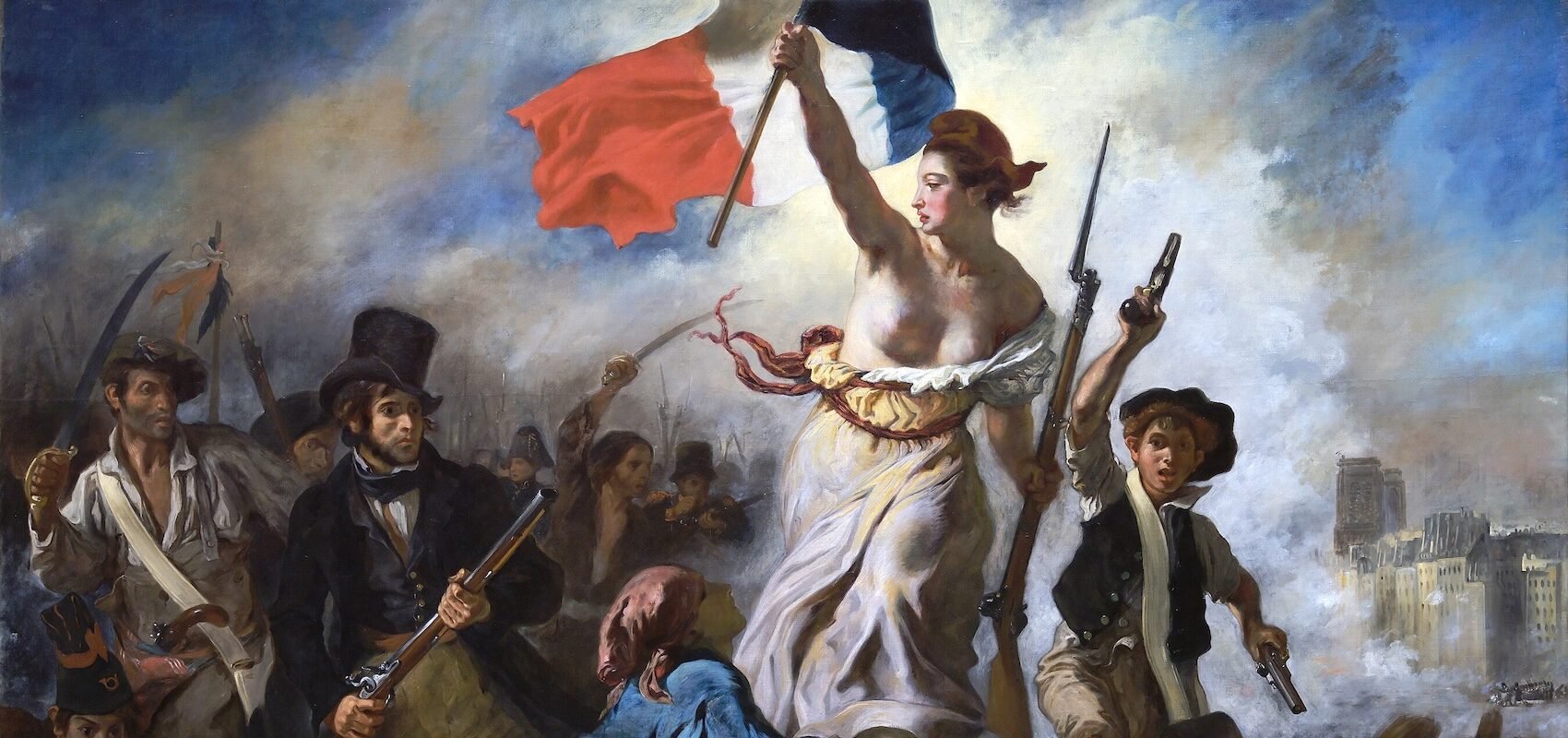
To paraphrase Antoine de Rivarol, the royalist pamphleteer who said that France was an absolute monarchy tempered by songs, one might say that France has never ceased to be, from the Middle Ages to the present day, an absolute monarchy tempered by riots—or a long succession of riotous episodes and civil wars, each followed by a passionate, Hobbesian return to order and authority.
This was true under the Old Regime, when the Most Christian King was periodically challenged by bourgeois, aristocratic, or plebeian uprisings—from Étienne Marcel’s urban revolution in the fourteenth century, to the Fronde in the seventeenth, and the storming of the Bastille in 1789. It has proved equally true in modern France—a curious case of Chinese-style social and administrative stability beneath a veneer of perpetual political turmoil. The geometric, centralized, and bureaucratic regime established by Napoleon in the early nineteenth century has remained for over two hundred years the structural backbone of the French nation-state, even while the nature and title of the regime appeared to change every fifteen or twenty years—shifting from imperial dictatorship to constitutional monarchy, and from parliamentary republic to presidential rule.
Why so? Many explanations have been suggested—including the fascinating notion of an early ethnic or civilizational clash between the Gauls, the nation’s unruly forebears, and their stern Roman masters that has never been overcome.
The presidential Fifth Republic, founded in 1958 by Charles de Gaulle in the wake of the parliamentary Fourth Republic’s disintegration, is no exception. Admittedly, it is still in existence sixty-seven years later—which makes it the second-longest-lasting French regime since 1789, right after the parliamentary Third Republic, which endured for seventy years, from 1870 to 1940. Yet it has been rocked by major crises and bouts of street unrest roughly every ten years, and its constitution has been repeatedly revised and diluted—so much so that many politicians and political scientists have recently been diagnosing, or advocating, a shift to a Sixth Republic.
In many respects, the Fifth Republic stands as the most coherent and deliberate attempt ever made to reconcile France’s contradictions. The architects of the 1958 constitution borrowed from an unusually broad array of sources—among them the “non-conformist” thinkers of the 1930s, who sought new paths for France’s future, and André Tardieu, several times minister and head of government under the Third Republic, who championed the creation of a presidential system modeled on that of the United States.
The new regime was designed as an antithesis to the Third Republic, held as responsible for the 1940 disaster, and the Fourth, which had entangled France in colonial conflicts that had become unwinnable. Both were “assembly regimes,” held hostage to unstable coalitions of tiny parties. By contrast, the Fifth Republic was meant to be a “republican monarchy,” with a quasi-regal president elected for a seven-year term, empowered to exert special authority in times of crisis, to consult the nation by referendum, or to call a snap election. Moreover, there was a coherent agenda behind these constitutional arrangements—the restoration of a fallen France as a great power—which implied the transformation of the senior civil service into a meritocratic state nobility, a modernizing semi-statist economy, an expanded welfare state, and the pursuit of “national independence” at any cost, especially against American postwar hegemony and Euro-federalism. Ultimately, France was expected to become, by the year 2000, a major industrial power with a population of one hundred million.
The Gaullist grand design was truly an expression of France’s national character in the early 1960s, supported not only by the conservative bourgeoisie and large segments of the middle class, but by the working class as well. Yet, what made it so convincing was that it coincided with an unprecedented prosperity that owed much, ironically, to the “enemy”—America and Europe. Moreover, the wealthier France was becoming, the more inclined it was to enjoy its good fortune without further delay, a contradiction that led to the 1968 “Baby Boomers revolution” in Paris, which—much like its American inspiration, the anti-war protest movement and the new left—was more bourgeois than working-class, and more hedonistic than Marxist.
De Gaulle resigned in 1969 after a failed referendum on “modernization” that had been pathetically out of touch with the changing moods of the nation. Still, a somehow diminished Fifth Republic went on under Georges Pompidou and Valéry Giscard d’Estaing, with the tacit support of the working class—and the Communist party. When François Mitterrand, a socialist and a harsh critic of de Gaulle, was elected in 1981, he kept the constitution intact to his own benefit. However, he also made, mainly for electoral reasons, several decisions that, in the long term, emptied the Republican monarchy of much of its real content.
The first phase of Mitterrand’s presidency, from 1981 to 1984, was a brave attempt to carry out to the letter the platform on which he had been elected—the left’s Common Program—an uneasy mix of Keynesian social-democratic ideas and communist-inspired measures such as the nationalization of banks and key industries. As a result, France was instantly bankrupt, the left-wing mystique evaporated, and the left’s traditional voters, including the communists, deserted him. In 1984, he had no choice but to reverse his policies and find new allies—the Europhile moderate left-of-center and right-of-center. The price to pay was to embark on a Euro-federalist platform that implied a gradual transfer of power to the Brussels technocracy, and the dismantlement of such pillars of French sovereignty as the national currency, the nationalized or state-run companies, the welfare state, and the supremacy of French law.
Another fateful decision was to weaponize “racism” (as in, the growing rejection, especially in the middle class and the working class, of immigration from the Global South) to divide the classic conservative right. In practical terms, the mere discussion of the immigration issue—and its corollary, the rapid Islamization of France—was turned into the preserve of the far right and banned from the “civilized” public debate precisely at the moment it was needed, and effective measures could be devised.
For all his faults and shortcomings, Mitterrand was still a seasoned politician with considerable maneuvering skills—qualities direly missing among his conservative or progressive successors, Jacques Chirac, Nicolas Sarkozy, François Hollande, and Emmanuel Macron.
An untimely snap election turned Chirac into a lame duck for five years in his first term, and his re-election in 2002 came almost by default, the quirks of fate having turned the unpalatable far-right candidate Jean-Marie Le Pen into his only opponent in the second round. Sarkozy, who had won brilliantly on a coherent conservative platform in 2007, went on to spend his presidency betraying much of what he had promised. Hollande, a socialist of the mildest sort, made common cause with the far left to secure his election, and allowed the dignity of the presidency to decay to an almost unimaginable degree. Young and eloquent, Macron seemed for a time to work a kind of magic—even to have reshaped French politics around a lasting centrist axis. His narcissism, exposed in full during the Yellow Vests crisis, would quickly undo what he had accomplished. Moreover, all four of them agreed, out of sheer demagoguery, to amendments that upset the balance of the constitution and thus accelerated the demise of the Fifth Republic, like shortening the presidency to five years or limiting a president to two consecutive terms, or burdening the well-written 1958 constitution with woke references to ecological concerns or the right to abortion.
It should come as no surprise, therefore, that France’s overall standing in the world has been eroding for the past thirty years. In 2024, France was ranking twenty-fourth globally in gross domestic product per capita, according to the International Monetary Fund: down from eleventh place in the 1990s and nineteenth in 2017, the year Macron was first elected. Public debt has soared to around 113 percent of the GDP in 2024, placing France third in the European Union behind Greece and Italy. The industry, Gaullism’s major achievement, has been cut to size by globalization, or is being sold piece by piece to foreign bidders. Immigration has slipped out of control so markedly that 61 percent of the French think they will be “replaced” by non-European, non-Judeo-Christian immigrants in one generation. France’s role in international affairs or global strategics is steadily receding, even in Africa, where the French military has been evicted by Russian mercenaries.
Last but not least, the political scene has been thrown into chaos after another reckless dissolution in 2024 and the election of a hung National Assembly. In less than two years, France has gone through five prime ministers. Macron’s flagship piece of legislation, a comprehensive reform of the pensions regime, has been “suspended.” Another important Macronist tenet, lowering the imposition rate, will probably go soon.
Macron’s main concern, in the meantime, is Macron’s future. When his second five-year term ends in 2027, he will only be able to run again after his immediate successor’s term, at which point he will be fifty-five—a tender age in politics. Everything he does now seems to be calculated with that in mind. While his popularity has sunk to less than 15 percent, two constituencies remain firmly attached to him today with 33 percent—young people under twenty-four, and Muslim immigrants. They will carry even greater weight in the future. Hence his sudden activism for the Palestinian cause.
Is it the end of the Fifth Republic? Is a Sixth Republic on the charts? I don’t know. But it is clear that most French citizens are demanding a return to an idealized Gaullist model. Marine Le Pen and Jordan Bardella, the National Rally’s leaders, who elicit support from at least one-third of the country, have explicitly endorsed this model. But it will be much more difficult to establish than in 1958.

YOU MIGHT ALSO LIKE
Restoring Man at Notre Dame
It is fascinating to be an outsider on the inside of an institution going through times of…
Deliver Us from Evil
In a recent New York Times article entitled “Freedom With a Side of Guilt: How Food Delivery…
Natural Law Needs Revelation
Natural law theory teaches that God embedded a teleological moral order in the world, such that things…
