
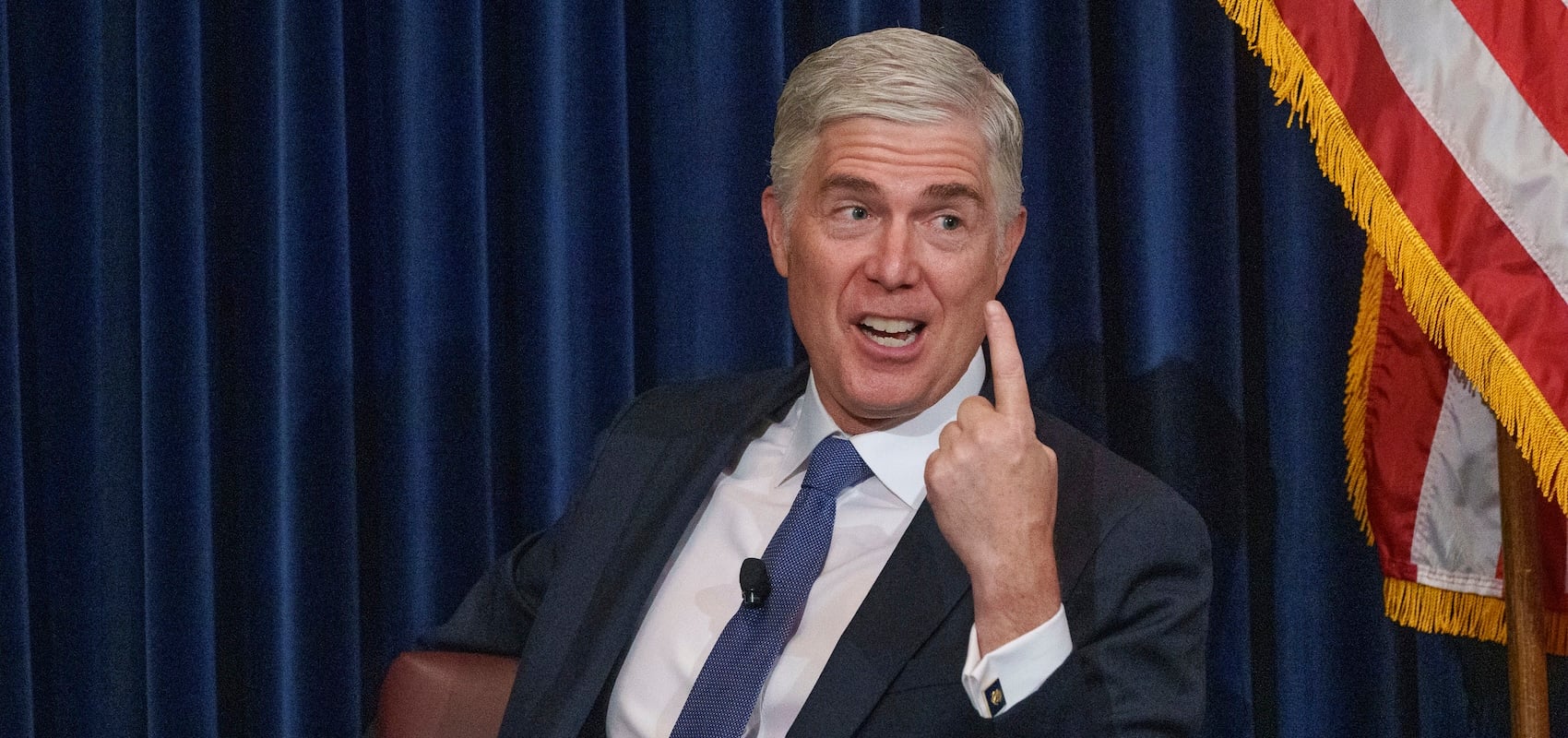
In Chiles v. Salazar, the conservative justices came again to that fork in the road that they are becoming more and more determined to avoid. Kaley Chiles, a Christian counselor in Colorado, risked violating the state’s “conversion therapy” ban if she told clients that transgender surgery cannot actually change a person’s sex. The justices ruled in Chiles’s favor, not because Chiles has every right to convey to her clients an objective, inescapable truth—that they were not born in the wrong bodies—but because Colorado had impermissibly restricted her speech, a ruling that carefully avoided acknowledging what she was saying was simply true.
Just a year ago, the court could have appealed to that deep truth about the immutability of sex when it sustained the laws of Tennessee that forbade “gender-affirming” treatments for minors. But the court was content simply to sustain the judgment of the legislature that this treatment was harmful, without vast offsetting benefits. And yet that left the question open to another legislature, as in Colorado, that would see “gender-affirming care” as a positive good, to be protected from medical and moral challenges. Recognizing that hard, unsettling truth would bring Justice Neil Gorsuch, who wrote the opinion for Chiles, to the edge of repudiating his handiwork in the Bostock v. Clayton County (2019) case, where he virtually stamped transgenderism into a constitutional right.
As Gorsuch wrote in his opinion, “All Ms. Chiles offers is talk therapy,” and “the spoken word is perhaps the quintessential form of protected speech.” Gorsuch finds here a classic case of “viewpoint discrimination.” But Gorsuch never reveals anything Chiles actually said. What was the “viewpoint” that put her in danger of losing her license?
For Gorsuch, saying nothing about the content of the speech may prove his point, for he wanted to argue that speech can be protected quite regardless of its content. Or as he put it once, quoting Alito, “it is the ‘proudest boast of our free speech jurisprudence’ that we protect speech that we hate.” And in this sweep of rhetoric he cannot stop himself from referencing Justice Robert Jackson’s line in West Virginia State Board of Education v. Barnette (1943), which ruled that children cannot be compelled to salute the American flag: “If there is any fixed star in our constitutional constellation, it is that no official, high or petty, can prescribe what shall be orthodox in politics, nationalism, religion, or other matters of opinion.”
Jackson was one of the best jurists of my lifetime. But it seemed to go unnoticed by this urbane man that he was himself in a position of uncommonly high “official” authority, and that the sentiment he proclaimed would be taken as nothing less than an orthodoxy on the matter of regulating speech. And that orthodoxy, as Gorsuch now understands it, is that there are indeed no truths—no moral truths—that would govern the rightful and wrongful governance of human beings on the matter of regulating speech.
The claim is preposterous, for it is at odds with the moral and jural understanding of the Founders; it is at war with the common sense that prevailed in our law before the Court started turning in the 1970s. The Founding generation recognized that liberty is always shadowed by license. Any act can be directed to ends rightful and wrongful. Even with the First Amendment, that Founding generation recognized that there was nothing categorically innocent about speech. Speech could be used as much as any other part of our freedom to inflict serious harm. It could be used to destroy reputations and businesses; it could be used to intimidate in threatening and extorting letters, to incite mobs to violence. As John Marshall famously said, anyone who publishes a libel in this country can be “sued or indicted”—sued for personal damages or indicted for stirring up hostility toward religious minorities. The old Chaplinsky v. New Hampshire (1941) case on “insulting words” recognized that “assault” does not strictly require bodily touching or material harm. An unloaded gun can be clicked near someone’s head, and there are those threatening and sadistic calls in the middle of the night. Gorsuch took note of the Chaplinsky case—and treated it as a kind of sideshow, an exemption from a sweeping protection of speech quite unsullied by a history of moral discriminations, persistently affirmed.
In Rust v. Sullivan (1991), the Supreme Court upheld a federal regulation prohibiting Title X-funded family planning clinics from counseling patients about abortion. The legislature in Tennessee has barred transgender surgeries for minors. It is not at all unthinkable that, with the same understanding, Tennessee and other states may bar doctors in public service, or in private practice, from encouraging patients to choose transgender surgeries. On what tenable ground would the court put up a doctrine that would bar that judgment?
The key, as in so many cases, can be found with Lincoln. In his famous Cooper Union Speech, he pointed out that “If slavery is right, all words, acts, laws, and constitutions against it, are themselves wrong, and should be silenced, and swept away.” If he conceded that slavery was a good and rightful thing, he might concede a policy of screening abolitionist literature. If slavery were morally defensible, he could not “justly object to its nationality—its universality; if it is wrong, [the defenders of slavery] cannot justly insist upon its extension—its enlargement.” He continues: “All they ask, we could readily grant, if we thought slavery right; all we ask, they could as readily grant, if they thought it wrong. Their thinking it right, and our thinking it wrong, is the precise fact upon which depends the whole controversy.”
What is at issue, in the cases of transgenderism, is whether there is an objective truth that challenges at the root the cruel illusions and grift of the transgender medical-political complex. To keep steering around that question—as though it was not indeed the question before the court—is just another step in a phase of conservative jurisprudence that is falling now into incoherence. The conservative justices managed to overturn Roe v. Wade without saying a word about the wrongness of abortion or recognizing the human standing of the nascent life in the womb. Steering around the moral substance of the cases is becoming the confirmed mode of operation for what is called today “conservative jurisprudence.”
AP Photo/Damian Dovarganes

YOU MIGHT ALSO LIKE
The Disappearance of Rational Control (ft. Harvey Mansfield)
In the latest installment of the ongoing interview series with contributing editor Mark Bauerlein, Harvey C. Mansfield…
Canada’s Offensive Secularism
On March 25, the Canadian House of Commons voted to repeal the good faith religious opinion defense…
Protecting Kids Online Doesn’t Threaten Speech or Parental Rights
Two misconceptions have been circulating since last week’s landmark ruling in K.G.M. v. Meta et al., which…
