
The twentieth-century philosopher Wilfrid Sellars drew an influential distinction between “the manifest image,” which is the way the world is presented to us in everyday experience and common sense, and “the scientific image,” which is the description of the world offered by scientific theory. For some thinkers in the Western tradition, there is a sharp conflict between these images—think of Zeno’s view that motion is an illusion, idealists who deny the reality of matter, or those who insist that science has disproved the existence of free will. But other philosophers argue that, rightly understood, the two images are in harmony. Aristotle and Thomas Aquinas are examples.
Another is John Searle, who died on September 17 at the age of ninety-three. Searle taught at the University of California at Berkeley for sixty years. He was active in the campus’s famous Free Speech Movement in the 1960s, though he came to criticize the excesses of student protesters. He made several first-rate contributions to academic philosophy, while also attaining an unusual degree of influence outside the field. The latter was facilitated by his crystal clarity as a writer and public speaker, and a personal style that was often as humorous as it was self-confident and pugnacious.
If it’s true that a man can be known by his enemies, then it tells us much about Searle that he had famous public disputes with the deconstructionist Jacques Derrida and the materialist Daniel Dennett. Both thinkers, in Searle’s view, peddled nonsense in the guise of sophisticated theory. In Derrida’s case, the sophistry involved putting forward the bold but absurd thesis that nothing exists outside of texts and then, when challenged, retreating into the perfectly reasonable but banal observation that nothing exists except in some context. Dennett’s sleight of hand was more subtle. He would pretend to be giving a materialist explanation of consciousness, but on closer inspection, Searle argued, he was actually denying that consciousness existed.
The controversy for which Searle was best known, however, concerned Artificial Intelligence. According to a criterion for intelligence proposed by the mathematician Alan Turing, if a machine could, in response to questions, produce answers that were indistinguishable from those a human being might give, then we would have every reason to judge that it was literally intelligent. Searle rebutted this claim in his Chinese Room Argument.
Imagine that Searle, who knows no Chinese, sits in a room with a set of Chinese symbols and a rulebook in English telling him which combinations of symbols to give out in response to written questions slipped to him through a slot in the door. The rulebook does not tell him what the symbols mean; it simply allows him to mimic the behavior of a person who does. What Searle would be doing in this scenario, he argued, is essentially what a computer does: manipulating symbols according to the rules of an algorithm. The resulting mimicry, no matter how convincing, would not yield genuine understanding of Chinese. Likewise, what computers do can never amount to the operations of true intelligence, but only a simulation of it.
This much-debated argument is one of several by which Searle resisted the reductionist tendencies of contemporary philosophy, which are often fallaciously promoted in the name of science. In the middle of the twentieth century, logical positivists attempted to reduce all meaningful discourse to the descriptive language of formal logic and empirical science. Searle’s first book, Speech Acts, which built on the work of his teacher J. L. Austin, was among several key texts that led Anglo-American philosophers to take a more nuanced approach to language and its multifarious uses.
Just as Searle rejected the thesis that computers might exhibit genuine intelligence, so too did he criticize the popular view that the human mind is a kind of software implemented on the hardware of the brain. For one thing, the brain cannot, in Searle’s view, properly be characterized as hardware. Computers, he argues, are not naturally occurring objects, as stones, trees, and bacteria are. They are a human artifact, just as chairs, can openers, and airplanes are. Nothing is intrinsically a chair. An object counts as a chair only relative to an interpretation assigned to it by human observers. The same is true of computers. It makes no sense to explain the human mind by reference to the idea that the brain is computer hardware, since the brain counts as “computer hardware” only relative to the interpretation imposed by a human mind. The software model of the mind thus puts the cart before the horse.
Searle was highly critical of other versions of materialism as well, such as the extreme “eliminativist” thesis that if beliefs, desires, and other mental states cannot be explained in neurobiological terms, then they do not exist at all. Searle’s 1992 book The Rediscovery of the Mind is a tour de force, a sustained demolition of what had by then become a dogmatic reductionist orthodoxy in contemporary philosophy of mind.
In his books Rationality in Action and Freedom and Neurobiology, which appeared in the 2000s, Searle turned to the topic of free will. He argued against the idea that our actions are the necessitated effects of mental events of which we are merely the passive observers—as if everything we think and do simply happened to us. Choice, of its very nature, involves an irreducible and persisting self, which actively brings things about as a result of deliberation. There is a causal gap between our beliefs and desires on one hand and our behavior on the other, and only the self can fill that gap, by way of its agency. Searle’s view is that whether or not we can strictly prove the reality of freedom, we have no intelligible model of human action without it.
In his later work, Searle’s central interest was the nature of social facts in general and of social institutions in particular. His account of the way social facts are grounded in language, and language in turn is grounded in the mind, imparted a unity to what might otherwise seem to be disparate themes in his work. Searle was typically thought of as a philosopher of language and of mind. But by the end of his career, he had produced what would more traditionally have been described as a systematic philosophical anthropology.
The main weakness of Searle’s work is that he never developed a metaphysics that was as carefully worked out as his anthropology. Searle’s materialist critics often accused him of being a dualist in the Cartesian mold, a charge he always denied. He was as committed as the materialists were to the thesis that the natural world is all there is. He simply thought their way of fitting human beings into that world was simplistic. The trouble is that the conception of nature he shared with them, which he never seriously questioned, makes his position unstable. When he emphasized the continuity of human beings with the larger natural world, he sometimes sounded like he was offering just another riff on materialism. But when (as was more often the case) he emphasized how radically different the human mind is from everything else in nature, the charge of dualism was hard to rebut.
Like his materialist critics, Searle also had a tin ear for religion; he once suggested that only “bores” could think religion was still intellectually credible. Fortunately, his attitude did not deter him from the occasional friendly engagement with the Dominicans at Berkeley’s Dominican School of Philosophy and Theology.
Searle’s last years were very difficult. Charges of sexual harassment did enormous harm to his reputation and career, and he was stripped of his emeritus title at UC Berkeley. He essentially disappeared from public life. Speaking of the specific allegations that led to his downfall, his longtime secretary Jennifer Hudin has said (in an email that was published online after his death) that “after an extensive and intrusive investigation, these allegations were never found to be true.”
Whatever the facts and whatever Searle’s personal views about religion—or rather, all the more so in view of these things—many of us who admired him and benefited from his work pray earnestly that the reality of God was one further bit of common sense that he came to appreciate in his final days.
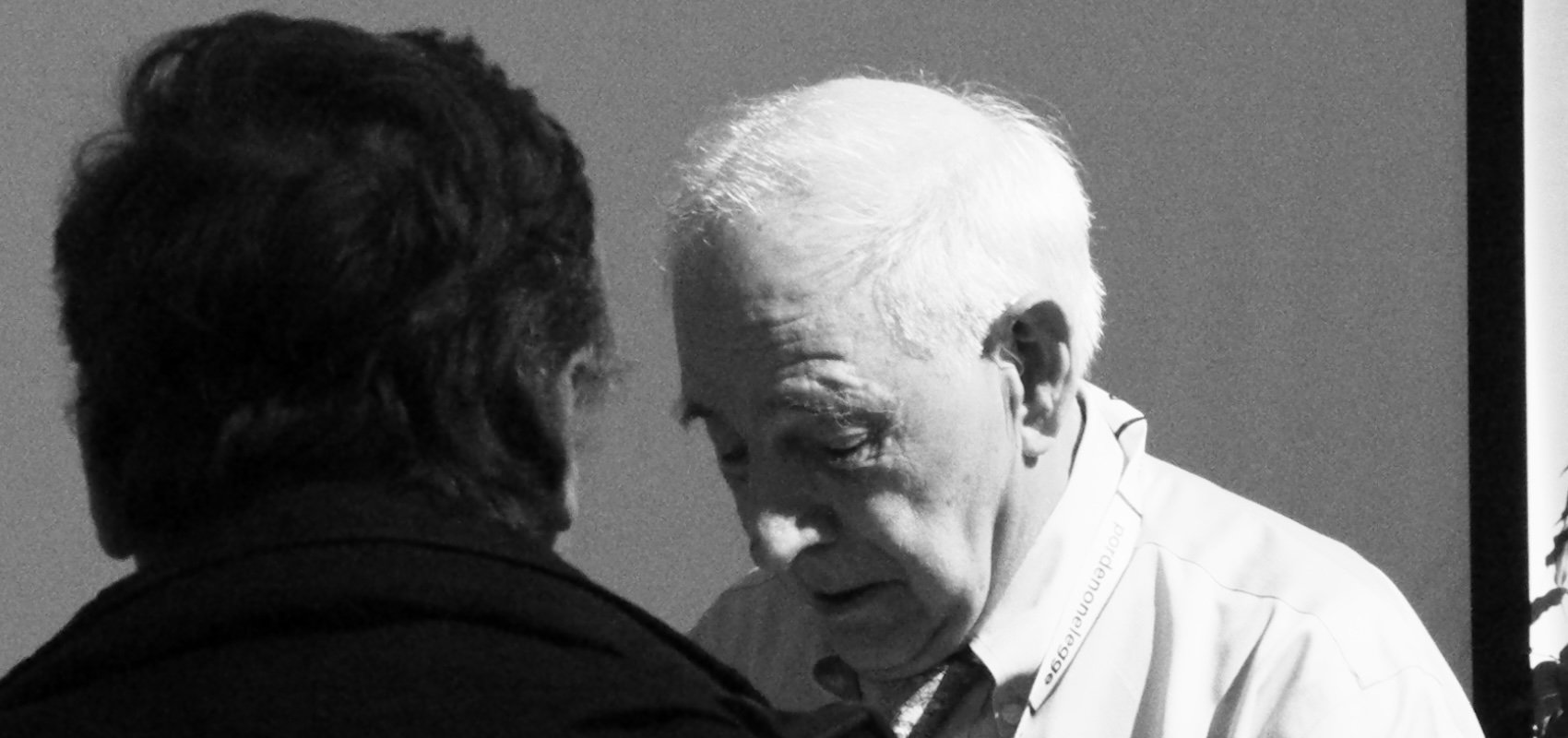
Image by Sascia Pavan, licensed via Creative Commons. Image cropped.

