
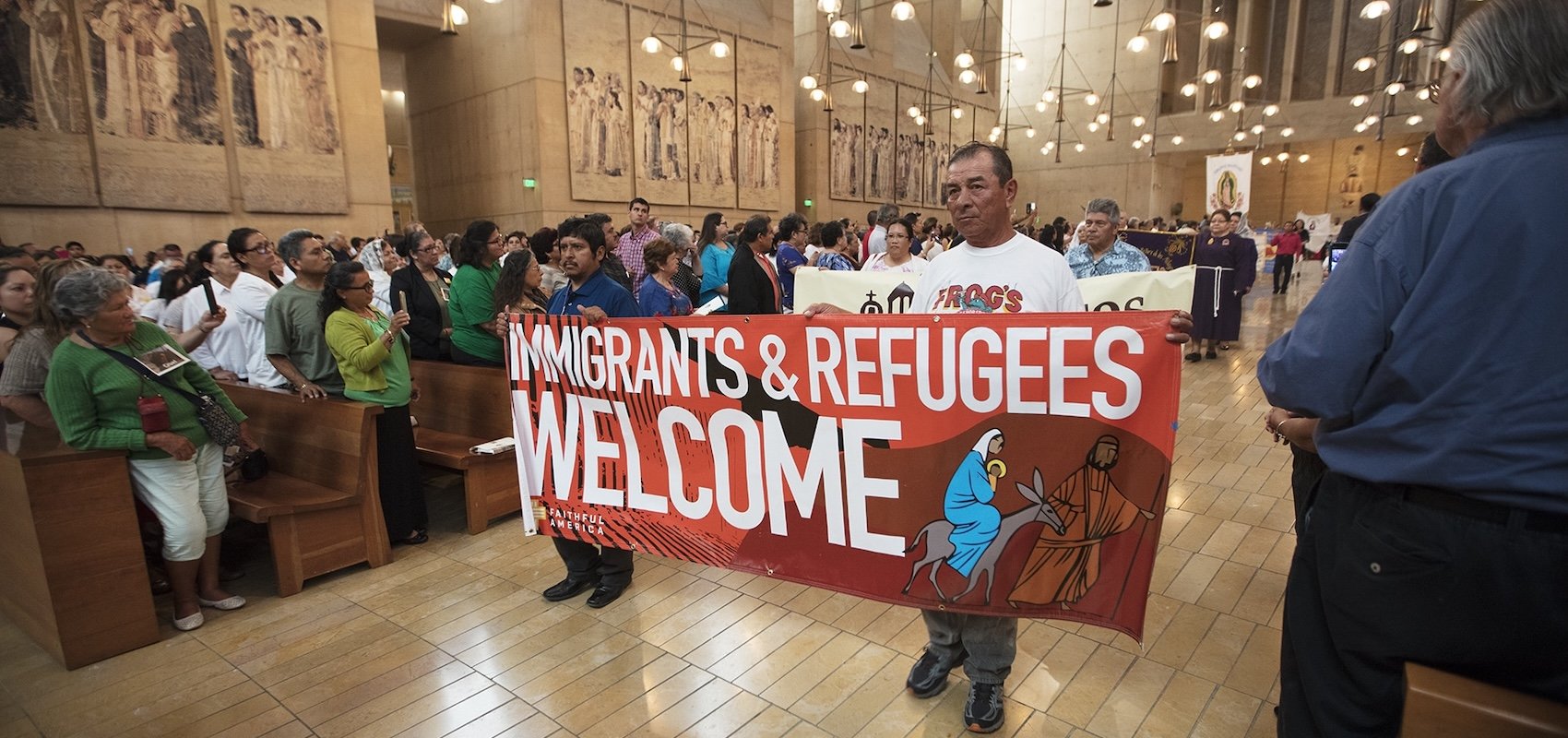
Let’s start with a thought experiment. A foreign-looking family knocks on the door one evening and asks for a place to stay. I’ve never seen them before. They look hungry. They need shelter. I have a Christian duty to help them; the content of Luke 2 sticks in my brain and conscience. At the same time, I know nothing about them. My resources are limited. Crime is on the upswing. And my first duty is providing for, and protecting, my own family in an uncertain time.
So what do I do?
Imaginary personal encounters make bad national policy. But like parents with a family, a nation’s first duty is to its own citizens. Their security and welfare matter. Thus, borders also matter. So does immigration law, especially in a nation created ex nihilo and held together not by ethnicity, religion, or even language, but by respect for the law and the actions that flow from it.
One can reasonably criticize the Trump administration’s current deportation efforts as too broad and too blunt. Along with arresting gang members, traffickers, murderers, and rapists, they sweep up innocent, undocumented immigrants who pose no criminal threat, and many of whom contribute as much to this country as they gain from it. But those same ugly removal efforts were inevitable. They were made so by a catastrophic border collapse under the Biden administration, and the failure by both of our political parties over the past two decades to produce workable immigration reform. Undocumented immigrants possess a God-given dignity that cannot be rescinded. But their presence here, under the law, is nonetheless illegal. Which is why the Obama administration, in its own time, deported 2.7 million of them—notably without the current hysterics from the political left.
To their credit, the Catholic and other Christian churches in this country have done heroic work for decades in offering material support and legal counsel to immigrants, documented and otherwise. I saw this firsthand in twenty-seven years of diocesan staff service. The Church resources allotted to social ministry, including immigration services, typically dwarfed other pro-life efforts. The current administration’s defunding of some of those legitimate services has ironically made the immigration crisis worse. But in serving the needs and championing the rights of new immigrants, church leaders have often been seen as downplaying or ignoring the just concerns of their own people. And most of their people are not reactionary nativists or right-wing bigots but ordinary men and women, often with families, worried—rightly—about crime, the financial stability of their public institutions, and social cohesion.
Acknowledging those honest concerns, as one border state bishop told me privately, has too often been inadequate; an unconvincing “throwaway line” for too many bishops and church workers dealing with the immigration issue. Another voice—a senior border state church staffer with intimate experience of the immigration crisis—added that
I don’t like Trump’s approach; it’s long on muscle and short on explaining why these measures are necessary. But [Pope] Leo and the bishops refuse to make distinctions about immigrants; they’re prioritizing the needs of the undocumented over the legitimate concerns of the faithful who built the Church in this country. Leo’s new apostolic exhortation [Dilexi Te] says that “in every rejected migrant, it is Christ himself who knocks at the door of the community.” That’s lazy exegesis in the service of a globalist set of assumptions. . . . My fear is that Leo does not understand why populism is sweeping Europe and the U.S. I’m also concerned about Rome’s presumption that migrants are automatically “missionaries of hope.” No. In fact, many are, but many are the opposite. And it is not inherently racist to be concerned that your country cannot handle the flood of immigrants.
The effectively “open borders” messaging of the Church in Europe seems particularly misguided because so many of the continent’s immigrants are Muslim, and Islam has a very different anthropology and approach to politics and the state from anything in Christian and Enlightenment thought. Christianity shaped the soul and development of Europe. But unlike the aftermath of Rome’s fifth-century collapse, the Church throughout Europe today is very far from having the will or the energy needed to convert the newly-arrived immigrant masses. That has massive religious, cultural, and political implications.
So how do we proceed as a believing people?
One of the best recent expositions of Christian thought on the immigration and deportation debate appeared on October 12. It’s worth reading and taking to heart. Writing in the Catholic Times, the magazine of the Diocese of Springfield in Illinois, Fr. Christopher Trummer outlines “a moral framework that neither oversimplifies nor ignores the complexity of immigration.” He stresses the dignity of “every human being, regardless of legal status, nationality, or origin,” that must be respected. This “obviously holds true for immigrants as well,” who should be viewed “not as burdens or statistics, but as persons to be loved, protected, and treated with justice.” Persons have a “right to migrate when necessary to protect their life, dignity, or livelihood.” This is especially true when seeking to escape from war, persecution, systemic poverty, and similar urgent factors.
Trummer goes on to note, however, that “the right to migrate is not absolute. Prudence is needed to determine what counts as a ‘just reason’ for immigration. . . . The desire to migrate, however strong and sincere, does not automatically establish the right to do so.” Alongside the rights of migrants, “the Church also affirms the right—and duty—of nations to regulate immigration in service of the common good. . . . This includes securing borders, maintaining public order, and ensuring the stability of cultural and economic life. While the right to migrate is real, it must be balanced with a nation’s capacity to welcome and integrate new arrivals. Finding this balance is the real crux of the debate.”
Finally, faithful Catholics should “note at the outset that the Church does not teach that deportation is intrinsically evil. . . . The state has the right—and at times the duty—to enforce immigration laws, including even the removal of those who lack legal standing.” In practice, deportation becomes morally problematic when it lacks justice and restraint—“when it is applied without proportionality or due process.” An inevitable tension thus arises between “overly aggressive law enforcement [that] breeds fear [and] fractures communities” and the fact that “legitimate laws do have to be enforced, and this is never done perfectly.”
The Trummer text is a model of prudent, balanced reasoning, persuasively expressed. But this should surprise no one. His bishop is Bishop Thomas Paprocki, himself both a canon and civil lawyer who spent years as a young priest working with immigrants and co-founding the Chicago Legal Clinic to help provide legal services for the poor.
Paprocki’s main focus, as he notes in the same Catholic Times issue, was immigration law, “helping people to obtain legal status as lawful immigrants and citizens.” He writes that “when migrants are undocumented, they are vulnerable to unscrupulous employers who pay them below minimum [wage], threatening to call immigration authorities if they complain. The best way for immigrants to thrive in our country is to come here legally.”
Alas, making that path more accessible to migrants, while also safe and manageable for the wider public, is a serious challenge. It demands serious immigration reform, along with the prudence and spirit of compromise to see it through. Our leaders in Washington—both political and ecclesial—might profitably give Springfield a call. Not for policy details, but some training in common sense. That would at least be a start.
