
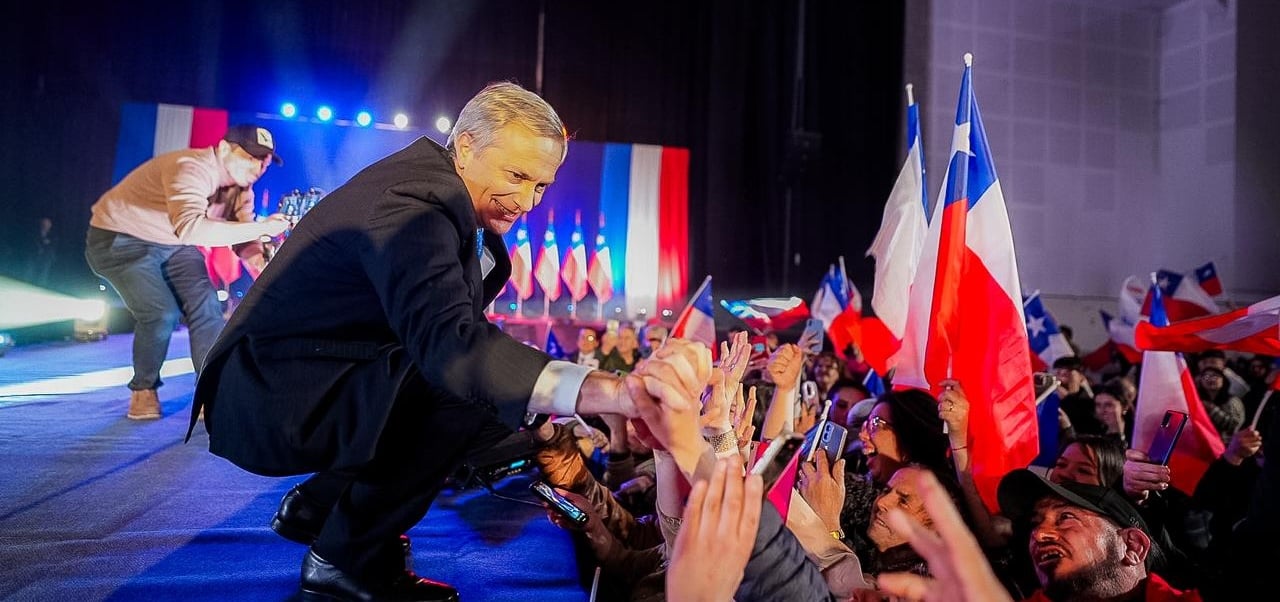
In 2017, Sebastián Piñera—Chile’s leading center-right figure—stood on the threshold of his second presidential term. He appeared poised to unify the opposition and reclaim La Moneda (the Chilean government palace) with little resistance. His leadership, at least on the surface, seemed unassailable.
Yet history would show that nothing was guaranteed. Although Piñera ultimately prevailed, his path to victory was far more fraught than expected. From the right emerged an unexpected warning: “I believe in God, in patriotic devotion, in the family . . . I also believe in freedom, in competition, and in the rule of law. As you can see, nothing very original.”
The words belonged to Congressman José Antonio Kast, who had just resigned from the UDI—the traditional conservative party—accusing it of drifting toward moderation, or “Piñera-ization,” in its political, economic, and cultural commitments. Indeed, Piñera’s first administration (2010–2014) had altered the ideological anatomy of the center-right, ushering in what R. R. Reno has termed “cultural deregulation”: The movement that once married free-market dynamism with patriotic sentiment and Christian moral intuition had by 2017 morphed into something technocratic, cosmopolitan, and—at least ostensibly—politically and anthropologically “neutral.”
But as Alasdair MacIntyre, Charles Taylor, and Patrick Deneen have each demonstrated, such neutrality is a fiction. There is no public square without a vision of the human good. Chile’s center-right had uncritically accepted the liberal myth that a stable political project could be erected without a substantive account of the person, community, and flourishing. And as Richard John Neuhaus warned in The Naked Public Square, when religion is banished from civic life, it is not neutrality that takes its place, but a militant—today, unmistakably progressive—secular creed.
Kast saw this clearly. He cautioned that if the center-right returned to power without a restored foundation, the progressive left—represented by Giorgio Jackson or Gabriel Boric, icons of the 2011 student movement—would soon occupy the presidency. And so it was. Piñera’s second administration, lacking a coherent political philosophy, unraveled amid the October 2019 uprising, which the new left deftly appropriated, positioning itself as the interpreter of Chile’s social unrest.
The Frente Amplio, far from retreating from philosophical contestation, pressed its advantage. Under its influence, words such as “development,” “quality of life,” “dignity,” and even “human rights” became empty vessels capable of being filled with meanings wholly alien to Chile’s cultural inheritance. This phenomenon—the appropriation of Christian moral vocabulary by an anthropological project at odds with its origins—is precisely what Carl Trueman has diagnosed as the moral inversion of late modernity, wherein the “psychological self” supplants any objective conception of human nature.
Chile had lived through its own May ’68, and the progressive left translated the turmoil into electoral victory. On March 11, 2022, just as Kast had foreseen, Gabriel Boric assumed the presidency.
Yet, as with Roger Scruton—whose conservatism was awakened amid the upheavals of 1968—the October insurrection provoked its own counter-reaction. The torching of subway stations, the harassment of Carabineros (the Chilean police force), the burning of churches—these acts exuded not only subversion but also nihilistic fragmentation. One graffiti image became emblematic: the figure of Christ wielded sacrilegiously above the caption, “Do not forgive them; they know exactly what they are doing.” In that moment, the October movement revealed its darkest impulse: the will to raze every cultural and institutional pillar that supports civilized life.
Despite the revolutionary fervor, Kast remained a formidable contender in the 2021 election, ultimately securing 45 percent of the vote in the runoff. His performance signaled that Chile’s conservative resurgence had only begun.
Kast’s platform, as he humbly noted, was “nothing very original.” A Catholic father of nine and an unwavering defender of life from conception to natural death, he stands firmly within a traditional conservative lineage shaped by Jaime Guzmán—the senator assassinated in 1991 for articulating a political vision grounded in Catholic social doctrine. This Christian foundation—recalling John Paul II’s insistence that no society can prosper while denying the truth about man—gives Kast’s project a distinctly organic character: a political vision emerging naturally from a living moral and cultural tradition, coherent in principle and rooted in a substantive understanding of human flourishing, rather than the merely technocratic or procedural conservatism that has so often dominated the Chilean right.
As elsewhere in the Western world, however, it was the surge in illegal immigration and the arrival of international organized crime that exposed the inadequacy of the progressive government. In this climate, Kast’s emphasis on the rule of law, on borders as expressions of national sovereignty, and on cultural particularity as a source of civic pride gained unprecedented traction.
Here Chile’s experience intersects with contemporary debates in the United States. As Yoram Hazony argues in The Virtue of Nationalism, the nation is not an oppressive fiction but the historical form through which moral obligations are ordered and prioritized. Without borders, responsibility dissolves; without sovereignty, the common good becomes impossible. Chile’s Republicans recognized—as MacIntyre also emphasized—that the modern state must draw upon traditions deeper than liberal technocracy “to be able to engage the patriotic regard of enough of its citizens, if it is to continue functioning effectively.”
Kast’s approach to immigration bears the same moral clarity found in JD Vance’s recent invocations of the ordo amoris. Christian love, properly understood, is not the amorphous humanitarianism that Pierre Manent has termed a “religion of humanity,” but a concrete charity ordered by the bonds of family, neighborhood, and nation into which we are providentially placed. As St. Augustine taught, love without order is not love but sentimentality; to “love everyone” without preference is ultimately to love no one meaningfully.
In Chile’s case, the Republican perspective recognizes both the dignity of migrants—many fleeing the cruelty of Nicolás Maduro’s dictatorship in Venezuela—and the moral obligation of political leaders, by virtue of their own hierarchy of duties and obligations, to prioritize the safety and well-being of their own citizens. Hospitality must be real, but it must also be ordered.
Crucially, Kast’s political vision extends far beyond immigration. The new Chilean right emerged not only as a response to progressive mismanagement of public order but also as a rejection of the center-right’s inability to articulate a holistic account of the common good. For Kast and his movement, addressing public security and declining birth rates simultaneously is not arbitrary but necessary: Social peace is the precondition for family life, and the family is the primary locus of spiritual and civic formation.
On this point, Christopher Lasch’s insights in The Revolt of the Elites resonate deeply: Families and local communities are not vestiges of a pre-modern world, but the only durable bulwarks against the atomization and emotional disintegration wrought by technocratic modernity.
In 2025, Kast’s project faces its decisive test. Now in his third presidential bid, he again reaches the runoff—this time as the frontrunner. His opponent is Jeannette Jara of the Chilean Communist Party. This is unprecedented: In its 103-year history, the Communist Party has never before advanced one of its own to a presidential runoff. And this is not a minor detail. Chilean communism is not a softened, Europeanized social democracy, but a Marxist-Leninist movement that has never severed its ideological ties to Cuba, Nicaragua, or Venezuela.
Jara has attempted to distance herself from her party, even hinting at suspending her membership, yet her lifelong formation in its ranks strains the credibility of such gestures. Her record is further complicated by her poor stewardship of public order during her tenure in the current administration, as well as her history of pursuing legal action against the Carabineros in the volatile years following the 2019 uprising—a posture symbolized by her widely circulated photograph wearing the “Perro Matapacos” T-shirt, a celebrated emblem of anti-police animus.
Viewed against this backdrop, Kast’s prospects are strong. Although Jara finished first in the opening round with 26.85 percent, the combined vote of the opposition—Kast’s 23.92 percent, Johannes Kaiser’s 13.94 percent, Evelyn Matthei’s 12.47 percent, and a substantial share of Franco Parisi’s 19.71 percent—positions the Republican candidate favorably for victory.
Such a victory would mark a turning point. Chile, once hailed as the success story of the Western liberal consensus, has become a testing ground for two irreconcilable anthropologies: one that affirms family, community, nation, order, and transcendence; and another that reduces freedom to subjective desire and the common good to the redistribution of cultural power. In this confrontation, José Antonio Kast stands not merely as a national figure, but as a sign of a broader political and spiritual realignment—one echoed in the ascent of leaders such as Giorgia Meloni in Italy and JD Vance in the United States.
Whether he will prevail remains to be seen. The answer, as Kast himself would affirm, lies in God’s hands.
