
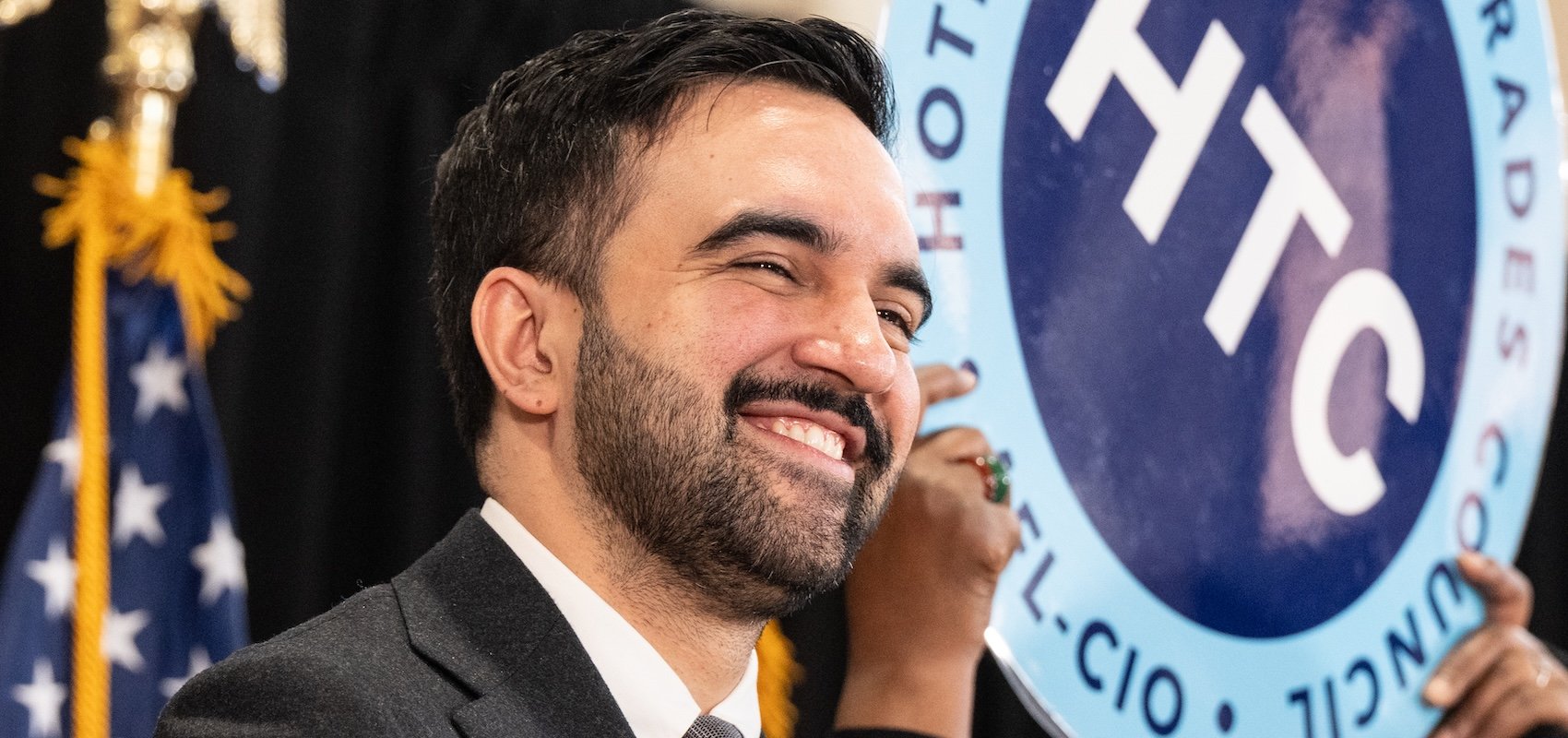
On January 1, newly inaugurated Mayor Zohran Mamdani made a solemn vow to his constituents: “I promise you this: If you are a New Yorker, I am your mayor. Regardless of whether we agree, I will protect you, celebrate with you, mourn alongside you, and never, not for a second, hide from you.” No Catholic clergy were invited to the inauguration.
Five weeks later, Ronald Hicks was installed as the eleventh archbishop of New York, but no mayor graced the first pew of St. Patrick’s Cathedral. Mamdani’s absence marked the first time since at least 1939 that the mayor of New York skipped the installation of the Catholic archbishop. On Monday, Mamdani told reporters, “I wasn’t able to make that event,” before adding, “I’m so excited, frankly, at his leadership in this city.”
The mayor’s presence at the installation Mass of a new Catholic archbishop goes back at least to Fiorello La Guardia, who attended Archbishop Francis Spellman’s installation in 1939. Given Spellman’s enormous political power, it behooved La Guardia—a reformer opposed to the Irish-dominated Tammany Hall—to remain on the cardinal’s good side. But the custom is meant to transcend political calculus, connecting public authority across administrations with an institution that anchors New York’s civic and religious life.
So ingrained was the mayor’s attendance at an archbishop’s installation that, at then Archbishop John O’Connor’s 1984 installation, he opened his homily with Ed Koch’s familiar catchphrase—“Mr. Mayor, how’m I doin’?”—prompting laughter and applause from Koch, a secular Jew. The two men became close friends. Cardinal O’Connor offered a depressed Koch consolation and reassurance during a 1986 scandal that engulfed members of his administration, but not the mayor himself. They even co-authored a book in 1989. Koch, a front-row fixture at St. Patrick’s midnight Masses, would later say that he loved O’Connor “like a brother.”
By contrast, a mayor who pledged never to hide from New Yorkers hid from a celebration representing one in three of them. Besides being the largest religious denomination, the Catholic Church operates an extensive network of schools and provides social services in New York City. Even more baffling, as of Monday, Mamdani had not spoken with Hicks yet, despite knowing of his appointment since mid-December. For all of the mayor’s professed excitement for the new archbishop’s leadership, he could hardly find a better way to express apathy.
Mamdani can scarcely claim the benefit of the doubt. He understands how such an absence would be perceived. During the campaign debates, he repeatedly faulted former governor Andrew Cuomo for failing to visit a mosque, casting doubt on Cuomo’s respect and concern for Muslim New Yorkers. As a sitting mayor, it’s only fair to judge him according to that same standard.
Missing the installation Mass wasn’t Mamdani’s only slight against New York’s Catholic community that day. On Friday morning, Mamdani was mere blocks from St. Patrick’s, at the New York Public Library, hosting his first interfaith breakfast. No Catholic priest was present, much less as a speaker. Mamdani used the occasion to lambast ICE and dole out 30,000 printed “Know Your Rights” guides.
What, then, has the mayor made time for? In his inauguration speech, he said that for his government, there would be “no concern too small for it to care about.” In keeping with that theme, during the first weeks of his administration, Mamdani oversaw transportation workers pave an asphalt bump, delivered pizzas to firefighters in Staten Island, and personally shoveled out a van stuck in the snow.
Read charitably, Mamdani’s attention to such trivialities represents an attempt to signal care for the people and everyday concerns that politics too often overlooks. If attending an installation Mass symbolizes the mayor’s attention for Catholics as a whole, his sweating the small stuff offers an alternative symbolism for “ordinary” people.
But doing so sets expectations no mayor can reasonably meet. After all, if he can personally dislodge a random van in Williamsburg during his first major test in office, why can’t he come to my block party, or cut the ribbon at my business’s grand opening?
A politics of small performances cannot come at the expense of showing up when it matters far more. If it does, his judgment comes into question—a political case of being penny-wise and pound-foolish.
If anything, Mamdani wasted an opportunity to generate goodwill and rapport with Archbishop Hicks, who has shown himself to be at least as solicitous to the plight of the marginalized as the mayor. Hicks began his installation homily in Spanish, and spoke of the call to be a “missionary church, not a country club. A club exists to serve its members. The Church exists, on the other hand, to go out and serve all people.”
If Mamdani attends the installation of another religious leader in the future, it will inevitably appear that he brushed off Catholics specifically, that he harbors particular affinity for the other leader, or both. The gospel compels the faithful to forgive, but prudence and justice in a democracy require holding public officials responsible for their decisions.
Mamdani’s inauguration speech declared, “the only expectation I seek to reset is that of small expectations.” For New York’s Catholics, he has lowered expectations of the mayor showing up.
Sipa USA via AP

YOU MIGHT ALSO LIKE
Turned Away on Palm Sunday
In politics, diplomacy, war, or pretty much any field of human interaction, one must contend not only…
Timothée Chalamet Is Right About Art (ft. Suzy Weiss)
In this episode, co-founder and reporter for the Free Press, Suzy Weiss, joins Virginia and Germán to…
A Medieval Pilgrimage in Modern Assisi
When you go to the hilltop town of Assisi, you’re immediately struck by how medieval it is:…
