

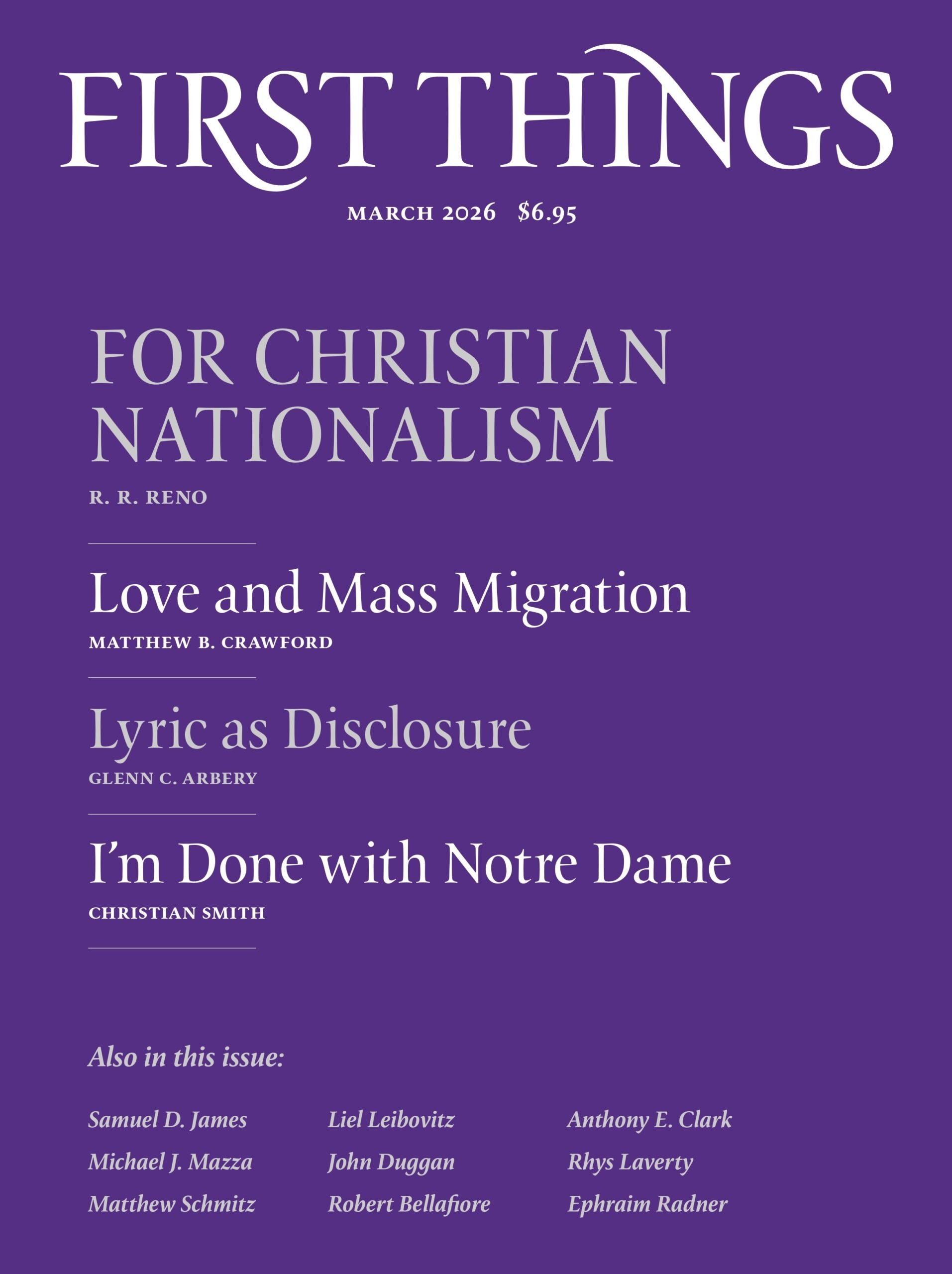
Recent polling paints a disturbing picture: Fewer than half of Gen-Z Americans are extremely or very proud of their country. There’s little doubt that relentless indoctrination in anti-American ideologies at school and in the media contributes to their lukewarm patriotism. But there’s another cause: They’re not stupid. The country shows signs of disease. Each year, a shocking number of people die of drug overdose. Marriage rates have declined. The rate of mothers without husbands has risen. Homeless encampments dot the landscape. A storm surge of pornography and other internet sewage drowns many souls.
Let’s say you’re an intelligent and reasonably observant young fellow. You would ask: How did things get so weird, empty, and pointless? Who let the country become so vulnerable and dysfunctional? The answers are many, but in the broadest terms, diagnosing the diseases that debilitate the body politic is not complicated. America in the twenty-first century was not engineered by evangelical pastors or Catholic bishops. On the contrary, the diseases have festered as Christian influence has receded. An intelligent person surveying today’s unhappy landscape ought to come to a straightforward conclusion: America’s best hope is Christian nationalism.
Unfortunately, few draw this conclusion. They fail to see the benefits of Christian influence in the public square. And so it is necessary to survey anew the points in favor of Christian nationalism.
Karl Popper was an influential exponent of anti-nationalism, which he adumbrated in his influential book The Open Society and Its Enemies. He criticized what he called a “tribal” and “collectivist” mentality. On its face, the criticism seems reasonable. The unity and well-being of the collective should not be the sole good we pursue. We honor God above any nation, and we rightly guard the freedom of individuals. But Popper went much further. In his view, an approach to governance that accords any moral weight to shared identity, whether a religion, culture, or ethnos, invites totalitarianism.
The Open Society and Its Enemies was published in 1945. At that time, Popper’s exaggerated polemic against the slightest hint of collective purpose was not widely adopted. In the decades immediately after World War II, America’s confrontation with the Soviet Union required social unity, which was encouraged by patriotic rhetoric and ritual. Nevertheless, Popper’s anti-nationalism was insinuated deeply into the postwar consensus. His image of an open society acquired tremendous moral prestige, and its antithesis, the “closed society,” became our paradoxically collective bugbear.
Our problems flow from the triumph of the open society, which has eroded our shared prosperity, fragmented our nation, and dispirited our fellow citizens. We are in a season of disintegration and polarization, not hyper-consolidation and dedication to collective purposes. Our historical moment calls for nationalism. We can (and should) debate how to serve the nation’s needs, how to repair the nation’s wounds, and how to renew the nation’s confidence. But I think that only those who are atavistically wedded to the open-society consensus can be blind to the need for nationalism.
Nationalism has many forms, which differ significantly in detail. But we can recognize underlying commonalities. As an “-ism,” nationalism becomes the fitting and responsible approach at times of collective crisis. Nationalism is called for when the body politic is threatened by disintegration, either under blows from external enemies or because of internal conflicts and contradictions. The fittingness stems from the fact that, as an “-ism,” nationalism mandates political judgments and encourages popular sentiments that give priority to the interests, needs, and purposes of the collective. Nationalism aims to restore solidarity, which is what America needs as she celebrates the 250th anniversary of the Declaration of Independence.
Perhaps the reader concedes that, yes, we need a bit of nationalism these days. But why Christian nationalism? Short answer: Because it’s the best kind. Christianity frames the nationalist project—which can go wrong, as history reminds us—with timeless truths. There are advantages to an approach to national reconsolidation that is guided by capital-T truth. Let me count the ways.
Christian nationalism is self-limiting. All political projects have extremist tendencies. In recent decades, American liberalism became unmoored. In the modern era, its central project has been to nurture and protect freedom. It was long limited by a Christian understanding of true freedom, which honors and obeys truths not of our making. As Christianity’s influence over public life receded, liberalism evolved to warrant plenary freedom to do as one pleases, even to the point of insisting that everyone has a “right” to choose his or her own sex, when to end his or her own life, and whether to end the life of a child in the womb.
Nationalism aims to promote the common good. It’s a political project ordered to securing national sovereignty, encouraging greater collective unity, and promoting more equitable sharing of worldly burdens and blessings. Just as the liberal endeavor can slide toward libertarian and individualistic extremes, nationalism’s collective spirit can go too far. The defense of sovereignty may become a bellicose and limitless effort to destroy all foreign threats. Unity may become suffocating homogeneity. A dangerous utopian egalitarianism may supplant the reasonable pursuit of equitable economic and social conditions. What’s needed is a braking mechanism. This is what Christianity provides.
When people cringe at the words “Christian nationalism,” for the most part, they harbor an overriding worry: Are the Bible-thumpers looking to establish a theocracy? Are Christian nationalists aiming to install Jesus (by way of his self-appointed surrogate) as omnipotent legislator and commander-in-chief?
Note well Jesus’s response to Pontius Pilate after his arrest. He does not say that he is not a king. Rather, he reminds Pilate of an obvious truth, which is that he lacks an army of followers who will fight for him and prevent his arrest. It’s a telling point. What kind of king goes around without palace guards? What kind of theocrat lacks Secret Service protection? If Jesus had been aiming to overthrow Herod, then he was comically ill-equipped. Having adverted to basic truths of realpolitik, Jesus makes his role clear to Pilate: “My kingship is not of this world.”
“Not of this world” might reassure those who fear theocracy. But what about the threat of rampant nationalism? If it’s not of this world, and therefore not political, then how does the Christianity in Christian nationalism restrain the political excesses that have shipwrecked pagan nationalisms such as National Socialism? The answer is found in what Jesus goes on to say.
At first glance, Jesus’s words would seem to reassure those who wish for a purely secular politics: not of this world, and therefore politically irrelevant. However, I read Jesus’s famous statement of his supra-political purpose as a warning, not just to Pontius Pilate, but to all who hold public office and exercise political authority. This meaning comes clear when Pilate, who is perhaps confused, repeats his question: “So you are a king?” Jesus replies with a succinct explanation of his lordship: “For this I was born, and for this I came into the world, to testify to the truth. Everyone who belongs to the truth listens to my voice.” So, yes, Jesus is a revolutionary contesting for power. But the stakes are much higher than those imagined by Pilate, or by critics of Christian nationalism. Jesus intends to lead a rebellion in our hearts, overthrowing the principalities and powers that rule this world and installing himself as our lord and master.
A few centuries later, Augustine explained Jesus’s spiritual lordship in relation to politics by way of a conceptual distinction. Pontius Pilate is but an instance of the magistrates who govern the city of man. In this earthly city, they wield the power of the sword to encourage virtue and punish wrongdoers, aiming (if they are godly rulers) to attain a tranquility of order. In contrast to Karl Popper’s Manichean distinction between the open society and the closed society, Augustine established the “decent society” as the highest ambition of worldly politics. This goal is quite different from that of the city of God. The heavenly city is ordered to the peace of God that passes all understanding, which is attained in and through the supreme and sole lordship of Christ. That city, inaugurated by the calling of Abraham, is most definitely a theocracy. But it is not “of this world,” which means that it should not be the aim of worldly politics.
Like Popper, the political philosopher Eric Voegelin lived through the ideological brutalities of the early twentieth century. A young professor at the University of Vienna, he fled Austria in 1938 after the Nazi takeover. This experience inspired Voegelin to reflect on the utopian temptations of modern political ideologies, which promise deliverance but deliver tyranny. Voegelin proposed that the grave flaw of these ideologies rests in their call for us to take responsibility for the final consummation and perfection of all things. He called this transfer of responsibility from God to us the “immanentization of the eschaton,” making what is properly a divine project into a political one.
Voegelin was surely right about the utopian perversion of modern politics. Secularization has not eliminated the religious impulse. Instead, the absence of God has led men to redirect their desire for transcendence into political dreams. Russian communism gave rise to the ambition to create the New Soviet Man, a secular version of St. Paul’s teaching in 2 Corinthians 5:17: “If anyone is in Christ, he is a new creation; the old has passed away, behold, the new has come.” As we know, when men try to make a new creation, they must rely on manipulation, deception, and coercion, dehumanizing citizens rather than ushering in the promised world of perfect justice.
Christian nationalism tempers the native idealism of America, which has not been immune to utopian aspirations. After the revolution, some embraced the notion that American society would inaugurate a new order for the ages (novus ordo seclorum). At best, this sentiment reflects an exaggerated patriotism. At worst, it mandates an American-led global revolution. The Christianity in Christian Nationalism disabuses its adherents of this disastrous fantasy.
The self-limiting character of Christian nationalism rests in more than Augustine’s distinction between the city of man and the city of God. Christianity promotes forms of life that by their very nature militate against overweening political projects.
Christian faith is not an individualistic enterprise. Discipleship is corporate. Christ calls us to become members of his body, the Church, and a Christian’s loyalty to the Church transcends his loyalty to America or any other country. For this reason, in a society animated by Christian nationalism, a vigorous and self-confident Church restrains the state from above.
At the same time, Christ instills in his followers a respect for the natural order of life, which is rooted in marriage and the family. Here again, bonds of loyalty engage the heart against the intrusion of the state. As we have seen in recent elections, parents are roused to resist the ideological capture of their children by progressive teachers and school administrators. The natural family, rooted in marriage, restrains the state from below.
As I know from experience, if you express support for Christian nationalism, readers of the New York Times immediately warn that you’re aiming to create a theocracy. This alarmism reflects an unfortunate ignorance. Christianity invented secular politics. The doctrine of the two swords—the spiritual sword of the Church and the secular sword of the magistrate—created room for a this-worldly concept of governance. God superintends all human affairs. The sword of the magistrate is ordained by God (Rom. 13:1). But the purpose of government is not to make disciples of Christ. Political authority serves the gospel indirectly by promoting a decent society, a well-ordered but not sacralized realm in which the gospel can be proclaimed and God worshiped in a proper fashion—which happens in churches, not in state houses.
Christian nationalism encourages us to care for our nation and helps us resist the pressures of a globalized economy, as well as the cosmopolitan universalism that arises from today’s ersatz religion of humanity. But because Christian nationalism is Christian, it is self-limiting. It does not fall prey to the utopian dreams of progressivism, and it curbs the sometimes unrestrained zeal of patriotism. Christian nationalism subordinates our proper and natural ardor for our nation’s sovereignty, prosperity, and civic health to the higher and supernatural love of God.
Christian nationalism encourages political realism. Many people dismiss the doctrine of original sin as a depressing, pessimistic doctrine. They think this way because they are imbued with the modern illusion that man is by nature good, needing only to be freed from bad influences, whereupon he will shower others with his benevolence. The Christian view, by contrast, is realistic. Left to our own devices, we will serve ourselves, not others.
For this reason, the doctrine of original sin is salutary for any approach to governance. A Christian nationalist recognizes that the first task of the magistrate is to restrain sin and punish wrongdoers (Rom. 13:4). The doctrine of original sin clarifies a sad but undeniable fact: There will be people who cheat, steal, and murder. They must be punished and deterred. No society can function without a firm hand that restrains sin.
But the Christian nationalist also knows that those—including himself—who make and enforce laws have imperfect motives. The policeman may enjoy his power and use it in arbitrary ways. The judge may take improper pride in his Christian virtue and exercise mercy when he should impose justice. The prison warden may slide toward a sadistic pleasure in the wretchedness of his inmates. Sin worms its way into every heart.
The Christian’s awareness that none are exempt from God’s judgment encourages constant vigilance. The Christian nationalist will never summarily dismiss criticisms of our present system. Every legal regime and cultural consensus is infected by sin. All require ceaseless efforts of reform.
At the same time, the Christian nationalist is not susceptible to moralistic dismissals of our imperfect order. He will not rush to tear down statues. The doctrine of original sin leads us to anticipate warts. It warns us against the illusion that we are somehow purer and more just than our forebears. Indeed, the doctrine of original sin discourages belief in moral progress. No society or era diminishes the net total of evil done by men. Yes, contemporary America has reduced the injustices of racism. But school shootings were not regular occurances before the Civil Rights Act of 1964, nor was there legal license for the killing of children in the womb. The proper balance of confident moral purpose and skeptical self-examination is difficult to attain in public life, and Christian leaders cannot claim a stellar record. Nonetheless, their faith encourages them to seek the right balance, which is very much needed today. The renewal of the country will require steady commitment and confident purpose. But history reminds us of the peril of unrestrained nationalism. Self-criticism is always needed. For this reason, Christian nationalism is the form of civic renewal most likely to attain nationalist goals while avoiding the excesses of nationalism.
Belief in divine providence also contributes to a political realism that not only is alive to the morally compromised nature of civic life, but also avoids the civic enervation that comes from despair. A belief that divine purpose guides the affairs of men takes some of the sting out of our inevitable failures and defeats. It allows us to maintain equanimity when those we believe are misguided gain the levers of power. The doctrine of divine providence reminds us that they are in some way serving God’s purposes, to which we are not privy.
The disposition of man’s worldly endeavors is in God’s hand. He is the author of final justice, and this fact relieves us of the weight of ultimate responsibility, freeing us to attend to our duties: to bind up the nation’s wounds, to restore solidarity, to attain what justice and peace God has ordained that we should achieve in the time he has given us.
The doctrine of divine providence is not unique to Christianity. Most religions envision a greater power that guides and governs history. But the moral and political imagination of Western civilization has been shaped by Christianity. For this reason, Christian nationalism is the most likely source of political renewal that instills both humility and purpose. We need both in twenty-first-century America.
Christian nationalism renews the moral foundations of civic culture. The main problem facing America is not a lack of faith in Jesus Christ. It is a lack of belief in anything whatsoever. Our society tends toward a tacit (and sometimes explicit) nihilism.
Today’s progressive moralism would seem to contradict my claim that nihilism abounds. Aren’t woke warriors animated by convictions, however misguided? Indeed they are. But their devotion is to the future, which does not exist. Hence the paradox of nihilistic idealism. We should be accepting of nonbinary individuals, the progressives insist. Why, we ask? Because to do so will help us create a society in which all are welcome! But doesn’t welcoming the nonbinary person require excluding the Christian (or, for that matter, the scientist) who insists that the male–female difference is fundamental? Yes, the patron of inclusion replies. We cannot build an inclusive future unless everyone is inclusive. The contradictions are of no moment. We will build a new world, a new truth, which is another way of saying that truth is relative.
Christians often battle over dogmas and doctrines. But we agree that God’s creation includes a moral order. Our reason is darkened by sin. In his wisdom, God addresses this defect by laying down clear rules. The Ten Commandments provide a handy summation of the moral order. This revelation is telling us nothing we don’t already know, however dimly. It reinforces the innate capacity of each person to distinguish right from wrong. As St. Paul teaches, when it comes to recognizing that we should honor our Heavenly Father and our earthly parents, and that murder and theft are wrong, the Gentiles muddle through, more or less. In so doing, “They show that what the law requires is written on their hearts.”
Like a driver falling asleep at the wheel, our nihilistic society needs to be jolted awake. The law written on the hearts of our fellow citizens has been obscured by propaganda, miseducation, and the broad accommodation (and often encouragement) of vice. Philosophical seminars are unlikely to overcome this deadening of the moral sense. What’s needed is clear and firm teaching. Jordan Peterson gained a following by admonishing young men to make their beds. Christians have a much fuller tradition of moral instruction to offer.
I do not wish to deny the positive contributions that secular voices can make to moral renewal. You don’t need to be born again in Christ to recognize that unlimited internet pornography is destroying souls, or that legalized marijuana abandons our fellow citizens to their vices. And, of course, Jews and Muslims who cleave to the clear teachings of their traditions are spokesmen for the moral truths woven into the fabric of creation. But in America, Christianity has the greatest cultural throw weight.
Anyone who is genuinely concerned to combat today’s debilitating nihilism and renew the moral foundations of the nation should support Christian nationalism, even if he is an atheist or agnostic or subscribes to another religion. The greater the influence of Christianity over the future of American society, the more it is likely that we will see a restoration of decency, to say nothing of virtue.
Christian nationalism restores America’s culture of freedom. In English translations of the New Testament, the Greek word eleutheria is rendered as “freedom.” A famous example comes from St. Paul’s letter to the Galatians: “It was for freedom that Christ has set us free.” This kind of freedom does not entail unhindered choice. Instead, if we look to ancient Greek usage, we see that a free man differs from a slave in that he is a citizen of a city, which imposes duties as well as accords rights. Here is how Joseph Ratzinger glosses eleutheria: “It means possession of full rights, full membership, being at home . . . The free man is one who is at home, that is, one who really belongs to the household. Freedom has to do with being given a home.”
The notion of home is crucial. Freedom requires a firm and steady sense of self, which comes from belonging to something or someone or someplace. The martyrs are images of perfect freedom. They belong to Christ and have a home in his household. For this reason, they are free to remain strong in their faith, even against threats of torture and death.
Contemporary Americans lack freedom, and not primarily because of government oppression. Rather, the progressive project has disintegrated our “homes,” one of the most important of which is marriage. In my experience, domestic life is a domain in which most Americans discover the full measure of their inner strength. Husbands and wives endure tough times together. Fathers and mothers make sacrifices for their children. As recent dust ups over transgender ideology at school board meetings demonstrate, when you mess with children, parents will stand up to authority.
Another “home” is our nation. Patriotism inspires loyalty. Men will rise to defend their nation and heritage. Here as well our inheritance has been severely damaged by progressive ideologies. I don’t want to litigate the historical veracity of the 1619 Project. I have a larger point: Our schools and media are filled with messages that erode our sense of being “at home” in America. The effect is to demoralize. A dispirited individual lacks the ardor to live as a free man.
Jesus reminds us that our true citizenship is in his kingdom, and he warns us that his followers may be required to hate their mothers and fathers. But in most circumstances, our earthly homes and temporal loyalties prepare our hearts for love of God. These loves nurture freedom.
Another New Testament word for freedom clarifies the ways in which love’s demands bring freedom. That word is the Greek parrhesia. It can be translated as “frankness” or “candor,” which means freely speaking one’s mind, rather than hedging or accommodating one’s words to external pressure.
In the New Testament, the most striking instance of parrhesia comes in the fourth and fifth chapters of the Acts of the Apostles. Peter and his colleagues preach the truth of Christ crucified and risen. The temple authorities are outraged by their brashness. They issue a cease-and-desist order. But Peter and his little band ignore these powerful men. Threats of arrest and imprisonment will not silence them. When they are called before the equivalent of today’s DEI commissars, these men, who live under the lordship of Christ, say: “We must obey God rather than men.”
That short sentence expresses the world’s most fundamental declaration of independence. Peter and the others lack legal rights. They enjoy no constitutional protection. No court will grant them relief. But they are free, not just in their words, but in every respect.
Many believe we can restore freedom by litigation for our rights. Or that we must slay the woke beast. Or drain the swamp and shrink the government. I’m in favor of these measures. But we need to allow Scripture to instruct us: Freedom comes from love’s capacity to motivate indomitable devotion. As followers of Jesus, we are called to nurture love, love of God first and foremost, but love of spouse, children, and flag as well. Christian nationalism holds out the greatest promise for restoring a civilization of love, and with it a culture of freedom.
More than a decade ago, I met Bobby Lopez. He was then a professor at Cal State, Northridge. In obedience to his Christian faith (and, I should add, informed by his experience being raised by a lesbian couple), Lopez took a courageous public stand against same-sex marriage. He was attacked by student activists and harassed by university administrators. Yet, as he told me, his classes were always overflowing with students. This perplexed Lopez. He knew that these students did not share his faith or agree with him about sexual morality. “Why,” he asked me, “do they want me as their teacher?”
I remember telling him that the answer was obvious. The young people in his classes were in bondage to the principalities and powers that rule our morally deregulated society. They saw in Lopez a man who enjoyed parrhesia, a man with the freedom to speak his convictions. Perhaps those young students disagreed with his convictions. But in Lopez they had a glimpse of freedom, which they desired.
Christians are blessed with loves—for our Lord and Savior above all, but also for our spouses, children, communities, and nations. These loves “own” us, and in being “owned,” we know who we are; we know where we stand. Love stiffens our spines, giving us the strength and determination to honor, protect, and promote that which we love. This strength and determination make us free. Christians in twenty-first-century America are the advance guard of those who refuse to kowtow, compromise, or be pushed around. The larger the ranks of the soldiers of Christ, the more likely that America will see a new birth of freedom. Any citizen of this great land who cares about freedom, whatever his beliefs, ought to welcome Christian nationalism.
Christians can reject nationalism. It is not a gospel imperative. Nationalism is warranted by prudent discernment of the political and cultural needs of the moment. I and others endorse nationalism because we have made an all-things-considered judgment that our present moral, social, and political problems are best addressed by defending and buttressing national solidarity.
When a Christian agrees with me about the pressing need for national restoration, I find it more than a little strange if he shrinks from the “Christian” element in Christian nationalism. Wouldn’t the nation be better off if Christianity exercised more influence in public life? Doesn’t the prayer that all things will fall under the lordship of Christ include the nation, however indirect that lordship can and must be until he returns in glory?
What about serious Jews, Muslims, and those of other faiths? I allow that they might prefer Jewish nationalism, Muslim nationalism, or some other approach. But political wisdom counsels support for the possible rather than quests for the unlikely. Shouldn’t all believers, whatever their faith, hope for a future in which American society is leavened by a strong commitment to honoring God and conforming to the moral order of creation? In view of our nation’s history and present population, is this future possible without Christian leadership? Supporting Christian nationalism would seem the sensible and worthy approach for all religiously committed Americans.
Secular Americans concerned about restoring national solidarity may have reasons to reject Christian nationalism. They have a right to place their hopes in liberal nationalism, or perhaps in one or another pagan nationalism. But they need not fear that Christian nationalism entails a theocracy or would compel their consciences. Christianity invented the secular realm, which is why Christianity is alone among religions in according a great deal of scope for secular leaders to govern in accordance with moral truths rather than saving doctrines. In the early nineteenth century, churchgoers in America voted to disestablish churches in Massachusetts, Connecticut, and elsewhere. And Baptists—the biggest voting bloc within the Religious Right—invented the doctrine of strict separation of Church and state.
I’ll end with a final word of assurance to those frightened by talk of Christian nationalism: It’s very unlikely to become the beating heart of the American right, to say nothing of the left. I foresee a future in which nationalism will wax strong. As a Christian, I’ll participate in that movement, as I hope other Christians will. Our task will be to bring the wisdom of Christian nationalism to whatever coalition emerges that seeks to restore America. Not the least of that wisdom is a clear-minded recognition of the limits of all political enterprises—including nationalism.


YOU MIGHT ALSO LIKE
Via Crucis, 2026
The Way of the Cross—and the third, seventh, and ninth stations in particular—has been an especially appropriate…
Trump’s Civilizational Project
Secretary of State Marco Rubio spoke at the recent Munich Security Conference. Last year, Vice President JD…
How to Bring Back School Prayer
Though it was overshadowed by the reversal of Roe v. Wade the Friday before, the Supreme Court’s…
