
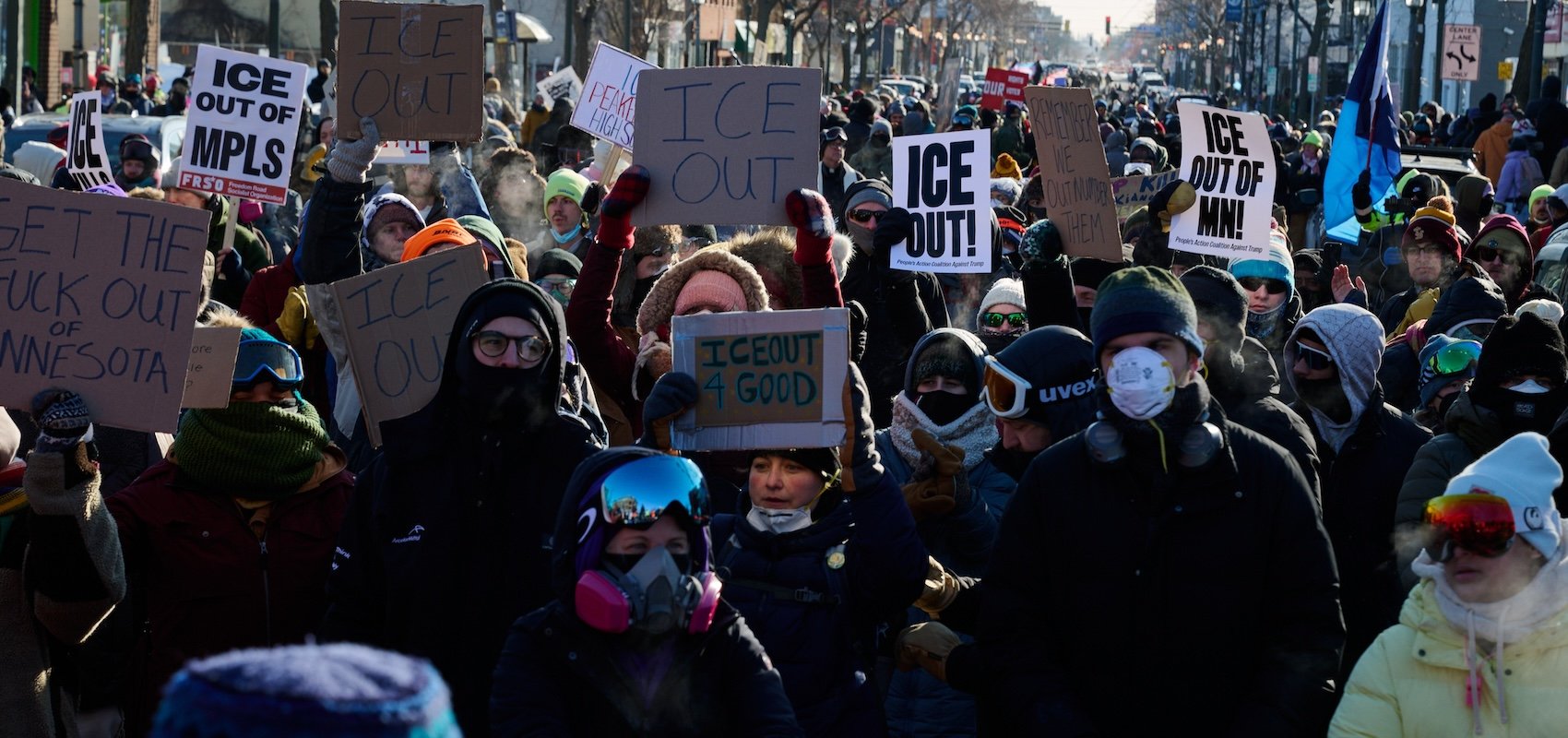
The Battle of Minneapolis is the latest flashpoint in our ongoing regime-level political conflict. It pits not just rival political parties, but diametrically opposed conceptions of government against one another. The most basic political questions are: “Who rules? On what ground? And for what purpose?” The belligerents in Minneapolis answer these questions in incompatible, opposed ways.
The Trump administration understands itself as the legitimate representatives of the American people, possessing authority derived from their constitutionally expressed consent, seeking to execute congressional statutes regulating immigration, and doing so with a popular mandate from 2024, when “securing the border” and “mass deportations” were explicit priorities set by the winning candidate. The One Big Beautiful Bill’s fivefold increase of funding to immigration-enforcement agencies provided the immediate legislative warrant, as well as the necessary means, to carry out Trump’s enforcement promises. And the administration has been doing just that across the country, with few hiccups, in all those jurisdictions where elected officials, law enforcement, and the general population comply with, and even assist, the enforcement of immigration law.
But the fundamental issues—that this nation has a border, that its people have the right to decide how to regulate it, that its government possesses legitimate means to enforce these regulations—were decided long ago by statute, the Constitution, and common sense. There are many in the administration who, if asked to define what “common good” they are pursuing, could point without hesitation or embarrassment to the Preamble to the Constitution: “to form a more perfect Union, establish Justice, insure domestic Tranquility, provide for the common defence, promote the general Welfare, and secure the Blessings of Liberty to ourselves and our Posterity.” The emphasis in the last clause is on “ourselves and our Posterity”: the limited, particular community that any good government, and especially a republic, ought to serve. As agents of a duly established government operating within the bounds of its constitution and the natural law, federal agents possess the authority to enforce the law, including by coercion.
Opposed to this is the whole coalition of the contemporary left, from Democratic elected officials down to the illegal immigrants, “legal observers,” Antifa terrorists, and other brawlers on the streets. Notably, and despite important tensions within it, this coalition not only acts like a highly coordinated network but is such a network, purpose-built to disrupt immigration enforcement throughout the Twin Cities. Integral to its efforts is a sophisticated propaganda strategy: the ceaseless provocation, harassment, and assault of federal law enforcement personnel until a violent incident, caught on video, emerges that can be used to further inflame indignation at the agencies in question, thus inspiring greater resistance and casting graver doubts on their very legitimacy. The two fatalities thus far, Renee Good and Alex Pretti, exemplify the inherent risk involved for those who enlist.
What has brought this left coalition together? At the official top, the Democratic Party actually believes that “our democracy” means the permanent and untrammeled rule by Democrats and the millions of popularly unaccountable, but reliably liberal, bureaucrats who staff the administrative state. At the street level, committed Antifa terrorists actually believe that having and enforcing borders, like having a natural family or worshipping God, is fascist, and that “fascism” is the sum of all that is evil, oppressive, and worthy of destruction.
Of course, any self-respecting anarchist would hold the polished and professional members of the Democratic Party, with their bourgeois values and liberal incrementalism, in utter contempt. But the strategic and tactical integration between the “high” and “low” elements of this coalition suggests a deeper harmony. The anarchist creed, “No Gods, No Masters,” and all that it implies about God, family, property, and the nation, is increasingly professed in the most respectably liberal venues. And the consistent application of liberal power, from the effective dissolution of the southern border to attempted dissolution of the difference between male and female, has all worked in the same anarchic direction. The left coalition seeks to destroy the institutions and populations they have loudly proclaimed, decade after decade, to be blood-stained, illegitimate, and oppressive, while materially benefiting the peoples they deem to be the greatest victims. In the Battle of Minneapolis, the illegitimacy of immigration enforcement as such—that is, the dissolution of America as a distinct, self-governing nation—is the crucial point of agreement between the business-suit sanctuary city mayors and black-clad Antifa terrorists. In the words of a 2001 anarchist classic (bemusingly blurbed by the arch-establishment New York Times Book Review), the goal is to “eclipse the past” and “usurp the future.” “Happy smashing!”
It is a sad irony that such fundamental political disagreements have come to the fore during the semiquincentennial of the Declaration of Independence, which proclaimed the right of “one people” to “assume among the powers of the earth, the separate and equal station to which the Laws of Nature and of Nature’s God entitle them.” But wishing away the problem is no solution. Nor can we tolerate a watering-down of our Founding principles to pretend that the present insanities of the American left are somehow compatible with our tradition. Whatever strategy and tactics it employs in the near term, the Trump administration would be unwise to back away from this conflict. To do so would be to fail the American people—not only those of us who believe that the Constitution still ought to govern us, but also those who, for whatever reason, are tempted to throw their lives into the chaos on the streets of liberal cities like Minneapolis.
Photo by Christian Zander/NurPhoto via AP

YOU MIGHT ALSO LIKE
How the State Failed Noelia Castillo
On March 26, Noelia Castillo, a twenty-five-year-old Spanish woman, was killed by her doctors at her own…
The Mind’s Profane and Sacred Loves
The teachers you have make all the difference in your life. That they happened to come into…
History’s Pro Tips on Iran
Nothing in human experience compares to the wars of the last 120 years. Their scope has grown…
