
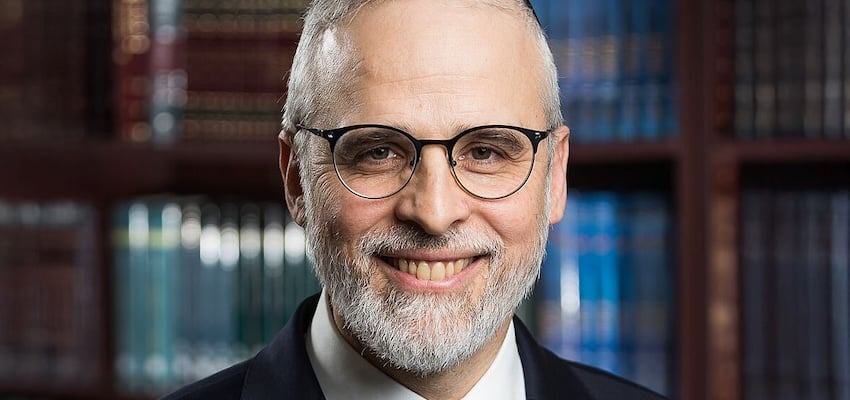
In an era when disagreement often feels synonymous with disdain, the life and career of Rabbi Moshe Hauer, who passed away suddenly on October 14, stand as proof that conviction does not require confrontation. As executive vice president of the Orthodox Union (OU), the largest Orthodox Jewish organization in North America, where I work, he was one of the most thoughtful religious leaders of his generation. His loss leaves a void not only in the Jewish community but in the moral fabric of American life.
Rabbi Hauer was an Orthodox rabbi, a label that to many outside observers implies inflexibility: laws, obligations, technicalities, and a worldview resistant to change. Yet those who encountered him, from progressive Jewish leaders to Christian clergy and secular professionals, found in him a man of grace, empathy, and intellectual generosity. Most people assume that coexistence requires compromise, that maintaining friendships across ideological lines means retreating from principle. Rabbi Hauer rejected that assumption.
In countless meetings and public appearances, Rabbi Hauer listened attentively, albeit with great concern, even to those who questioned the values he held sacred. The respect he showed was not strategy but sincerity. He believed that every human being is created b’tzelem Elokim, in the image of God, which compelled him to treat every person as worthy of dignity no matter how strongly he disagreed. People who expected confrontation found conversation. Those prepared to defend themselves discovered they could instead open up to a warm friend.
Rabbi Hauer’s approach exposes a false dichotomy that dominates modern discourse: the idea that one must either compromise or condemn. He charted a third path. He understood that compromise may preserve relationships temporarily but often weakens both truth and trust. If friendship depends on pretending differences don’t exist, it is not genuine. The better way, he believed, is honesty suffused with compassion.
This guided his leadership of the OU, where he built coalitions with non-Orthodox Jewish leaders on issues like anti-Semitism and communal security, even as he maintained sharp theological boundaries. It guided his advocacy for family, education, and moral clarity in the public sphere, where he worked with faith leaders and policymakers from diverse backgrounds. It guided his pastoral work, where he counseled people across the religious and political spectrum with empathy and discretion.
When paying a condolence visit to the family, I sat next to an unlikely visitor. In a room full of Orthodox Jews sat Rabbi Rick Jacobs, the president of the progressive Union for Reform Judaism. Rabbi Jacobs commented about the deep friendship and comradery he experienced with Rabbi Hauer, even while both passionately believed in opposing worldviews. Everyone present was moved by the love between these ideological opponents.
America is drowning in a culture of outrage. It is hard to even remember when public debate was about persuasion rather than performance. Rabbi Hauer modeled another way. His presence and demeanor were his arguments: that strength and compassion can coexist, that moral clarity and openheartedness can reinforce each other.
The Torah’s laws are not just rules of conduct but also “ways of peace.” Part and parcel of observing the many divine rules is also disagreeing peacefully and respectfully, albeit vigorously and passionately. The path of peace is not paved by ignoring differences or lowering standards. It is paved by seeing others as partners in society, even when their conclusions diverge dramatically. Rabbi Hauer believed that while disagreement is not a flaw of society, disagreeableness is a flaw of character. The danger lies not in disagreement itself but in the absence of goodwill that must accompany it.
Rabbi Hauer loved people enough to tell them the truth. He loved truth enough to tell it gently. This was not tolerance in the contemporary sense of benign indifference. It was a more demanding standard: caring deeply about others while standing firmly for what one believes.
Rabbi Hauer’s life offers a moral methodology this fractured nation needs. The Torah teaches traditional morals and family values, among which civility and respect play important roles. He modeled this in his leadership of the OU, in his writing and teaching, and in private, where no title or prestige could obscure his humility.
His final lesson to this country is that to disagree agreeably is not weakness. It is moral maturity. His legacy challenges every one of us, leader and lay person, to rediscover that balance.

YOU MIGHT ALSO LIKE
Canada’s Offensive Secularism
On March 25, the Canadian House of Commons voted to repeal the good faith religious opinion defense…
A Win for Christian Counselors and Religious Liberty
In a resounding victory for religious liberty on Tuesday, the U.S. Supreme Court ruled 8–1 in Chiles…
What Drag Queens and Blackface Have in Common
My new book, The Desecration of Man, emerged from something I had noticed while researching questions of…
