
This article is adapted from a talk delivered at the 2025 National Conservatism Conference.
Nietzsche, in his Genealogy of Morals, is prescient once again: “In case [the psychologists] might for once want to study ressentiment at close quarters: this plant now blooms most beautifully among anarchists and anti-Semites, in hidden places, just where it has always flowered.”
With the definitive shift of young men to the right, a new anxiety has arisen among Movement Conservatism, reaching a paroxysm in recent weeks: the rise of the so-called Groyper Right. “Groyper” is on its way to becoming a new polemical synonym for “Nazi” or “fascist,” but to the extent that the word retains any specificity, the Groyper is an adherent of, platformer of, or perhaps even merely someone who occasionally laughs at the jokes of, the online influencer Nick Fuentes. Among Fuentes’s many (many) talking points runs a consistent thread of anti-Semitism, and this seems to be the main objection of his alarmed critics.
But Nietzsche identified a wider problem affecting our male youth, in light of which Fuentes and even anti-Semitism are mere epiphenomena. The root issue is resentment (ressentiment), which subverts the Will to Power away from the manly activities of building, conquest, and heroism into conniving attempts at backchannel manipulation, or the vengeful destruction of a hierarchy for the pure pleasure of seeing it collapse. Nietzsche famously blamed Christianity for the rise of ressentiment in European culture; he identified the force’s origins in priestly power hierarchies, which were mostly absent in ancient Greece, but in his view especially characteristic of the ancient Jews.
But we must remember that resentment is a universal human emotion that waxes and wanes depending on any society’s condition. In his study of the political emotions in Book 2 of the Rhetoric, Aristotle named the culprit in somewhat different terms, namely as envy (phthonos). Envy is “a certain kind of distress at apparent success on the part of one’s peers . . . not that a person may get anything for himself but because of those who have it.” Envy is a destructive emotion of mythic proportions, responsible for the ruin of cities, as in the tale of the sons of Oedipus and the Seven against Thebes, examined in Euripides’s play The Phoenician Women. A Greek Christian like St. Basil the Great could identify envy as the first sin. It was what motivated Satan first to rebel against God. Envy also threatens to rip apart our own polity if we are not careful.
It is understandable that young men should feel disproportionately high resentment after a generation of being shut out of opportunities. They have been told throughout their education—whether public, private, or often even “Classical Christian”—that the very things that make them men render them unfit for promotion: disagreeableness, restless energy, or the uncompromising desire to excel above their peers.
When envy, or resentment, breeds, something is missing. Envy is the evil twin of a more productive emotion, in Aristotle’s view: zelos, a word usually translated as “emulation” but which in fact lies at the root of the English word “zeal.” Zeal, in this classical sense, is “the pain felt when one sees present among others things good and honorable which one is capable of achieving.” It is a good thing and characteristic of good people. Zeal drives people to match the successes of those they admire; it is the competitive drive directed toward the sort of pursuits that forge skill and character. The archaic Greek poet Hesiod identified zelos as a god, aiding Zeus to overthrow his tyrannical father Kronos in the war with the Titans. Zeal also generates economic productivity, and even the highest arts; it is synonymous with the good kind of strife that Hesiod portrays in Works and Days:
Thus neighbor zeals for neighbor,
Hastening on to wealth: this Strife is Good for mortals.
Potter will begrudge a potter, builder will a builder,
A beggar seethes about a beggar, likewise bard for bard.
Classical zeal is the feeling felt toward a charismatic leader who inspires by his personal example. For Aristotle, it is especially characteristic of the great-souled. In other words, it is both an emotion felt toward heroes and the emotion most likely to produce living examples of heroism.
Zeal has a trans-historical dimension as well. Plutarch was one of the greatest devotees of zeal in history, and he wrote his biographies of the greatest Greek and Roman statesmen, the Parallel Lives, to serve as fodder for the zeal of young men in his day. The project seems to have been a bigger success than he could have imagined. It is fair to describe Plutarch’s Lives as the foundational text for Christendom’s uptake of the heroic spirit of antiquity.
Ever since the text made its way to Italy during the Renaissance, it’s been not only a cornerstone of the boyhood education of generations of Europe’s ruling classes, but also a constant companion throughout life for kings and statesmen. King Henry IV of France wrote to his wife, “Plutarch always delights me with a fresh novelty. To love him is to love me; for he has been long time the instructor of my youth. My good mother, to whom I owe all, and who would not wish, she said, to see her son an illustrious dunce, put this book into my hands almost when I was a child at the breast.”
Plutarch’s Lives was one of the five most popular books in the American colonies in the eighteenth century, and far and away the most popular from Greco-Roman antiquity (besides the Bible); it is the most cited text in the Federalist Papers.
In his preface to the Life of Pericles, Plutarch observes that classical zeal, in particular the kind felt toward the dead heroes of the past, can drive people instinctively to excellence, even in the complete absence of moralizing sermons. Zeal thus serves like a magnet, aligning the emotions and values of an individual, a war band, or a whole nation toward an ideal of greatness.
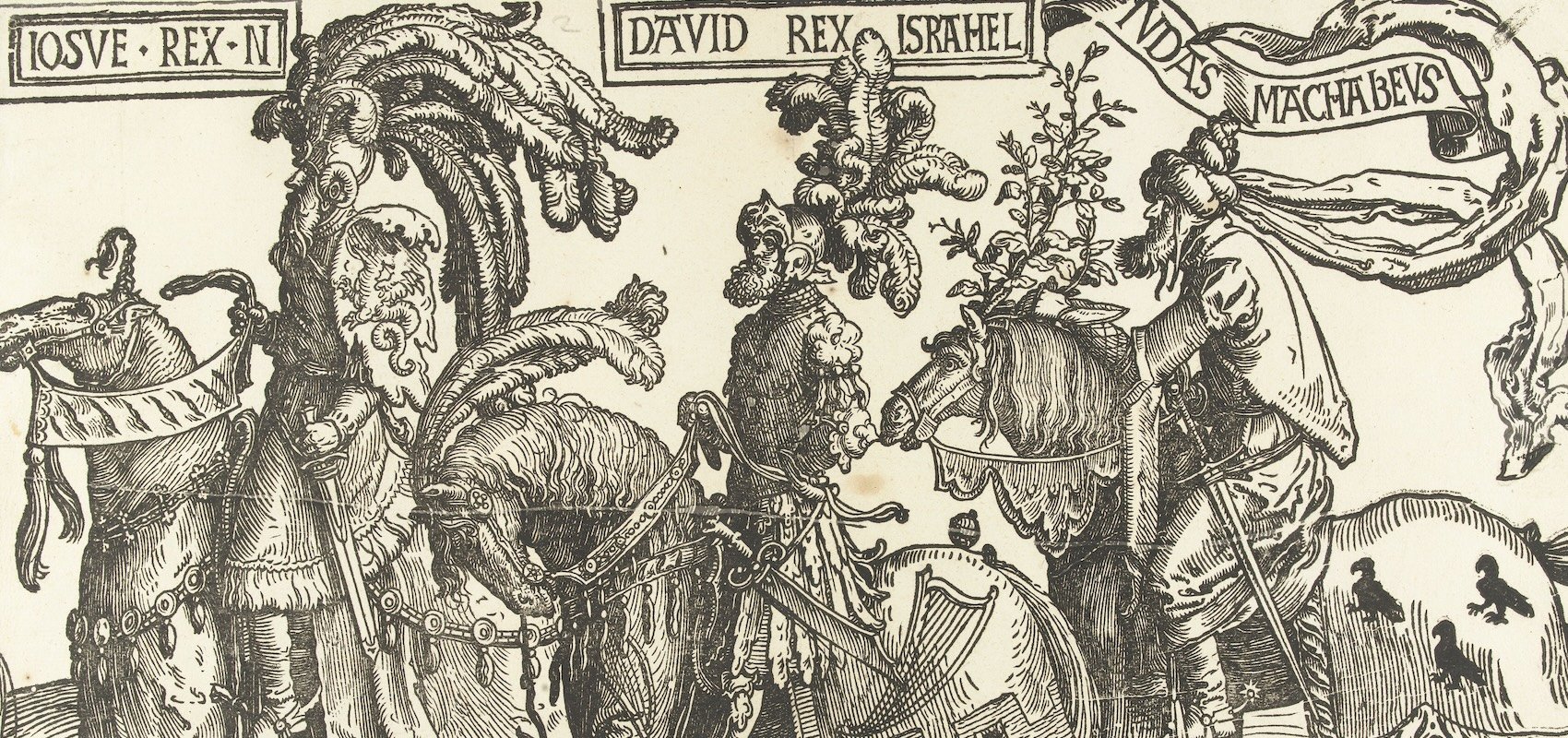
Even before Plutarch hit the early humanists, Christendom had already developed a framework for admiration and emulation of worldly heroes, models distinct from the superior holiness of the saints, but nonetheless useful, even essential, for men charged with secular authority. The Nine Worthies, celebrated by the likes of Jacques de Longuyon, featured three Christian, three Old Testament, and three pagan heroes (Hector, Alexander, and Julius Caesar, in the latter case), all held up as models for Christian chivalry.
Over the decades of the postwar consensus, however, our schooling, and as a result our entire culture, grew more suspicious of heroes. Plutarch fell off the curriculum, along with any attempt to “lionize” our own native heroes. We have lost our culture of heroism, and it will take more than vibes and memes to reinstate them.
Aristotle also identified the force that blocks zeal: its opposite, contempt (kataphronesis, literally “thinking down” upon something). Casual dismissal of great men, as we have seen for the past few decades, leads to a mood of contempt that can infect an entire society. A contempt for greatness leads to a contempt of human nature and its capabilities—a contempt for the self.
When zeal is forbidden by a culture of contempt, it will rot into a soup that oozes elsewhere—in particular, toward its evil twin, envy, or resentment. The pain felt on seeing others flourishing offers us a choice: We can strive to match that success (zeal), or, if this is impossible, we can seethe in the spiteful hope of seeing them destroyed (envy).
Figures like Nick Fuentes voice emotions bubbling up from an undercurrent of resentment. We can start to address the root problem by reviving zeal and honoring heroism. This is a challenge for educators, artists, intellectuals, and builders, but also for every grown man who might have some younger soul watching him, quietly wondering, “What sort should I be like?”
But if conservatives want the youth to take them seriously, they should acknowledge some very real frustrations of this group. Some of the aggressive anger at the cultural status quo fueling the disaffected incel might even be a good thing. Aristotle identifies another important emotion in the equation: indignation (to nemesan). Indignation is “the distress felt when one sees undeserved good fortune.” This feeling is, in his view, characteristic of good men. Without indignation, aspiring heroes might be content to let the wicked prosper, whereas they have a duty to put a stop to the nonsense if it lies within their power. They should be encouraged not to underestimate their power.
At the end of a hard day of drudgery, Machiavelli would take off his boots to “enter the ancient courts of ancient men,” in order to feed on the food that was his alone and that he was born for. In the effort to dislodge the guarantors of the anti-heroic consensus from their high places, we too should pause occasionally to draw energy from the great-souled few who have gone on before us.

YOU MIGHT ALSO LIKE
Jürgen Habermas’s Search for Moral Justification
The German philosopher and critical theorist Jürgen Habermas has died at the age of ninety-six. The tributes…
Mainlining Nostalgia
Ryan Burge is unignorable. A political scientist known for his “graphs about religion,” Burge is required reading…
The Women the Vatican Forgot
Last week, the Vatican Dicastery for the Doctrine of the Faith released a synodal study group’s final…
