
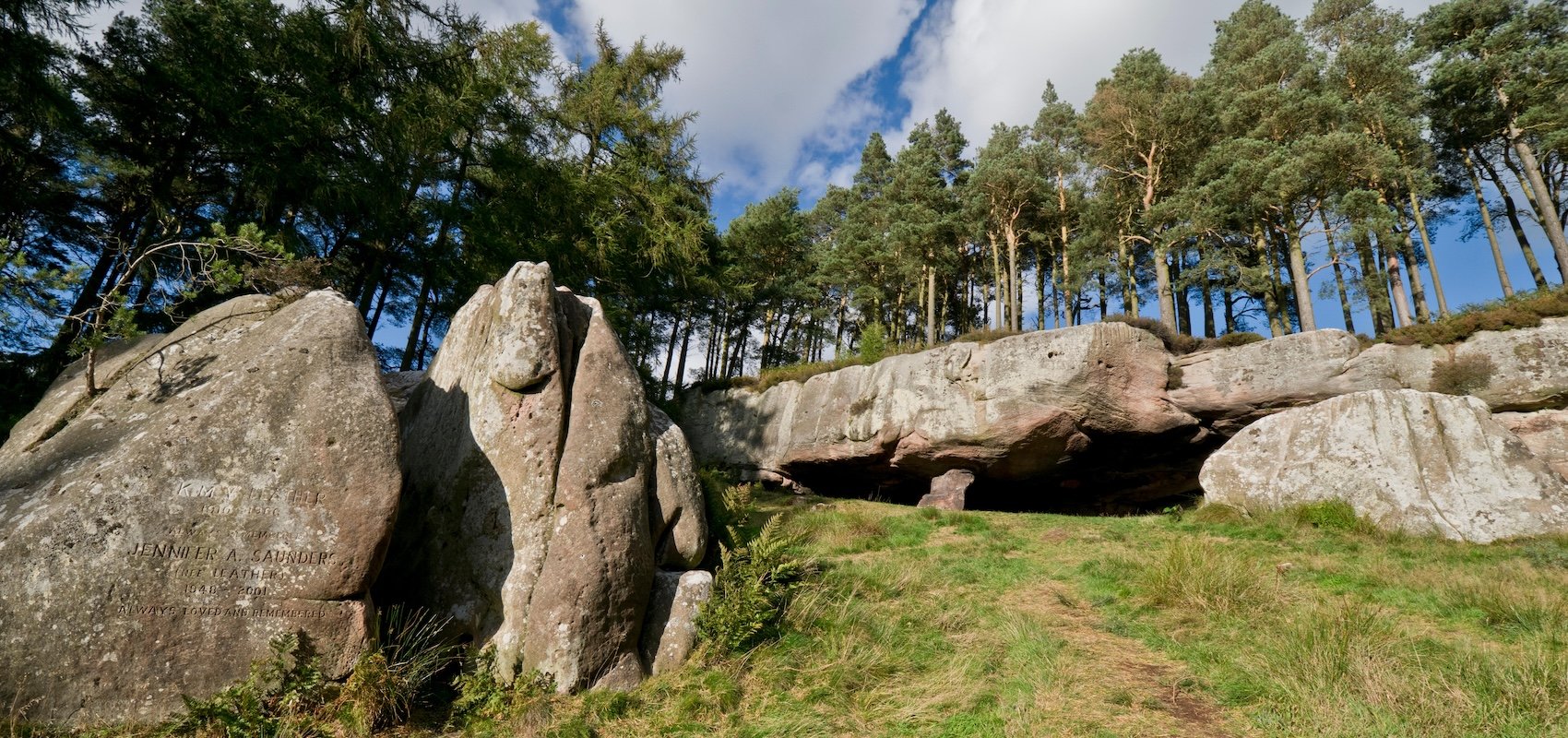
August 2025 in northern England was chilly and windy. I had gone over to this land along the Anglo-Scottish border one month earlier, in July, to scout out St. Cuthbert’s Way, meet taxi drivers, and find really good pubs, as I was preparing to lead a half-dozen Angelico Fellows from Benedictine College along the path and document our journey on film. But I almost froze to death while I was at it. In a blinding rain, I wandered up into the hills, wearing a defective raincoat and ugly sweater I had bought in a thrift store. I found and took shelter within St. Cuthbert’s Cave, where, after wringing out my soaked sweater, I sang an Akathist hymn. As soon as I had finished my hymn, the storm cleared, and all turned sunny again.
A month later, when I returned with the fellows, the weather was supposed to be even worse. The day before our hiking and filming was to begin, the forecast called for winds so ferocious that all northbound trains were canceled. And yet, when we began our hike, after a light rain, all was sunny and beautiful and a little windy. If you’ve read St. Bede’s Life of St. Cuthbert, then you’ll remember that the medieval saint had a habit of doing this.
St. Cuthbert’s Way is a 62.5-mile hike from charming Melrose, Scotland, to the tidal island known as Holy Island (Lindisfarne). As a proper path, it’s relatively new, but the trail revisits the life and experience of the most important saint we Americans have never heard of: the seventh-century Cuthbert. From Melrose the path goes up and over the bare and reddish Eildon Hills, where Cuthbert, tending his sheep at night, had a dramatic vision that led to his conversion to the religious life. From the Eildon Hills you descend into the Tweed River valley, where the trail passes the ruins of Dryburgh Abbey following a river full of salmon during the later autumn months. Once out of the wooded river valleys, the path cuts across farmland and then begins to climb up into the tiny village of Morebattle. From there on it ascends up into the Scottish hills.
After crossing the border into England, Cuthbert’s Way goes through the village of Wooler to climb up a crest, where you find a series of caves, including St. Cuthbert’s Cave, tucked away within a pine wood. According to pious legend, one of these caves is the site where the monks of Lindisfarne hid their most precious possessions when the Vikings raided the island: the wonder-working and incorrupt body of St. Cuthbert and the Lindisfarne Gospels. The goal of the trip, of course, is Holy Island. If you time your crossing just right, you can walk across the cold gray sands, barefoot, when the tide is low, and thus arrive at the place where Cuthbert spent his final years in contemplative seclusion.
Although we Americans are less familiar with Cuthbert, he was the St. Francis of his day, and thus this region is to him what the Vale of Spoleto would later be for Francis. Cuthbert wandered everywhere through the ancient kingdom of Northumbria, preaching, healing, and performing miracles. Indeed, Bede wrote Cuthbert’s life three separate times, including one version in dactylic hexameter, intimating that he had found a subject fit for the heroic meter used in the pagan past for ancient epics.
Part of my motivation to take my students to this area was, as I like to put it, to rummage around in the basement of the Church and to see what a long-forgotten saint had to say to our contemporary world. And part of my motivation was to see if we could do with the technologies of our day something analogous to what Cuthbert’s near-contemporaries had done in theirs. Some scholars speculate that the Lindisfarne Gospels, with their elaborate, leafy illuminations, in which the words of Scripture become paintings, were made in honor of Cuthbert.
Inspired by such a vision, then, my Center for Beauty and Culture at Benedictine College teamed up with Daniel Catone of Arimathea Investing, Christian Holden of St. Anthony Media, and Fr. Marcus Holden of St. Bede’s Seminary in Rome to make a film, which is part Catholic reality television (although I’m sorry to say there was no nasty gossip or embarrassing personality conflicts), part documentary, and part modern hagiography. I told my friend and collaborator, Christian Holden, that I wanted our film to be a digital “icon”; or, perhaps better, given the locale, that I wanted to do through film what our ancestors did in paint: a cinematic illuminated manuscript. The fruit of our labor will be aired on EWTN on March 20, 2026—appropriately, the feast of St. Cuthbert himself.
Holy Island is ineffably beautiful, and I was excited to take my students across “the pilgrim sands” at low tide, but I was as excited to let them see St. Cuthbert’s Cave, a place that had sheltered me in a storm and had felt to me a place of prayer, inspiration, and holiness. But, shockingly, the National Trust, the not-for-profit organization in the U.K. that owns the property on which the cave sits, would not grant us permission to film on the site—precisely because, they explained to my friend Christian, we were religious. We tried to reason with them: This is a not-for-profit film; for us it is a religious site; we’re not political, cranky, or controversial. We just want to tell a story from Bede and make it feel relevant again. But they doubled down on their position. The result is that now the National Trust is all over the headlines in the U.K. for, as the Telegraph put it, “banning a Roman Catholic from filming at a religious site.” As my friend put it to me, I’m afraid that country has a long history of suppressing Catholicism. But cave or no cave, we’ve made a film that is going to touch some hearts.
