

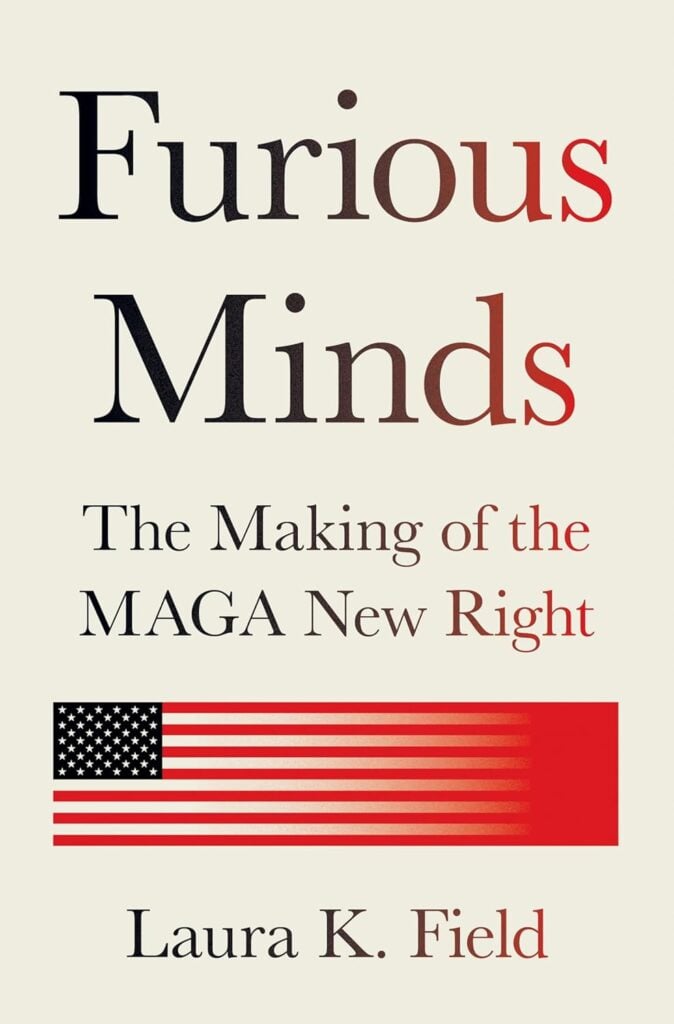
Furious Minds:
The Making of the MAGA New Right
by laura k. field
princeton university, 432 pages, $35
American conservatism has produced a bewildering number of factions over the years, and especially over the last decade, each angling for its place in what has come to be called the New Right. You’ve got your paleocons, your common-good conservatives, and your crunchy cons. There’s the tech right and the Dark Enlightenment. The Straussians (East and West Coast), integralists and TradCaths, BAPists and Groypers. Can anyone make sense of it all?
Laura K. Field’s Furious Minds: The Making of the MAGA New Right is the latest effort to explain this movement to the alarmed, or simply confused, observer. Field, a political theorist trained in the tradition of Leo Strauss and an apostate from “the world of conservative intellectualism,” offers a tour of the thinkers, books, and tweets representing the brainier side of the effort to Make America Great Again. For those who have read ten years of Atlantic and New Yorker explainers about the right’s scheming and found themselves wanting more, Furious Minds offers similarly satisfying harangues at book length. For anyone else, its value derives instead from its offering a case study in liberalism’s failure to comprehend why a growing number of Americans have chosen to repudiate it.
Field’s taxonomy focuses on three genera that have risen to prominence since 2016: the Claremonters, the Postliberals, and the National Conservatives. The Claremonters, intellectuals in the orbit of the Claremont Institute, seek to revive the self-evident truths of the American Founding against the tide of progressivism, the administrative state, and historicism. The Postliberals, who tend to be the most religious of the bunch, appeal to a largely Catholic understanding of classical accounts of the common good and the corporate political body against modernity’s atomistic, materialist individualism. And the National Conservatives pit America’s particularist culture and sovereignty against a difference-eroding globalist imperialism. Field also gives attention to adjacent factions in the New Right, such as the hyper-online, testosterone-oozing alt-right and the largely Protestant Christian Nationalists. Much of this is likely to be familiar to the readers of this journal, which makes a number of appearances (Field calls it “the foremost Christian periodical on the American Right”) and has featured representatives of all three groups over the years.
Without denying the differences among them, Field focuses on two unifying features. First, every bloc on the New Right seeks to impose a “homogenizing moral and political vision on the rest of the country.” They all accept some form of what John Rawls called a “comprehensive doctrine,” a robust conception of the good as it relates to politics, and all wish to use the instruments of public life—government, school, church—to that end, driven by the conviction that “there is only one legitimate perspective on anything.”
The second shared feature is an “Ideas First” approach to politics. Like the conservative heavyweights of yesteryear, such as Lincoln scholar Harry Jaffa and philosopher Allan Bloom, contemporary New Rightists such as Why Liberalism Failed author Patrick Deneen and DEI-buster Chris Rufo exhibit a devotion to ideas—about the nature of the human person, the consequences of liberalism, the principles of the Founding—over the messiness and contingency of the real world. In a reversal of the usual direction of accusation—conservatives have been leveling the criticism of abstraction against the left for centuries—Field perceives a rigid idealism motivating the right’s ruthless pursuit of conformity. Claremonters, Postliberals, and National Conservatives are all “theoretically-minded . . . ideologues” whose love of abstraction makes them willing to do whatever it takes to force the world to resemble their reactionary concepts.
Field contrasts both these traits—the urge to impose one’s values and a facile understanding of how ideas relate to reality—with her own moral flexibility and openness. Appealing to an old chestnut of liberal political theory, the “fact of reasonable pluralism,” Field states that twenty-first-century America simply has so much diversity in ethical outlook that it’s hopeless to give any one view precedence, in politics or even as a matter of fundamental verity. There is no one, true account of ethics and the good life, and even if there were, it would be unjust to force that account on others who think otherwise. Whereas “Ideas First” conservatism wishes to force all of reality’s variety into a few simple forms, Field insists that liberalism recognizes and even celebrates moral difference.
For all the significance Field attaches to ideas—and despite “trying [her] best to give their ideas a fair shake”—she shows little interest in them, instead relying on sniping and snark or groundless rejections that rise only a notch or two above the “clapback” styleof argumentation that has become so popular on the left. New Right thinkers exhibit “fascist buffoonery” and are “just so silly and off-base” and “bogus”: “None of this was based on careful thinking about anything.” Field exhibits an odd reliance on the first person, as though personalizing her criticisms might mask their emptiness: “To me [one argument] seemed silly and conspiratorial”; “I have no idea where Jaffa found ‘certitudes’ in Aristotle”; “I did not buy it.” She frequently cosigns commentary provided by others, without contributing anything of substance to it. Citing a critic of Rufo who writes that he seeks “a wholesale assault on mainstream liberal institutions designed to indoctrinate the public into [his] preferred social vision,” Field merely adds, “That’s right.”
This superficial approach is especially frustrating when she brings up a conservative counterargument to her political liberalism, only to assure readers that there is a good answer . . . somewhere. Considering two “‘gotcha’ quips” Bloom posed to liberals—“So you think all morality is relative, but is that claim relative too?” and “So you believe in toleration, but what about the intolerant?”—Field assures the reader that “thoughtful liberals and philosophers have responses to these questions,” before moving on to a new topic. The reader is left wondering just what those responses might be. Remembering a conservative who suggested that her relativistic embrace of evolving principles put her in the “majoritarian, winner-takes-all” camp of Stephen Douglas in his defense of slavery against Lincoln, Field refuses to explain why the accusation is unfounded, opting instead to contrast her “liberal pluralism and epistemology against bull-headed self-certainty and fundamentalism.” Liberalism here means never having to say you’re wrong.
Though Field scoffs at these arguments when they’re directed at liberals, she ought to know that her three factions also fight endlessly amongst themselves over such matters: whether liberalism is self-undermining, how to reconcile objective morality with democratic self-rule, where a healthier regime would set the limits on tolerance, and so on. Indeed, one might accuse the New Right’s intellectuals of thinking too much about these matters, at the expense of political cohesion. Even a decade on, the New Right remains divided over fundamental matters that, though they can be debated forever in the seminar room, really must be settled one way or the other before they can figure in a coherent governing agenda.
A return to the truths of the Claremonters’ cherished Declaration of Independence and the dismantling of the administrative state, for example, would look quite different from a Postliberal quasi-confessional state that co-opts the bureaucracy for Christian ends. Some Postliberals’ esteem for what they understand to be the classical notion of universal empire, meanwhile, contrasts sharply with National Conservatives’ America-First prioritization of the nation-state. And the alt-right’s celebration of transgression rejects much that the more pious sects of the New Right wish to conserve. Just in recent months, ugly intra–New Right fights over Israel and anti-Semitism have again made clear that serious disagreement persists despite shared concepts and common enemies.
Field recognizes these disputes, but amid all the discussion of each faction and its convictions, Furious Minds never really grapples with why so many people have been drawn to the New Right. If its diagnoses are so overblown, its philosophy and history so crude, its predictions about liberalism’s direction so faulty, then surely we need an account of why the movement has nevertheless managed to gain so much traction that a book had to be written to refute it.
According to Field, the future of the nation depends on fending off the New Right. But how can you stop the spread of the New Right’s dangerous ideas without understanding how they spread? Concepts don’t just float in the ether until they settle in certain straight white men’s brains. Why are people drawn to these arguments and not to liberal ones, or to those offered by the last generation’s conservatism? Field seems to subscribe to the usual ad hominem liberal explanation. She says that racism provides the answer—she is “sympathetic,” for example, to the claim that “a good deal” of the New Right’s opposition to the 1619 Project was “just pent-up racism and white supremacy.” Elsewhere, she suggests that conservatives are suckers for a new “noble lie,” which, even if true, would not explain why they fell for this lie rather than another.
A refusal to comprehend why people think the way they do—even if they are completely wrong—is always dispiriting, but it’s particularly glaring amid Field’s praise for the blessings of pluralism, and serious enough to make one wonder how liberal tolerance’s big philosophical shrug is supposed to work. How will the open society ever be possible, with everyone applauding each other’s experiments in living, if its proponents cannot muster sufficient theory of mind to make sense of anyone’s hostility to that society?
At this point, we ought to take Field’s advice: We will not settle for airy-fairy abstraction, but descend to the earth and observe the actually existing liberalism around us, which does not sponsor a happy and inclusive pluralism. The reason the New Right is gaining momentum, and that Field’s pluralistic paradise is in jeopardy, is not primarily that people have been persuaded by Deneen’s attack on Lockean metaphysics, or seduced by Adrian Vermeule’s revival of Carl Schmitt’s political theology. Rather, these figures gain an audience because they are willing to say what Americans see before them every day: that liberalism’s vaunted pluralism is a fiction.
For at least the entire decade that Field says she hopes to explain, Americans—especially younger ones going through school and starting their careers—have experienced a barrage of progressive homogeneity, the stifling promulgation of just the sort of comprehensive doctrine that Field says is supposed to be off-limits. While being told that “you can’t legislate morality,” they watched every major institution in American public life, which we’re assured recognizes moral difference and allows each to go his own way, instead enforce the same ever-shifting but immediately unquestionable precepts. Anyone who attended almost any university in the country, or worked anywhere in the private or public sector, or simply saw the ads on TV or the signs at the grocery store, witnessed the very devotion to a thick, public account of the good that Field ascribes exclusively to the right. When liberals then preach about “reasonable pluralism,” a growing number of conservatives become incredulous: What pluralism?
The “making of the MAGA New Right,” then, is the process of more and more Americans refusing to stomach any longer this fiction, or its mealymouthed apologists. On the rare occasion when Field criticizes the left, it is by way of the most milquetoast mumblings. The New Right’s belief that “antiracism seminars and diversity trainings had chilling effects . . . in my view, was not entirely unfounded.” “Some of the problems” identified by conservatives (which ones?) “are real.” In the closing pages, Field concedes that “conservatives who complain about liberal intolerance have a point.” When this is the furthest liberals will go in acknowledging the millennialist fervor around them, it is hardly surprising that those constituting the New Right began to look elsewhere—and, as some of the more outré characters in Furious Minds indicate, they’ll listen to the craziest son of a bitch they can find who will tell them that they can believe their lying eyes.
There is an irony in the supposedly closed-minded New Right’s success in gaining adherents among conservatives and the politically disaffected, while liberals on both the left and the right who speak of critical thinking and the joys of hearing other viewpoints struggle to persuade. To her credit, Field recognizes the problem: Liberals, she laments, “have difficulty conceiving of perspectives and world views that differ so significantly from their own.” That’s right.
Image by Lorie Shaull, licensed via Creative Commons. Image cropped.

YOU MIGHT ALSO LIKE
Timothée Chalamet Is Right About Art (ft. Suzy Weiss)
In this episode, co-founder and reporter for the Free Press, Suzy Weiss, joins Virginia and Germán to…
Trump’s Civilizational Project
Secretary of State Marco Rubio spoke at the recent Munich Security Conference. Last year, Vice President JD…
The Real JD Vance (ft. Frank DeVito)
In the latest installment of the ongoing interview series with contributing editor Mark Bauerlein, Frank DeVito joins…
