
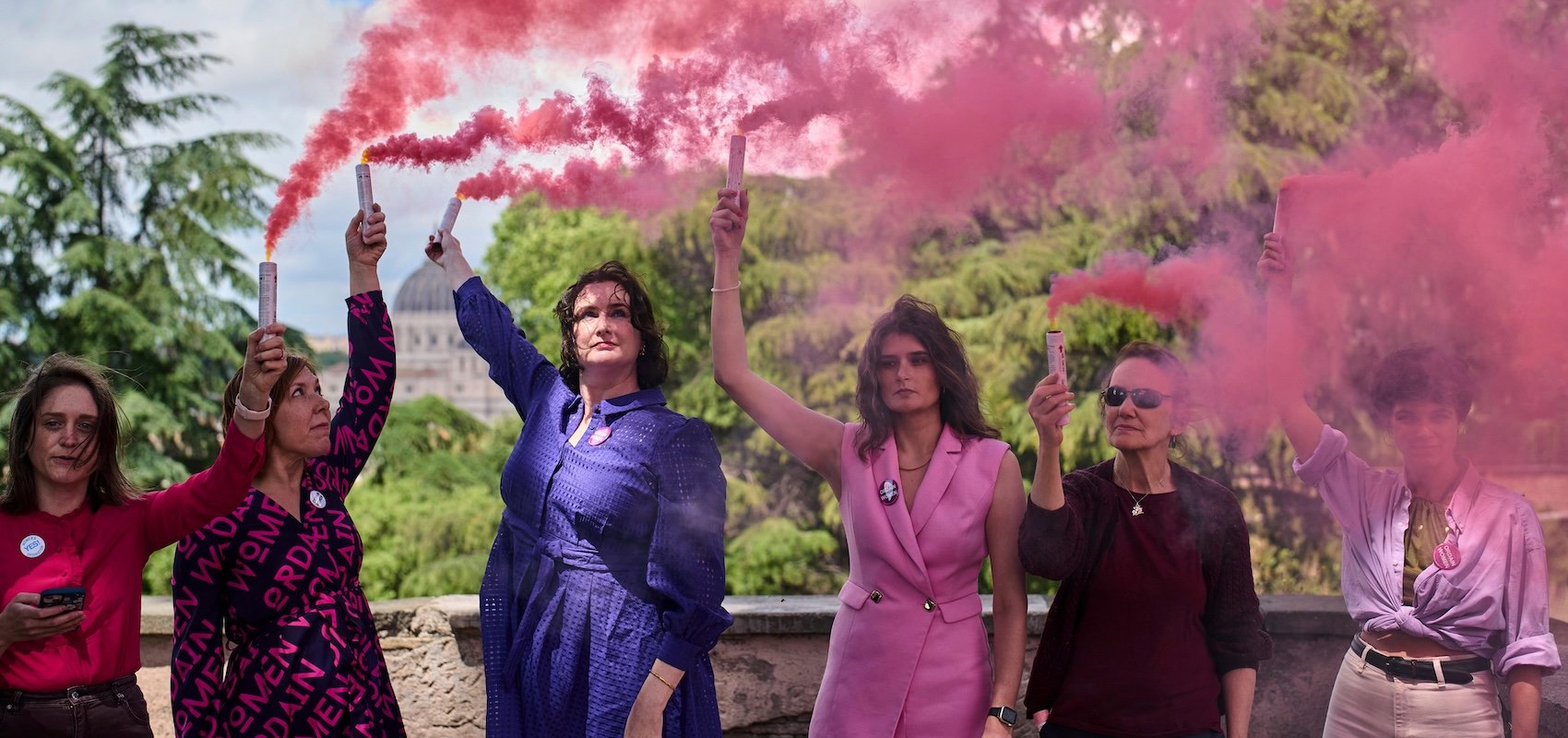
The year 2025 witnessed not only the death of the most liberal pope in the history of the Church but also, seven months later, the final defeat of a fifty-year campaign to ordain Catholic women clergy. On December 4, a “Study Commission on the Female Diaconate” set up by Pope Francis in 2020 published its conclusion that women could not be ordained as deacons. Reuters reported the story as follows:
A high-level Vatican commission voted against allowing Catholic women to serve as deacons, maintaining the global Church’s practice of all-male clergy, according to a report given to Pope Leo and released on Thursday. The commission, in a 7–1 vote, said historical research and theological investigation “excludes the possibility” of allowing women to serve as deacons at this time but recommended further study of the issue.
Note the words “at this time” and “further study.” Some commentators seized on them to suggest that the question of ordaining women deacons was not settled. Indeed, that was the shared message of two Catholic factions with diametrically opposed opinions on most issues: hardline traditionalists, who regard Pope Leo XIV as a “Francis II” whose self-effacing charm conceals a modernist agenda; and hardline progressives, who hope that the traditionalists are proven right about Leo. Both groups of extremists—the former adjacent to sedevacantists, the latter to liberal Protestants—insisted that, in stressing the need for further research, the Vatican had left the door open for future female deacons with the same sacramental ministry as their male equivalents, who can preside at baptisms, weddings, and funerals, and preach the Gospel at Mass.
The Study Commission on the Female Diaconate has, in fact, slammed shut that particular door with tremendous force. As early as 2022 the ten-member Commission (which included two permanent deacons, two priests, and five women scholars) argued by a margin of seven to three that the current state of both historical research and theological inquiry excluded “the possibility of proceeding in the direction of admitting women to the diaconate understood as a grade of the sacrament of Orders.” This month’s report into the Commission’s work underlines that conclusion.
How, then, could the document be interpreted as leaving room for future debate? The truth is that the New Testament Greek word diakonos invites confusion, since it can be translated either as “servant” or “deacon.” When it is used to describe women, for example by St. Paul, there is the extra option of “deaconess,” historically applied to non-ordained women ministers in various Protestant denominations. One may state clearly, as the Catholic Church does, that no female diakonos was ever in Holy Orders, and that no woman will ever be ordained, while still acknowledging that the precise role of early Christian women diakonon (Paul’s word) invites further research. But that is no more than stating the obvious. To quote the influential Italian website Silere Non Possum, “It is true that the Commission, correctly, does not issue a definitive judgment: it is not for a study body to define doctrine. But this does not mean that the lack of definition implies openness.”
Let us look again at that Reuters report. Its author is Joshua McElwee, a veteran American Catholic journalist widely regarded as a partisan liberal. Sure enough, his article—supposedly a news story, not commentary—brings us reactions from three sources passionately in favor of the ordination of women as deacons and priests. There is no quote from a Catholic supporting the Commission’s findings.
The third of McElwee’s feminist sources is the American-based Women’s Ordination Conference (WOC), which we are told criticized the Commission for “not soliciting input from more women in its discussions” and described its conclusion as a “deep, and theologically unsound, insult.” That last quote is not attributed to any specific person, but one suspects that McElwee did not have to travel far to secure it, since he is married to the executive director of WOC, Kate McElwee.
The Women’s Ordination Conference describes itself as “the oldest and largest organization working to ordain women as deacons, priests, and bishops into an inclusive and accountable Roman Catholic Church.” Their website also states that “More than 1,200 people, including many religious sisters, participated in the first ordination conference, November 28–30, 1975. The conference was publicly endorsed by 49 religious congregations (men’s and women’s), organizations, and individuals.”
No doubt there was a tangible sense of excitement at that first gathering. Progressive Catholics were confident that the frail Paul VI would soon be succeeded by a pope more sympathetic to women priests; as in the Anglican Communion, the ordination of female deacons would be a necessary prelude to the first Masses celebrated by women. Then came John Paul II, who in 1994 declared not only that women priests would not be ordained but also, crucially, that they could not be ordained: Jesus Christ had not granted the Church the authority to take such a step. At which point, the prospect of female deacons lost its attraction for Catholic feminists, since—although the point was never formally conceded—its only real significance had been as a stepping stone to the ordination of women priests.
The Catholic women’s ordination movement collapsed like a vegan soufflé. Perhaps there was a moment after the election of Francis when WOC fooled itself into thinking that the Argentinian pope was preparing to reverse John Paul’s ruling; it quickly discovered that he wasn’t. Bear in mind that the current Study Commission on the Female Diaconate is the second body to bear that title. Francis originally set one up in 2016 but soon replaced it with another that could be relied upon to kick the subject into the long grass—and then kill off the notion of a female diaconate when no one was looking. Which is essentially what has just happened.
Meanwhile, you can examine the remains of the Women’s Ordination Conference on its YouTube channel, though it seems almost cruel to do so. Just before the bad news from the Vatican, WOC put up a video of an “Advent Liturgy” in which a handful of digitally linked women excommunicated themselves by performing a parody of a concelebrated Mass. At the time of writing it had been viewed 132 times.
Image by Bernat Armangue, licensed via AP News.

YOU MIGHT ALSO LIKE
Turned Away on Palm Sunday
In politics, diplomacy, war, or pretty much any field of human interaction, one must contend not only…
A Medieval Pilgrimage in Modern Assisi
When you go to the hilltop town of Assisi, you’re immediately struck by how medieval it is:…
Via Crucis, 2026
The Way of the Cross—and the third, seventh, and ninth stations in particular—has been an especially appropriate…
