
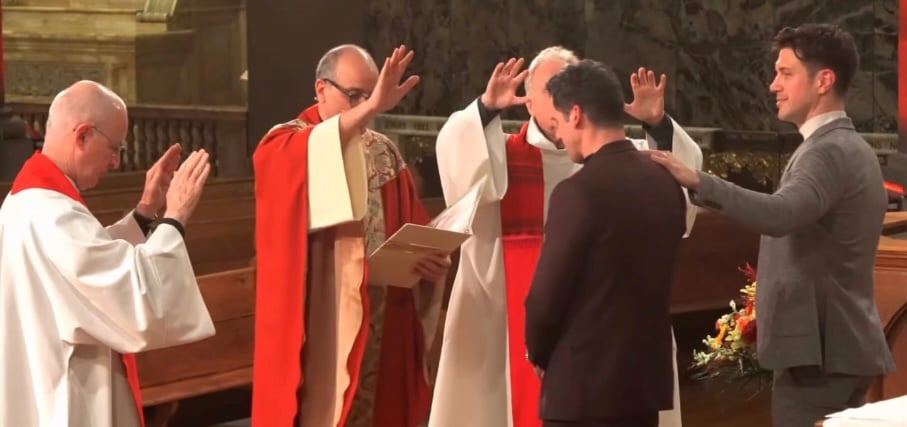
The sacrament of confirmation has not generally been a pressing concern to the editors of People magazine. Last week, however, this often neglected and misunderstood sacrament made the news. A minor celebrity—a news anchor—returned to the Catholic Church and was confirmed. People dedicated an article to the event.
Had the ostensibly secular publication been caught up in a wave of piety? Were its writers moved by the image of the Holy Spirit, who at Pentecost brought to completion the work of Easter, now placing his seal on the heart of a child of God reborn in baptism? Did the thought of another witness of Christ equipped to build up the Church on earth energize and inspire them? Did they, like St. Thomas Aquinas, thrill at the image of more soldiers of Christ equipped for spiritual combat?
People’s motives, alas, may have been elsewhere. It seems the confirmand—Gio Benitez—is openly gay, civilly married, and was confirmed with his “husband” as his sponsor. The phrase “exactly as I am” stood out in the Instagram post announcing the event.
The confirmation raises plenty of hard-to-answer questions and seems to have been intended to do so; the team around the altar was rather more media-savvy than your average parish clergy. Was the ceremony intended to create scandal—that is, to legitimize behaviors that the Christian faith considers sinful? Was the sacrament being instrumentalized to serve a larger political and cultural agenda? Is it discriminatory to admit to the sacraments homosexual couples living in a situation contrary to the Church’s teaching when heterosexual couples in a comparable situation would be denied the sacrament? Or does the discrimination run the other way: Could it be that Benitez had been denied the possibility of repentance and a true spiritual rebirth by a watered-down creed of self-affirmation?
I’ll leave those rabbit holes to others. Unlike People, I am actually more interested in the sacrament of confirmation than in any of the sex questions. And of more concern to me than one celebrity confirmation is the much more common phenomenon of confirmation having become functionally the ceremony of graduation from Catholicism.
There are lots of reasons why this is the case, including the order in which the sacraments of initiation are celebrated, but it seems to me that the root of the problem—and a deep root it is indeed—is that the sacraments of initiation have become detached from any notion of conversion.
The story of how this happened, however, doesn’t start in the previous pontificate, the 1960s, or even in modernity. It’s actually a medieval problem.
In the days of the Church Fathers, Christian initiation was an involved and demanding process; the reception of baptism, confirmation, and the Eucharist was a life-changing event. It had to be. In a hostile pagan society, a muddled or ambiguous Christian identity would have guaranteed the dissolution of the faith in the more aggressive currents of the cultural majority.
All of this changed, of course, with Christendom. When practically everyone was Christian, preparation for the sacraments—and mystagogy afterward—could be minimal to non-existent. Everyone was baptized more or less automatically at birth, so the first sacrament hardly seemed a rebirth. The surrounding Christian culture meant that Christian formation still happened, but mostly through cultural osmosis. One became a Christian by virtue of growing up in a Christian society. Even if the official theology never changed, the sacraments could become, in the popular imagination, rites of social belonging. For many, they became rites marking social, family, and life milestones—rather than rites conforming one to the death and resurrection of Jesus.
Today, we live in a culture that has largely come to resemble the pagan pluralism that surrounded the early Church, but our system of sacramental practice remains mostly that of Christendom. And it’s not working particularly well.
The Second Vatican Council provided at least a couple of tools to face this new—and old—reality: the Order of Christian Initiation of Adults with its extensive catechumenate—still perhaps not used to its full potential—and the theology of liturgical participation, which is almost universally misunderstood. As Pope Leo the Great once put it in an Ascension homily, what was once visible in Jesus when he walked the earth is made present for us in the sacraments. The unique grace of the sacraments is neither affirmation nor reward; it is being able to participate in the divine action of the Incarnate Christ.
This theology, in turn, explains why the arguments used to justify administering the sacraments to the indifferent and the unconverted amount to pious-sounding superstition. I’ve heard many an argument that boils down to: “Maybe they’re not ready, but, you know, the grace of the sacrament . . .”
Sacramental grace, however, doesn’t work against our will or without our cooperation. It works because it is participation, because it allows us to cooperate. Administering the sacraments to those not yet ready and willing to live in communion with Christ and to be conformed to his Paschal Mystery is a bit like giving a placebo instead of chemotherapy to someone suffering from cancer—it may provide doctor and patient with a comforting moment but it won’t bring true healing.
That might work to serve People’s agenda, but when it comes to the mission of the Church, initiation into the fullness of Christian life is what really matters.
