
In music,” writes the Italian priest Luigi Giussani, “what man pays homage to is something else, something he is waiting for.” Upon hearing a beautiful song, something is “awakened inside him”—the foretaste of an “Other” to which “he immediately bends his soul . . . he grasps what he can grasp, but he waits for another thing.” This intuition poignantly describes the role music played in my own conversion. I can still remember specific songs that—despite not being explicitly about God or religion—were so profound that I couldn’t help but be overwhelmed with wonder, asking how it was possible for such beauty to exist and where it ultimately originated from.
This fact seems to be lost on the numerous pop stars who, after having a dramatic “come to Jesus” moment, renounce their previous “secular” songs and vow to only make music that “glorifies God” going forward. The Puerto Rican reggaeton star Daddy Yankee is one such example. Ironically, it was his old repertoire that made me contemplate the divine more than his recent flimsily-produced, church-approved singles.
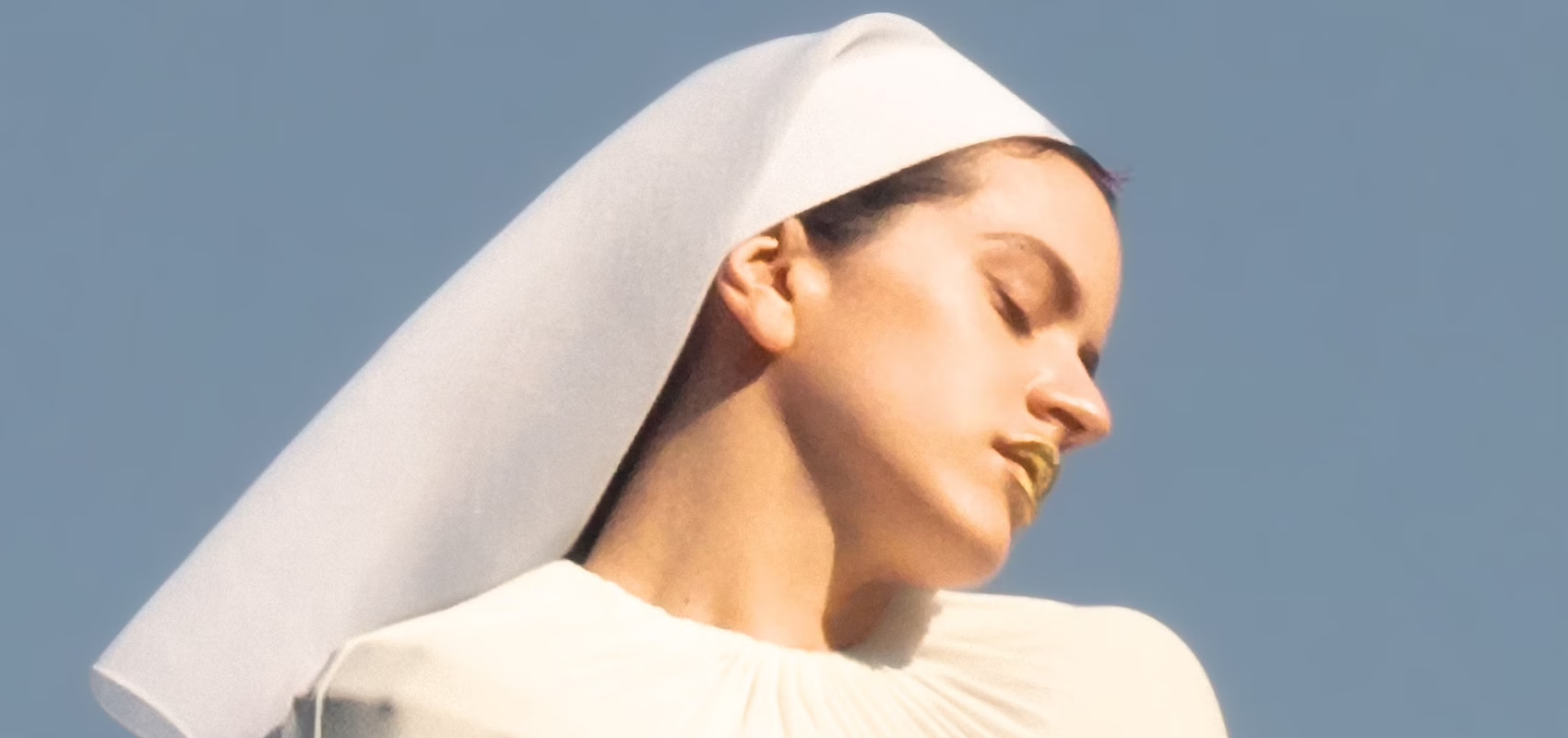
The music world has been set abuzz by Spanish singer Rosalía’s latest album, LUX. Its cover features the singer dressed as a nun in a white habit, a look inspired by her sudden realization that she has “a desire that nothing in the world can satisfy” other than God himself. As with most things she does, the thirty-three-year-old Barcelona-native’s religious awakening is difficult to pin down. Some have been quick to celebrate her having become an influencer for the Lord. Others have written her off as yet another aesthetic tradcath LARPer (live action role player). The true nature of LUX is much more complicated and much more fascinating.
Rosalía released her first album Los Ángeles in 2017 while studying musicology in college. Her 2018 album El Mal Querer—an eclectic mix of flamenco, R&B, and hip-hop tracks inspired by the thirteenth-century Occitan tale Romance of Flamenca—served as her baccalaureate thesis. Several of the album’s singles topped charts around the globe and garnered attention for their avant-garde music videos.
Alongside her international acclaim came numerous accusations of cultural appropriation: As a white Spaniard, she was “capitalizing” on a gypsy art form without giving adequate credit. Despite being universally lauded by critics for its creative amalgam of themes and genres, her third album Motomami’s inclusion of reggaeton—an Afro-Latin art form—further incited the ire of the woke mob. Rather than backtrack, she replied by obliquely “shading” her accusers for their lack of education and by playfully dissing them in her songs.
Like her music, Rosalía’s enigmatic public persona blends paradoxical elements: high and low art, measured subtlety and overt sexuality, progressive social-consciousness and reverence for tradition, humor and gravity. Her captivating Instagram page has featured photo carousels of herself reading books by Camille Paglia, Simone Weil, Tolstoy, and Ocean Vuong. Her performative persona offers a metacommentary of sorts on the nature of fame, postmodern art, and the society of the spectacle from deep within its trenches.
Given her expansive and ever-evolving set of influences and interests, her latest “nunmaxxing” era is not surprising. In fact, religious themes have previously appeared in several of her songs and videos. Take “El Redentor” from her first album, which reworked a classic saeta typically sung during Good Friday processions in Spain, or her rendition of St. John of the Cross’s poem “Aunque Es De Noche.” Numerous songs on her sophomore album alluded to esoteric religious themes, as well as to occult initiation rituals. Said allusions fired up conspiracy theorists who said her use of such imagery clearly indicated that she was yet another artist to have “sold her soul.” In one of her “deconstructed club” tracks on Motomami, she tells her fellow pop stars who are overly puffed-up with pride to “keep it cute,” as “the first artist here is God.”
LUX is her most overt exploration of religiosity by far. One can clearly see how her Augustinian realizations about the restlessness of the heart, as well as her continued fascination with the Spanish Carmelite mystics, have inspired the lyrics. She describes feeling like God has been stalking her in “Dios Es Un Stalker,” and the tension she feels between loving earthly and heavenly goods in “Sexo, Violencia y Llantas.” But perhaps the most deific elements of the album are her breathtaking operatic singing style; the grandiose production, which melds flamenco and a sort of “baroque” pop; and the lyrics incorporating fourteen different languages—all of which feels like she is attempting to grasp for something that lies beyond this world. Several of my friends have remarked that “Mio Cristo Piange Diamanti,” a song in Italian inspired by the friendship between Sts. Francis and Clare of Assisi, brought them to tears and left them with chills.
In an interview a week before LUX’s release, Rosalía revealed that she had—inspired in part by her respect for nuns, whom she believes to be “celestial citizens”—taken a vow of celibacy while working on the album. While I doubt she’ll inspire her listeners to enter religious life, I do think her new album is a true provocation. Perhaps even more provocative than asking her listeners to contemplate the Creator himself is asking them to contemplate creation, reality, itself: “The more we are in the era of dopamine,” she says, “the more I want the opposite. . . . There has to be something that pulls us . . . to be focused for an hour where you’re just there. I know it’s a lot to ask . . . but that’s what I’m craving.”
According to Fr. Giussani, at the core of “virginal vocations,” like the priesthood and consecrated life, is a sincere attentiveness to reality, recognition of God as its origin and destiny, and memory of Christ who made himself flesh within. While we can debate the sincerity of Rosalía’s “God-pilled” moment, one thing is for sure: Beautifully crafted music that fully captures one’s attention like the songs on LUX can’t help but stir up the restlessness of the human heart. We can only pray that listeners, and that Rosalía herself, encounter he who alone can offer it rest.

YOU MIGHT ALSO LIKE
The Oscars’ Unlikely Tribute to Motherhood
On Sunday night, while accepting her Academy Award for Best Actress, Hollywood star Jessie Buckley spoke lovingly…
The Parasocial Generation
When Technoblade, a popular Minecraft streamer, announced his cancer diagnosis in August 2021, the outpouring of support…
How to Write a Russian Novel
The Prodigal of Leningradby daniel taylorparaclete press, 256 pages, $21.99 There is of course no generic “Russian…
