
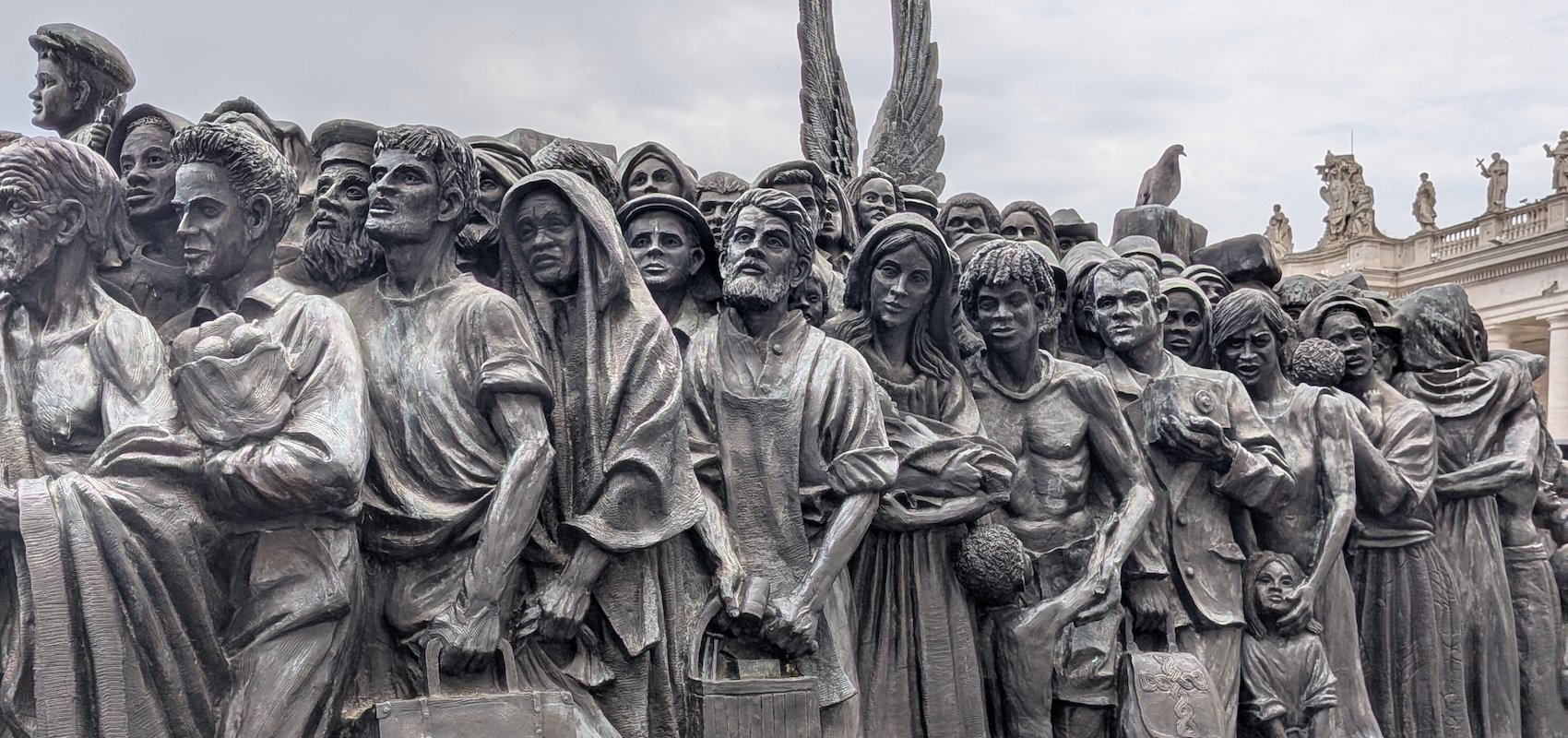
The West is being roiled by populism. Voters are increasingly bitter about the effects of globalization, which has deindustrialized many regions. They’re especially angry about mass migration, a problem compounded by the fact that elites refuse to affirm and defend their cultural identities, instead waving the banners of diversity and siding with the newly arrived. Amid these economic, cultural, and political conflicts, Rome has almost nothing helpful to say. For when the Vatican speaks, it echoes the failing political and cultural establishments in the West.
Dilexi Te, the recently issued apostolic exhortation of Pope Leo XIV, offers an example. The topic is love for the poor, and the document offers fine spiritual guidance to which we should harken. But one section addresses migration. Although these paragraphs admit of nuanced reading, on their face they convey the impression that the Catholic Church does not just endorse open borders, but also teaches that those opposed to unlimited migration are enemies of Christ.
One passage mentions St. John Baptist Scalabrini, a bishop who founded the Missionaries of St. Charles “to accompany migrants to their destinations, offering them spiritual, legal and material assistance.” In fact, the order, like its founder, was Italian, and it accompanied Italian immigrants to the New World to ensure that they flourished and remained faithful to the Catholic Church. The apostolic exhortation transforms this noble ministry—pastoral leadership from a people and for a people—into today’s progressive dream. Dilexi Te cites Pope Francis’s fantastical opinion: “Scalabrini looked forward to a world and a Church without barriers, where no one was a foreigner.”
Pope Leo cites more of Pope Francis’s rhetoric: “Our response to the challenges posed by contemporary migration can be summed up in four verbs: welcome, protect, promote and integrate.” The sentiments are astonishingly inapt. In 2025, migration, both legal and illegal, is tearing apart the political settlements that have governed Europe for decades.
Recently, authorities in Birmingham declared that Israelis must not attend an upcoming soccer match because the police could not guarantee their safety. The ordinary Englishman wonders, “Who governs England? Imams in Birmingham or the people we elected to enforce the law?” A similar distrust affects France, Germany, and many other nations. And in this fraught context, the Catholic Church preaches “welcome, protect, promote and integrate”? Doing so insinuates that, were it not for the nativist rubes and their St. George flags, everything would be fine.
Meanwhile, in the United States, the administration has reinforced our borders and embarked on an effort to deport large numbers of people. I predict that European nations will soon join this effort to repatriate migrants. In this context, the Catholic Church offers little moral guidance. To my knowledge, the Vatican sponsors no seminars or consultations to discuss the ethics of deportation.
There are important questions to address. In cases of illegal immigration, it would seem obvious that deportation is always permissible. But we must take into account the fact that European policies in recent decades conveyed the clear message that, if you could get to the West, you would not be deported. (U.S. non-enforcement and toleration of massive abuse of asylum claims conveyed a similar message.) To a significant degree, these arrangements amounted to a de facto invitation, which millions accepted. I’d like to read a nuanced moral analysis of this aspect of illegal immigration and its bearing on deportation, which should include reflection on the moral culpability of the architects of the de facto invitation.
Family separation is another issue. The Church endorses imprisonment as a licit form of punishment, so family separation cannot be intrinsically evil. Moreover, the wife and children of a man who is deported can accompany him back to his home country. In this respect, unlike imprisonment, in nearly all instances repatriation does not require family separation. Nevertheless, there are human factors that must be weighed. What if the spouse of a person being deported is an American citizen? Or what if, more likely still, his children are? Perhaps the more suitable word is family dislocation, an uprooting from long-standing relations in an enduring community.
The moral evil of uprooting people invites another line of reasoning. In matters of real estate, there exists the common law principle of adverse possession. This legal doctrine holds that if a person occupies private property not his own and, over the course of many years, the owner does not object, then he can claim ownership.
Perhaps we should think about citizenship, or at least the right of residence, in a similar fashion. The common law recognizes adverse possession because it acknowledges the importance of settled expectations. If a man can farm a plot for twenty years without interference or expulsion, then he is entitled to continue to do so. By analogy, if a man can live and work in Houston for twenty years without legal hindrance, is he entitled to continue to do so?
Will this pontificate encourage reflections of this sort, which draw upon lucid legal and moral concepts? Leo inherited from Francis a magisterium of sentimental slogans. And when not sentimental, the Francis magisterium was largely irrelevant. Denouncing greed is a perennial necessity. It does nothing, however, to help Catholic leaders think about the effects of economic globalization on their own nations—or what principles to use to oversee de-globalization. The same holds for mass migration. Urging “accompaniment” is fine. The Church should minister to all, including migrants, whatever their legal status. But this notion gives no guidance to governing authorities. What are the limits of “welcome”? How should we think about populations of migrants (Muslims, for example) that don’t integrate? Do governing authorities have a duty to promote the interests of the natives of a nation above the interests of newcomers?
These questions and others are not asked. Instead, we get citations of the parable of the Good Samaritan. A few years ago, I had a conversation that helped me better understand the parable. The migrant crisis, born of non-enforcement of the border during the Biden administration, had brought tens of thousands of migrants to New York. They were housed in the fine hotels left empty by the pandemic. During the weeks after the first well-publicized arrivals, I was getting my morning cappuccino at my usual place. The owner is Tibetan, an immigrant of recent citizenship. I asked him what he thought about the situation. With disgust, he replied, “They are in nice hotels, while our people are sleeping in the streets.”
The Tibetan-American’s use of “our people” struck me powerfully. It is true that many native-born Americans sleep in the streets of New York, a fact our society tolerates with a shrug. I thought about the parable of the Good Samaritan. One striking element of the story is the fact that his fellow countrymen hurried past the half-dead man lying by the roadside. Perhaps they were on their way to the ancient equivalent of an anti-ICE protest.
The open society consensus that followed World War II set the agenda for civic life in the West. In its early decades, this consensus influenced Catholicism. Pope John XXIII famously urged Catholics to open the windows of the Church. In the aftermath of the Council, clergy drank deeply at the well of openness. The removal of altar rails symbolized the general embrace of a Church open to the world.
In a similar fashion, the Catholic Church adopted mid-twentieth-century internationalism, the general outlook on world affairs that looked forward to a more open world, knit together in pursuit of peace and prosperity. The great hopes many put in the United Nations in the 1950s and 1960s epitomized this outlook. That institution proved to be a flawed vehicle. But after the fall of the Berlin Wall, the dreams of internationalism were renewed.
In Caritas in Veritate (2009), Pope Benedict XVI called for the establishment of a “true world political authority.” Its purpose would be to manage the global economy and address problems that transcend national borders. To some degree, that authority already existed, erected after the Cold War in a patchwork of international institutions and accords, ranging from the World Trade Organization to the International Criminal Court. The most ambitious element of this emerging global system was the European Union, which took its current form in 2009. Further efforts to establish binding international norms were made in the 2010s. The Paris Climate Agreement (2015) is a leading example.
Today I worry that twenty-first-century Catholicism will repeat the mistake of the nineteenth century, when the Church remained staunchly loyal to a collapsed system, urging its restoration. In that era, the old system was the ancien régime. In our era, Rome too often appears to be fighting for the restoration of the open society consensus and the institutions it constructed—even as that consensus is already discredited by events, not the least of which is mass migration, and as the institutions of the open society, such as the European Court of Human Rights, impede efforts to chart another course.
As I noted at the outset, the West is being roiled by the bad consequences of the utopianism that Pope Francis falsely ascribed to Scalabrini: a world and a Church without barriers, where no one is a foreigner. I hope that Pope Leo will follow his namesake, forsake the restorationist impulse, and turn to the task of reframing Catholic social doctrine for a world that is de-globalizing. We need guidance. What should be our principles as we re-erect barriers and reject the foolish utopian notion that no one is a foreigner?


