
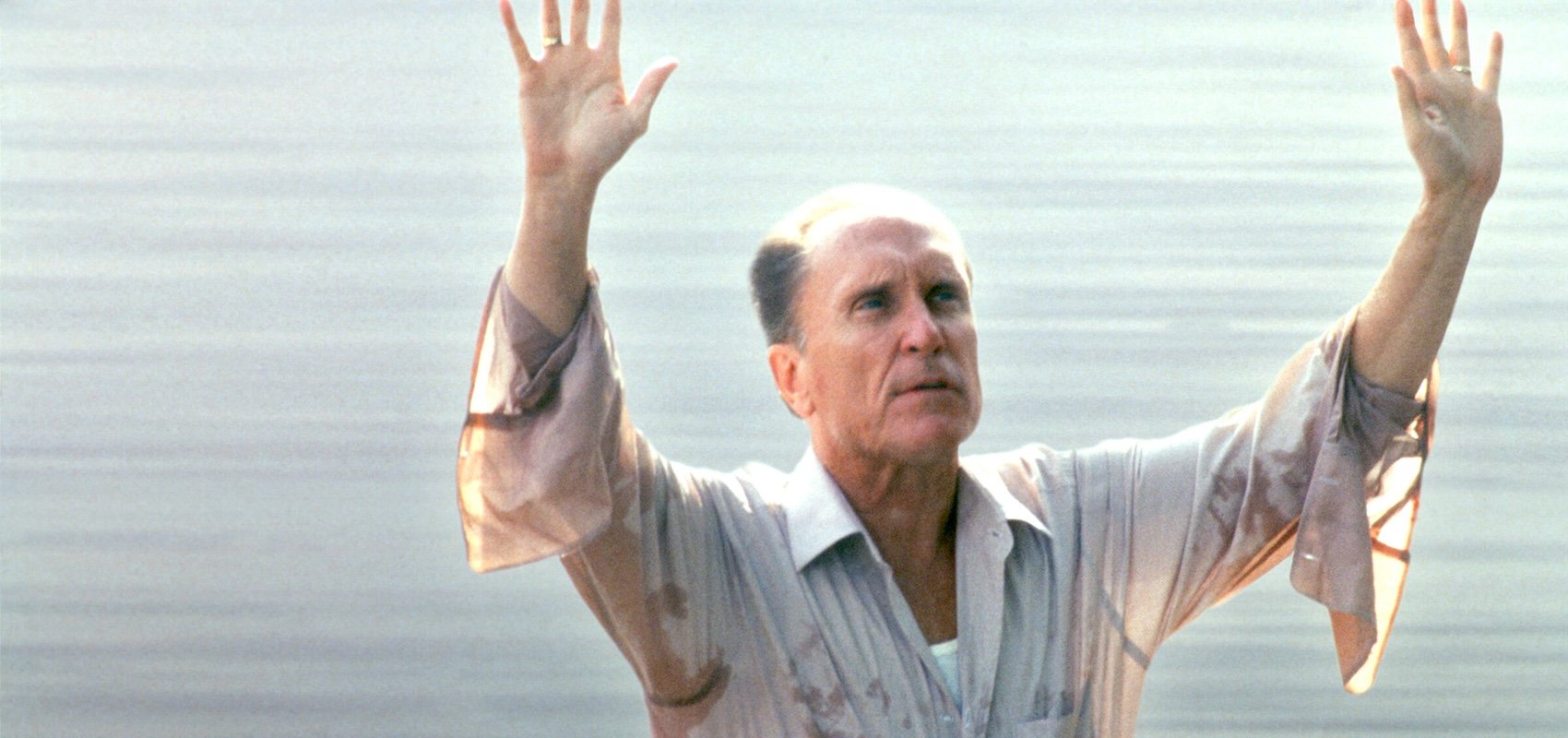
Robert Duvall, one of Hollywood’s most versatile and admired actors, has died at the age of ninety-five. He played any number of iconic roles: from Col. Kilgore in Apocalypse Now (1979) to Gen. Robert E. Lee in Gods and Generals (2003), from Tom Hagen in The Godfather (1972) to country singer Mac Sledge in Tender Mercies (1983, his only Oscar win), from Stalin in the eponymous miniseries (1992) to Adolph Eichmann in The Man Who Captured Eichmann (1996).
Duvall was a writer and director, too. Back in 1997, he made a movie about a Pentecostal preacher, The Apostle. First screened at the Cannes Film Festival, it earned him one of his eight Oscar nominations, and even turned a tidy profit. It was a rare movie about religion that got very good reviews in major liberal newspapers and trade papers alike. But it’s also a movie no studio wanted to make, despite Duvall’s fame. They deemed it “too religious.” He had written the script in 1984. By the 1990s, he decided that if no one else wanted to make it, he would finance and direct it himself.
This was before Mel Gibson’s The Passion of The Christ, which crystallized the rift between legacy media and the broad American audience. But in the mid-1990s, the conflict between elites and “deplorables” was already the major divide in American life, from politics to religion. Duvall’s decision to make The Apostle had the character of a plea to the chattering classes to take religion more seriously, to find something human in it to appreciate, whether the struggles of life or the art of preaching. For Duvall, the inner experience of a sinner born again was more than worthy of careful (and faithful) artistic representation.
Duvall grew up in a Christian Science household, but became disengaged from “organized religion” as an adult. He nevertheless identified as a Christian and maintained a private devotion to Christ throughout his life. His interest in Pentecostalism began in 1962 when he spent time in Hughes, Arkansas, to research his role in an off-Broadway show. One day, he found himself being drawn inexorably into a Pentecostal worship service. The effect on him was profound and enduring. “People could barely contain the joy of their faith,” Duvall wrote in 1998.
Their faces were alive with it, imbued. Folks were on their feet, singing praise and clapping, shouting to God! The air crackled with the Spirit. It was nearly impossible to be a mere observer. I wanted to sing and shout with them. I couldn’t explain it, but I knew the people in that church had a gift, a story to share. Somehow, someday, I would tell that story.
The Apostle is the story of Euliss F. Dewey (Duvall), affectionately known as Sonny, the pastor of a successful Pentecostal church in Texas whose family is falling apart. His wife Jessie (Farrah Fawcett) leaves him for the youth pastor and takes his church, too. Sonny began preaching when he was twelve; it’s his whole world. His wife’s cruelty costs him everything. His reaction is manful but unChristian: Drunk, he strikes the cuckolding youth pastor with a baseball bat, and the man falls into a coma and eventually dies. Sonny’s children, who witness the violence, are horrified and he loses them. Now on the lam, the preacher skips town. What’s more American than skipping town?
Act two begins with Sonny baptizing himself in a river and taking on the new name “the Apostle E. F.” in order to return to the same old mission: to start a new church and save souls. He proceeds to do so with customary elan, this time among the mostly black poor of rural Louisiana. Within a month, he has a growing flock, converts, a radio spot, and is making a new life for himself. His past, of course, will soon catch up with him.
The all-American quest for authenticity drives The Apostle’s plot. “Praying on it,” asking God what his plan is for us, seems to be both a cause and an effect of the American insistence on freedom. It’s not simply a question of the right thing to do, but of what to make of one’s life on the road to heaven. The Apostle E. F. is a marvelous sinner (women are his weakness) intent on becoming a saint. In an early scene, he pulls to the side of the road near a car accident and runs to offer spiritual comfort and witness to the stunned, perhaps dying driver. The policeman is irritated, but the driver, having just accepted Christ, is grateful. Throughout the film, E. F. shines the light of the gospel into the wreckage of lost souls, even as he’s slow to let that light confront the wreckage of his own heart.
E. F. is constantly on the road, preaching in tent revivals as often as in church. He changes his identity, too—rips apart his papers and sinks his car in a lake after fleeing home. For E. F., repentance and conversion is what counts; justice is a secondary matter. Of what concern are the judgments of courts, when one speaks directly to God? E. F. focuses so intently on the wellbeing of others’ souls that he neglects the upkeep of his own. He busies himself meeting the needs of others so as not to confront his own restlessness. He’s always in a hurry.
E. F. possesses the all-American quality of entrepreneurship in spades. He’s a hands-on leader and organizer. He’s the most himself while preaching, but he’s also a handyman and not shy about work, holding multiple jobs to fund his restoration of a small church. He’s got the common touch, he impresses both men and women, and his remarkable doggedness never belies his humility.
His too-quick return to spiritual leadership doesn’t last. His ex-wife hears one of his radio spots after the radio switches stations on its own, perhaps by divine intervention, and calls the police. E. F. is eventually arrested, by officers decent enough to let him finish leading worship service before taking him in. It’s a compelling scene: Aware of their beloved pastor’s imminent departure, many in the congregation weep as E. F. draws out his final service to spend as much time as possible with people he has shepherded. Especially moving are the tears of one early congregant, played by Walton Goggins, who answers E. F.’s altar call and finally gives his life to Christ. The effect of E. F.’s performance is to leave his community confident that it can stand on its own feet once he is gone. Before he is cuffed, he sets his gold watch and rings on the hood of the police cruiser for Goggins’s character to collect and give to the church to sell. We are left with the indelible impression that E. F. bears his fate with such dignity and grace by “Holy Spirit power,” not his own. As the credits roll, we see E. F. has returned to ministering, now on a chain gang, still trusting in God, still preaching Jesus.
The strength of Duvall’s characterization is his intuitive understanding that preachers lead in ways other men do not. “I’m a soldier in the army of the Lord” speaks to a spiritedness lacking in ordinary life—a spiritedness inseparable from humility. Hope in God, prayer, repentance, and confession do not presuppose control over the universe or society, and yet their power is undeniable. In Duvall’s performance, that power is palpable.
The Apostle is a tragicomedy: E. F. is brought low by his own sin and fails to outrun his fate, despite his righteous labors; and yet he remains animated by the Holy Spirit until the end. One suspects he’s nearest the heart of the Lord, and most fully an apostle, when he leads a call-and-response as a prisoner in a chain gang. By the world’s standards humiliated, his joy is a powerful, contagious countersign.
The gratitude The Apostle enjoins is connected to the pleasure it offers, most obviously in the hymns sung throughout by a slate of artists, including June Carter Cash, Lyle Lovett, Emmylou Harris, and Duvall himself. It’s a remarkable gift, the only movie Duvall directed that really shines, and one of his greatest performances. We should pray for his soul and thank him for his witness.

YOU MIGHT ALSO LIKE
Timothée Chalamet Is Right About Art (ft. Suzy Weiss)
In this episode, co-founder and reporter for the Free Press, Suzy Weiss, joins Virginia and Germán to…
Trump’s Civilizational Project
Secretary of State Marco Rubio spoke at the recent Munich Security Conference. Last year, Vice President JD…
Via Crucis, 2026
The Way of the Cross—and the third, seventh, and ninth stations in particular—has been an especially appropriate…
