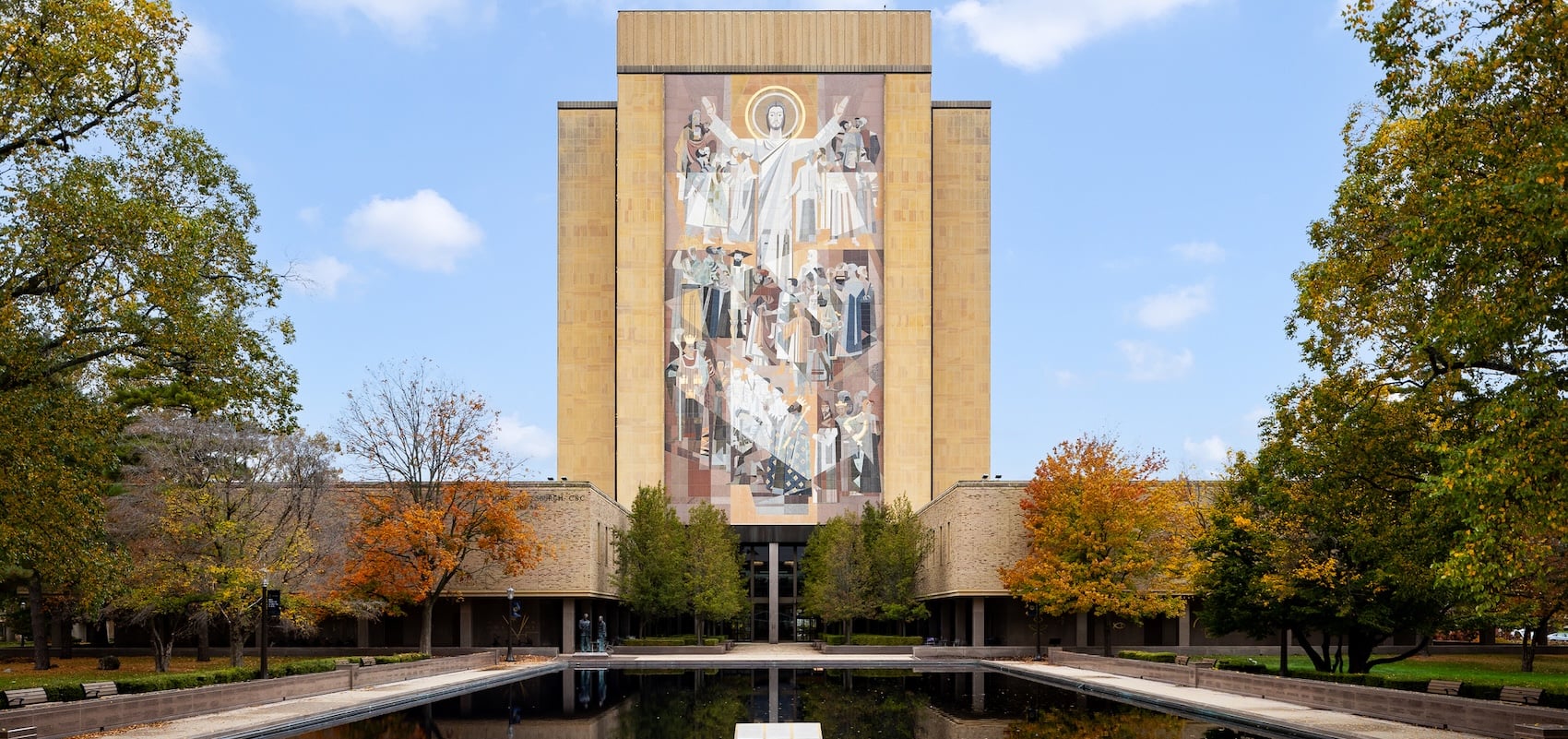
It is fascinating to be an outsider on the inside of an institution going through times of trouble. It is akin to having a backstage pass to a Police concert in the 1980s and witnessing the rock band’s rumored conflicts exploding in a real-time punch-up. Such have been my feelings these last few weeks as I have watched Notre Dame, my temporary academic home, air some of its most intractable difficulties in public and have listened to colleagues and students debate the controversy’s long-term significance. Yet amid the public turmoil, classroom life goes on and is, for me at least, a ray of real hope.
I had the privilege this semester of teaching a course entitled (as a shameless hook to draw in C. S. Lewis aficionados) “The Abolition of Man.” Lewis’s book was one of the texts, but other readings—from Friedrich Nietzsche, Czeslaw Milosz, George Grant, Jacques Ellul, Aleksandr Solzhenitsyn, Eric Cohen, and Mary Harrington—formed the real core. The students were an eclectic group; a majority were Catholic, a handful were Protestant, one was a Copt, and one was a Latter-Day Saint. Their disciplines ranged from architecture to computer science to theology. As it was a pass-fail class, we were able to make each seminar a free discussion of ideas, with no risk to the students’ future. This made the students somewhat self-selecting: Nobody was there because the class was “useful” for GPA or career. They were there for the sake of thinking through the biggest question of our day: What is man?
One thing that emerged was that the anthropological problem we face today has numerous roots and is metaphysical—or, better still, theological. There is an intuitive anti-essentialism in today’s culture. This is fueled by a vision of personal value built not upon what we do so much as what we choose to buy, by a subjective and therapeutic notion of what constitutes a good life, and by the manner in which technology has reshaped the cultural imagination. The shift in modernity from man as producer to man as consumer moved us away from a sense of significance grounded in external community functions. This then helped to foster what Solzhenitsyn lambasted in his Harvard address: an impoverished view of human freedom and happiness as nothing more than the ability to buy things that we don’t need but make us feel good.
The imagined possibilities of contemporary technology have finished the process of stripping us of metaphysical norms and guardrails—indeed, of any sense of a given teleology. This deracination of human nature dates back to at least the intellectuals of the seventeenth century but is now common currency for all. Even traditional Marxism, which deferred the realization of true human nature to the future workers’ paradise, retained a normative sense of a historical telos. Now we float aimlessly into that future, with no direction and no destination and no register beyond contemporary taste to make moral judgments. It is why today’s leftist radicals stand shoulder to shoulder with religious reactionaries like Hamas, at least in the safe environment of the West they despise. They have no positive future vision. They have only a commitment to tearing down anything that aspires to be normatively human and therefore by definition oppressive. Only a recovery of a theological understanding of man made in God’s image can offer a stable place upon which to build a normative anthropology.
Abortion, the immediate cause of Notre Dame’s recent difficulties, fits into this picture as a symptom of the abolition of man, as it further enables this very Western, consumerist, therapeutic anthropology. But if it is an obvious force for dehumanization in our culture it is far from the only one. One of the things upon which the class agreed was the importance of real, physical presence. The architecture student commented that very few new houses in the U.S. today are built with dining rooms. Such rooms are considered a waste of space in a world where meals are eaten in front of screens that are consumed, like the accompanying meals, individually. And when human interaction is mediated through screens in general—be it social media or chatbots—this process continues apace. Divorced from embodiment, we reduce others to the sum of the ideas expressed via their X accounts; building “relationships” with chatbots reinforces our understanding of human relationships as defined by what we take from others rather than what we give of ourselves; disembodiment removes the depth, subtlety, and complexity of what it means to be human.
This raises a pointed challenge not simply for Notre Dame but for every educational institution that aspires to take seriously its task to help students understand themselves. Teaching what it means to be human cannot be done purely via reading texts and exchanging ideas about them. Embodied interaction, both in the classroom and on campus, is key. I remember little of my time at college, but I do recall both the invitations to drinks or dinner at professors’ houses, conversations in dorm rooms, and the formal college dinners. They involved little time compared to that spent in lectures or at seminars, but they were memorably formative. As one student commented to me at the end of the course: “Something that I really appreciated about the class was that we didn’t just learn about what it means to be human in a detached, entirely abstract way, but had the opportunity to begin to live and to put what we learned into action, whether it was your wife’s shortbread . . . or having the chance to have one of our classes in a home.” Sharing food, sitting around in a beautiful living room, debating texts while also enjoying each other’s company—that was a powerful countermove in the struggle over the abolition of man.
“Humanity” is an abstraction. Abstractions are too weak to resist the dehumanizing forces of consumerism, abortion, disembodied online “relationships,” and other aspects of our therapeutic age. But human beings are not abstractions. They have faces, to borrow language used to make this point by thinkers such as C. S. Lewis and Roger Scruton. And institutions that claim the Christian mantle need to counter these challenges in ways that do not simply rule some positions out of bounds as incompatible with a Christian anthropology, but also allow a positive vision of what it means to be human to permeate all aspects of campus life, from the classroom to the residence halls to canteens to the homes of hospitable professors. Yes, it is a hard task, but it is also a high calling, one that Christian educators cannot ignore.