
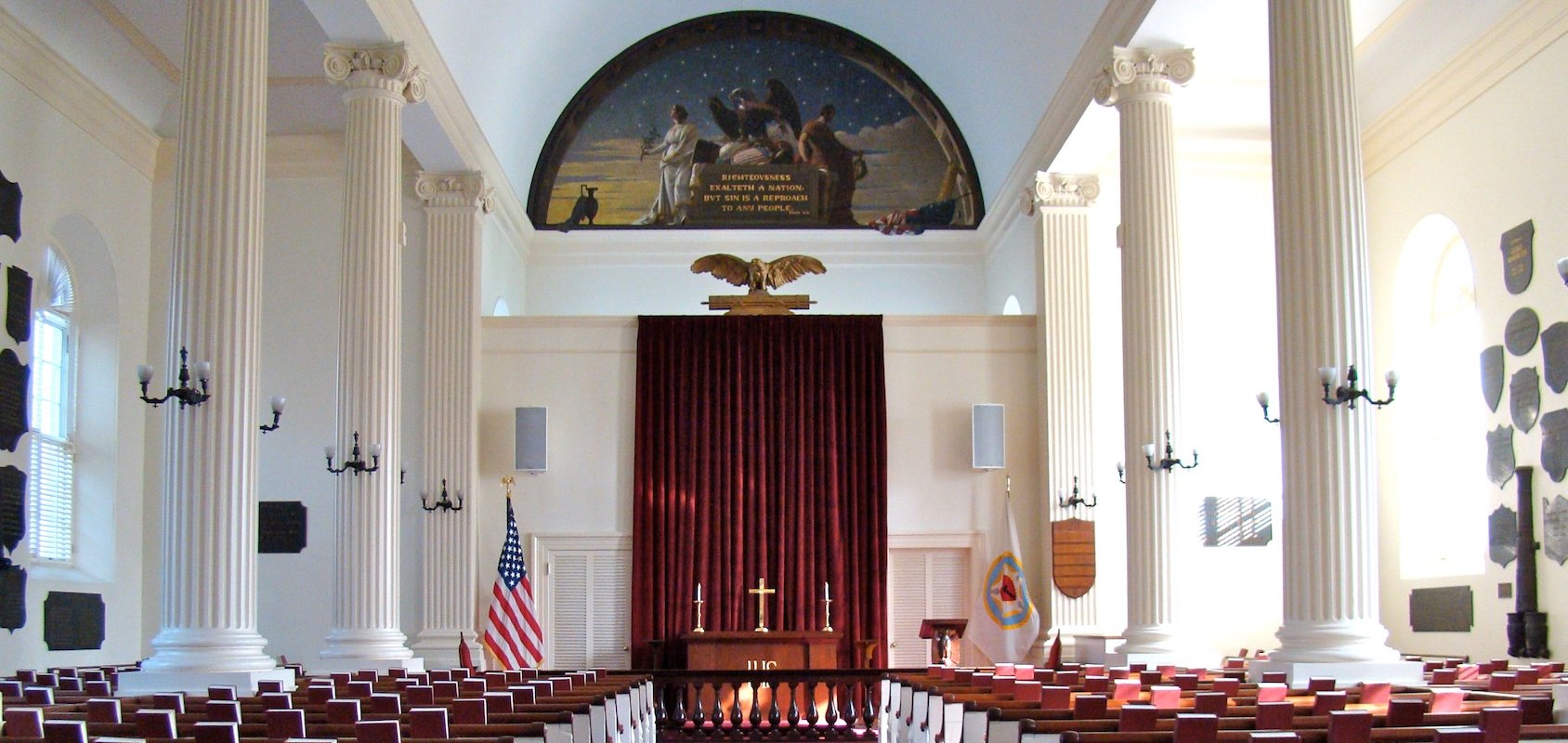
In the quiet sanctuary of West Point’s Old Cadet Chapel, a striking mural crowns the apse above the altar. Painted by Robert Weir and titled Peace and War, it captures the eternal tension at the heart of the soldier’s calling. At its center stands a radiant female figure—Lady Peace, robed in white, extending an olive branch in one hand and the Scriptures in the other. To her side, the man of war, armored and resolute, sheaths his blade not in defeat but in deference to a higher order. Between them, the majestic eagle rises, its talons clutching arrows in one foot and an olive branch in the other—the emblem adopted for America’s Great Seal, symbolizing the nation’s dual commitment to vigilance in defense and aspiration to harmony.
No doubt contemplated by generations of cadets since its completion in 1836, the scene poses an enduring riddle: How does a nation forged in righteous arms secure lasting peace?
The 2025 National Security Strategy, published last month, offers an answer. “The rights of free speech, freedom of religion and of conscience, and the right to choose and steer our common government are core rights that must never be infringed,” the strategy declares, invoking the God-given natural rights that birthed America as a sovereign republic. This is no mere preambulatory flourish; it is enumerated as a strategic priority. It is, in effect, a statement of national policy against spiritual desiccation. In a document both pragmatic and urgent, religious liberty is reclaimed not as a footnote to geopolitics, but as a very foundation stone of American security.
Throughout its history, faith has been the sinew binding America’s might. George Washington fretted that no nation could flourish if it “disregards the eternal rules of order and right, which Heaven itself has ordained.” Abraham Lincoln’s presidential policy was replete with acknowledgment of dependence on the divine. In the twentieth century, Harry Truman was convicted by the belief that at the heart of America’s purpose was the defense of “spiritual values—the moral code—against the vast forces of evil.”
In recent memory, this pillar vanished. Outright religious discrimination in the armed forces has been well documented, including in recent testimony to the Religious Liberty Commission. This bias, present in yarmulke bans a generation ago, accelerated in recent years as utopian critical theories usurped traditional sources of spiritual vigor. A 2023 Heritage Foundation poll captured the consequences of the palace coup: Nearly eight in ten active-duty members said that official fiats of gender ideology decreased their trust in the military somewhat or a great deal, while seven in ten said that such decisions would somewhat or significantly decrease the likelihood they would encourage their own children to serve. Such survey data prompted Mike Berry, a military religious freedom expert, to warn that the armed forces risked devolving into just another “political bureaucracy,” its moral core outsourced to the caprice of the hour.
The NSS reverses this neglect with the clarity of a bugle tone at reveille. It recognizes that religious freedom is not a domestic sideshow but a strategic priority against division at home and aggression abroad. In an era of hybrid threats—propaganda, cultural subversion, and demographic erosion—the document insists on “the restoration and reinvigoration of American spiritual and cultural health, without which long-term security is impossible.” Faith becomes the antidote to enfeebling despair.
Thus, the NSS should be read in part as a call to spiritual and cultural retrenchment, not an isolationist retreat. It is realistic about other nations’ “traditions and histories” differing from America’s own (using language reminiscent of recent jurisprudence re-grounding the Establishment Clause in America’s history and tradition). Yet, rightly, this pragmatic reserve is not extended to Europe, which teeters on “civilizational erasure.” In twenty years, the cradle of Christendom could be “unrecognizable,” its historic alliances strained by a loss of self-confidence in its own identity. This remonstrance has offended some European leaders, and others have rejected the critique of Europe because it is not applied equally to the world’s dictators. Yet these objections forget something worth remembering: European nations have always been America’s kin in a way other nations are not. Europe’s storied Christian heritage is, to a great extent, the progenitor of America’s own religious soul. The correction is a fraternal one.
As the NSS avows, security demands more than missiles; it requires souls attuned to the divine order that undergirds liberty. This strategy can drive further application in several helpful ways. With religious freedom as a recognized source of strength and a national strategic priority, compartmentalization that exists between national security officials and so-called “values” staffers in government should become more porous, if not eliminated. Core priorities like religious freedom and conscience must inform national security planning and actions. Further, military service secretaries and combatant commanders should be evaluating the ways they train, equip, and employ forces with religious liberty impact assessments as a leading consideration. Additionally, Congress should elevate and protect the military chaplaincy in its appropriations authorization and lawmaking via the National Defense Authorization Act.
The wisdom of certain features of America’s foreign policy will remain the subject of civic debate. But religious freedom, long sidelined, is the soul of the current strategy. This is a needed corrective that should be embraced by all. After all, what orients America’s instruments of national power if not the moral commitment to the divine spark in every individual conscience? Gazing upon Weir’s West Point mural today, the promise of the 2025 strategy is seen prefigured. Lady Peace prevails not by disarming the warrior but by directing his strength toward transcendent order. In reclaiming faith’s urgency, the 2025 NSS articulates a framework that offers the world not dominion, but a model, a nation strong enough to defend liberty—especially religious liberty—and wise enough to seek peace.

YOU MIGHT ALSO LIKE
Deliver Us from Evil
In a recent New York Times article entitled “Freedom With a Side of Guilt: How Food Delivery…
Natural Law Needs Revelation
Natural law theory teaches that God embedded a teleological moral order in the world, such that things…
Letters
Glenn C. Loury makes several points with which I can’t possibly disagree (“Tucker and the Right,” January…
