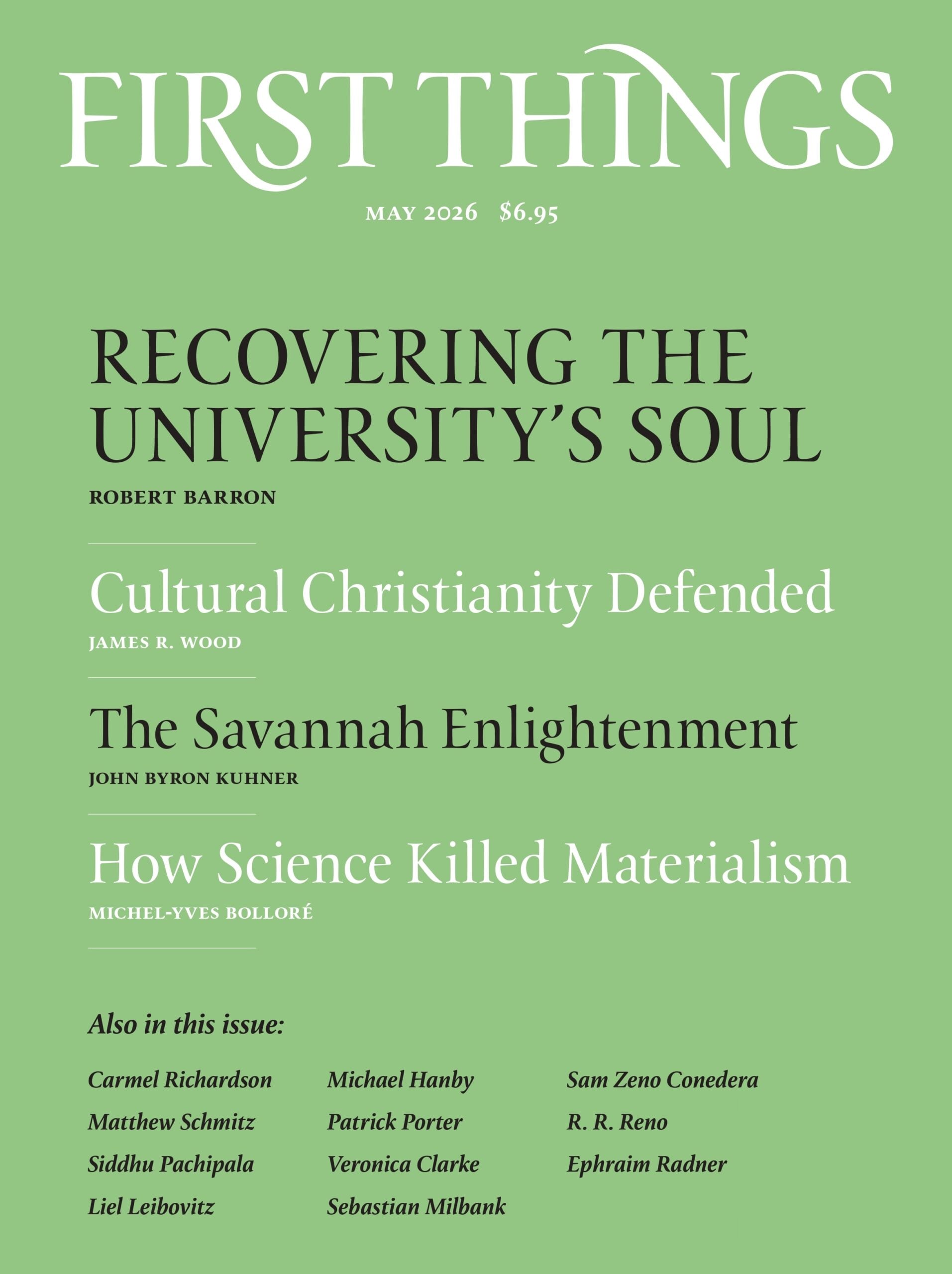
The contemporary university is widely acknowledged to be in crisis. Loss of public confidence, relentless tuition increases, and intensifying debates over speech and academic freedom have called into question its purpose and institutional legitimacy. Yet these seemingly discrete crises and external pressures are best understood as symptoms of a deeper contradiction—one that reaches to the very heart of the university’s self-understanding and, at a still deeper level, to its conception of the human being it exists to serve.
More and more, the university treats education not as an intrinsic good but as a mere instrument—a means to economic security, social prestige, and self-invention. The university is reimagined as a service provider, the student as a consumer. For many, a four-year degree program represents not a period of intellectual formation but a season of self-exploration, a final interval of freedom before the obligations of adult life set in.
When education is subordinated to self-invention rather than ordered to the pursuit of truth, the notion that students ought to submit their minds to an inherited body of knowledge and pedagogical tradition becomes untenable. Traditional curricula, disciplinary standards, and intellectual authorities are increasingly viewed with suspicion as remnants of a repressive past or impediments to personal freedom. In many institutions, this suspicion is not merely tolerated but fostered. Students are habituated to approach texts, arguments, and traditions not with a view to their intrinsic merit or the truth they may disclose, but rather by questioning whose interests they serve, whom they marginalize, and what structures of domination they reinforce. Thus, the intellectual life is transformed from a common search for truth into a contest of competing identities and narratives.
In this atmosphere, cycles of protest regularly disrupt the conditions of thought and learning. Authority, once vested in the teacher, is transferred to the student, as the institution grows uneasy with the suggestion that truth might precede choice or lay a claim upon freedom. The professor, no longer seen as an initiator into a tradition ordered to truth, is reimagined as a facilitator of self-invention.
The radical transformation of higher education cannot be explained as a sociological phenomenon or the unintended consequence of administrative or pedagogical misjudgments. It signals an anthropological crisis—an erosion of confidence in the moral and intellectual constitution of the human person. Increasingly, the university seems uncertain whether human beings are indeed ordered to truth, capable of disinterested inquiry, or able to receive meaning rather than manufacture it. In such a climate, suspicion is an academic virtue and freedom is an absolute good.
That such pessimistic anthropological presuppositions are neither native to nor compatible with the project of the university becomes clear when we recall the institution’s origins. The university did not begin as a credentialing apparatus or a hub for political activism. It emerged as the institutional expression of a remarkably generous vision of the human being. Medieval Christian thinkers understood the human person as imago Dei and, as such, endowed with extraordinary intellectual and volitional power and destined for transcendent knowledge and love. The human being was understood to be both material and spiritual, possessing interests and appetites proper to each dimension of his nature.
In the human proclivity to wonder, the medievals saw a sign of our spiritual nature: a capacity to be captivated by things that offer nothing of service to us in the corporeal, economic, social, or political dimensions of life. The human being is capax universi, as they would say, capable of attending to the whole of reality—not merely the “useful” parts. To be fully human was to possess this radically unrestricted interest in the whole of being.
This grand anthropology is inscribed in the very idea of the university. Universitas was not meant to represent a loose aggregation of specialized disciplines, mutually suspicious but unified by a shared campus and administrative bureaucracy. It first stood for a community of research ordered to the whole of reality—not merely the practical arts and sciences but also the liberal ones, those free from utilitarian constraint. The university was established to honor and cultivate the human capacity for genuine, disinterested wonder, which the medievals took as a given.
In recent centuries, however, a rival anthropology has asserted itself with increasing virulence over and against the generous vision of the medievals—a pessimistic and at times cynical anthropology that enjoys broad currency in the academic mainstream and elite. This anthropology stands in direct contradiction to the vision of human nature that undergirds the project and very idea of the university.
In what follows, I briefly examine four modern thinkers who serve as architects and representatives of this pessimistic anthropology: Karl Marx, Friedrich Nietzsche, Jean-Paul Sartre, and Michel Foucault. Each articulates a distinctive form of suspicion or nihilism that continues to shape the academy today. To understand the crisis of the university—and the possibility of its renewal—we must first attend to the anthropological vision that underwrites it.
Karl Marx is typically remembered as an economic theorist, but one of his most enduring and consequential legacies is the reductive view of human nature that undergirds his mature system of thought. For Marx, the human being is not capax universi; his attention and orientation to the world are defined by the demands of production and use. The human being is homo faber, the maker who fashions both himself and his world through labor. Marx denies the spiritual dimension of human nature that, for the medievals, made disinterested wonder possible. The human being, in his account, never stands above the material conditions of his existence. In The German Ideology, Marx asserts: “Men can be distinguished from animals by consciousness, by religion or anything else you like. They themselves begin to distinguish themselves from animals as soon as they begin to produce their means of subsistence, a step which is conditioned by their physical organisation.” It is hard to imagine a more radical departure from the classical tradition of philosophical and theological anthropology.
Thought itself is thus reduced to a moment within praxis, an expression of social and economic relations rather than a disclosure of any intelligible order beyond them. Thus in the famous sixth thesis on Feuerbach, Marx states: “Human nature is the sum total of social relations.” Marx’s materialist analysis treats philosophy as ideology and assigns explanatory priority to economic relations, power, and material resources as the shaping forces of human agency and history. The discourses of philosophy, theology, aesthetics, and moral theory are not disinterested pursuits of truth, goodness, and beauty, but ideological superstructures that protect and conceal the arrangements they serve. As Marx famously says, “The ruling ideas of each age are the ideas of the ruling class.” What masquerades in the university as speculative wonder is propaganda in the service of power. The intellect no longer reflects reality; it is an instrument of domination. The studia humanitatis lose their claim to disinterested metaphysical grounding, and the institution devoted to disinterested truth—the university itself—appears an ideological ornament of the economic order it sustains.
Whereas Marx defines the human being by his material needs and productive activity, Friedrich Nietzsche defines him in terms of his will to power. Like Marx, Nietzsche rejects the spiritual dimension affirmed by the medievals and understands the human being in terms of a dynamic force seeking self-expression, expansion, and dominion. Beneath human thought and values lies not a spiritual capacity for wonder but a primordial striving.
Within this framework, knowing is no longer a matter of receptivity to what is, but an act of interpretation driven by the will’s self-asserting dynamism. Truth does not precede the knower; it emerges as the provisional outcome of competing wills. “There are no facts,” Nietzsche famously insists, “only interpretations,” and interpretation is an expression of power.
Nietzsche’s declaration of “the death of God” therefore signals more than a sociological thesis about the decline of religious belief and practice. It marks the collapse of the metaphysical horizon in which the human being was understood as a participant in a cosmos endowed with intelligible meaning—a cosmos to which the mind might bear witness in wonder. Previously, wonder and worship were possible because reality offered itself to a receptive human intellect. But once the will is elevated as the ultimate source of meaning, the universe can no longer be regarded as inherently intelligible. Any meaning that reality might possess independent of the will becomes inaccessible in principle, for the will no longer waits upon what is but asserts itself over it.
Nietzsche’s anthropological vision thus excludes the assumptions that made the university possible: that human wonder is real, that the universe is a fitting object of that wonder, and that meaning—logos—precedes us and gives itself to us. Wonder yields to self-assertion, and because all appeals to meaning are now interpreted as expressions of the will to power, claims about inherent intelligibility naturally arouse suspicion. Discourses of higher learning are unmasked as contests of competing narratives. The lover of wisdom is displaced by a mercenary interpreter, for whom meaning is a tool—or a weapon—and homo contemplativus gives way to homo potens.
For all his iconoclasm, Nietzsche did not abandon the idea that there is something given about the human being. Although he rejects the classical account of human nature as ordered to truth and goodness, he presupposes something like a fixed, ontologically grounded nature: the primordial will to power. Human beings do not invent themselves ex nihilo. The will to power is the deepest truth about human nature; it is what explains and drives human thought, agency, and history. Thus, however hostile Nietzsche is to metaphysical realism, he still assumes a human nature that is not itself the product of choice or culture.
Jean-Paul Sartre breaks decisively with even this residual givenness. In his account, there is no prior nature or essential dynamism from which human life and thought follow. The human being is radically undetermined. His slogan “Existence precedes essence” indicates that a person first exists and only subsequently becomes something through acts of free self-definition. The kind of radical, unconditioned freedom Sartre wants to affirm requires him to deny any determinate essence that might constrain that freedom or norm its exercise. The human being is free not only to act as a being of such and such a kind, but is free even as regards his being itself.
It has been observed that Sartre’s peculiar anthropology represents a transposition of voluntarist accounts of God into a human key. On the voluntarist reading—on display in certain late-medieval figures, some of the Protestant reformers, but also in the father of modern philosophy, René Descartes—truth is finally a function of the divine will: 2 + 2 = 4 only because God has so determined it. In his completely sovereign freedom, he might have determined otherwise.
The implications of such an anthropology for the university are far-reaching. No longer is the university the human institution par excellence—an institution ordered to the pursuit and realization of the highest ends proper to human nature. Learning and contemplation, once privileged as the distinctive aspirations of the human spirit, are reduced to the status of optional projects among many, lacking any intrinsic claim upon the person. A university animated by this nihilistic vision no longer regards learning and contemplation as its primary ends; it becomes instead a workshop of self-creation, where instruction is no longer directed toward the cultivation of understanding and intellectual virtue.
Within such an institution, freedom is secured primarily through resistance to constraint: Rules, norms, and inherited forms of order are treated with suspicion, valued only insofar as they serve self-invention and -expression. And just as Sartre subordinates essence to existence, so, too, must he subordinate truth, which—because it places claims upon the subject and thereby limits freedom—can no longer function as the governing norm of the institution. The university animated by this anthropology relinquishes its vocation to form minds ordered toward what is and reconstitutes itself around the imperative to protect and promote self-determination.
The anthropological vision of Michel Foucault emerges in critical dialogue with the existential humanism of Jean-Paul Sartre. Like Sartre, Foucault rejects the claim that the human being possesses any given or ontologically grounded nature. The self, on this account, is a construct. Yet whereas Sartre still assigns authorship to the autonomous subject, Foucault recasts the self as the effect—indeed, the by-product—of heteronomous social and historical forces whose legitimacy is itself always suspect.
A self thus constituted, together with the patterns of thought it produces, can never stand above suspicion. Shaped by regimes of power, neither human subjectivity nor its intellectual activity can be regarded as reliably capable of truth. Still less can the academy’s traditions of discourse and theory be trusted. For Foucault, these are not disinterested attempts to understand what is, but mechanisms through which domination is exercised and maintained.
Within this framework, the theorist cannot be taken at his word as someone seeking to understand reality. What he says is explained not by its truth, but by his social position; his claims are read not as insights, but as the result of his own conditioning; his appeals to universality are treated as attempts to gain authority. Theory is understood not as an effort to know, but as a way of exerting influence. Interpretation, therefore, turns away from meaning and toward suspicion—asking not what a text says, but what it is doing and why.
It is here that the cynicism of contemporary academic culture takes shape. If knowledge is always bound up with power, then trust becomes naivete, and assent becomes complicity. Students are trained to approach texts, traditions, and institutions with a severe hermeneutic of suspicion, convinced that what presents itself as a pursuit of truth is an attempt at domination. Scholarly excellence comes to be measured less by depth of understanding than by acuity in exposing hidden interests. To believe that a thinker might mean what he says, or that a discipline might be ordered toward truth rather than control, is treated as a failure of critical maturity.
The university thus becomes highly skilled at demystification, and yet it finds itself ever less able to articulate why learning is a good to be sought, or indeed why an institution devoted to higher learning ought to exist.
Seen in this context, what is now commonly called “wokeism” appears less a novel doctrine than a popular and moralized convergence of anthropological assumptions long operative within the modern university. Its habits of mind—reflexive suspicion toward inherited authority, unease with claims about objective meaning and value, and resistance to any appeal to a shared human nature—are rooted in a broadly negative disposition toward the human being himself.
The anthropology behind this outlook is negative in two distinct but related senses. Evaluatively, it presumes that human motivation is so thoroughly pervaded by self-interest and the will to dominate that even theoretical inquiry and the aspirations of higher learning must be explained in those terms. Ontologically, it is negative insofar as it denies or minimizes the reality of any human nature that might ground common norms, shared ends, or stable criteria of judgment.
These two forms of negativity stand in evident tension. One presupposes a bleak nature; the other denies nature altogether. This inconsistency is not accidental. It reflects both the heterogeneous sources on which the movement draws and the priority of suspicion over coherence. Traces of Marx’s economic reductionism, Nietzsche’s will to power, Sartre’s rejection of a human essence, and Foucault’s social constructivism coexist within the same intellectual space not because they form a unified doctrine, but because each is an expression of skepticism about the sincerity, freedom, and intelligibility of human aspiration.
The result is an unstable anthropology, formed at the intersection of existential self-authorship and social construction. On the one hand, the individual is exalted as sovereign, empowered to define himself without reference to a given nature or normative form. Identity is treated as a project of expressive freedom, answerable above all to choice and authenticity. On the other hand, that same individual is repeatedly redescribed as the product of social location, economic forces, historical conditioning, and group identity. In one register, the self is celebrated as autonomous and self-defining; in another, it is reduced to an instance of a category—a bearer of structural forces that shape belief, desire, and action. Responsibility is demanded rhetorically while being dissolved theoretically, and freedom is affirmed only to be explained away.
It must be recognized, moreover, that the woke movement is not the origin of this confusion but only its most recent cultural manifestation. The deeper crisis is the West’s loss of confidence in the reality and goodness of human nature itself. The chief casualties of this loss in the sphere of higher education are not merely institutional—though institutional decline is real enough—but profoundly human. Students are deprived of the opportunity to encounter the university as a place of genuine intellectual formation, where learning introduces them to the world as it is, situates them within a broader horizon of meaning, and shapes both understanding and character. In its classical sense, such learning finds its fulfillment in contemplation: the distinctively human act by which the mind comes to rest in truth and, in so doing, becomes most fully itself.
Instead, students are increasingly formed in habits of suspicion and cynicism that estrange them from the very possibility of such fulfillment, rendering them adept at critique yet unable to experience and inhabit the world with the wonder so proper to the human spirit.
The enduring significance of Josef Pieper, especially his book Leisure: The Basis of Culture, lies not merely in his defense of contemplation but in his recognition that epistemology is downstream from anthropology. What a culture believes about the intellectual life—its possibility, character, and meaning—depends on what it believes about the human being. A university that has succumbed to suspicion and cynicism about human nature will come to see something nefarious behind even that nature’s highest yearnings and endeavors.
Yet the conclusions yielded by this hermeneutic of suspicion are often strained, counterintuitive, and tendentious. They require us to deny, against all appearances, that human beings seek truth in earnest, are genuinely moved by beauty, and recognize the intrinsic authority of the good. To interpret these aspirations as illusions or disguised expressions of the will to power is a mark not of rigor but of pessimism and bad faith. An institution ordered to higher learning cannot flourish when such habits of mind define its intellectual culture.
Against the negative anthropologies that dominate much modern thought, Pieper offers an intuitive and refreshingly positive account of what it means to be human. His approach is largely descriptive. He does not so much refute suspicion as render it inert by offering an alternative picture that rings truer. Pieper’s vision thus stands in quiet tension with any anthropology that reduces thought to labor, will, self-assertion, or social conditioning. Against these accounts, he presupposes that the human being possesses a given nature ordered beyond survival, power, and self-construction—one capable of wonder, receptive to meaning, and open to the whole of reality.
The pragmatic frame of mind opened up by the modern philosophers has become so pervasive, and its technological achievements so useful, that most of our contemporaries remain bewitched, incapable even of imagining another way of thinking. Josef Pieper dedicated a good deal of his intellectual energy to the rediscovery of what he called “the philosophical act.” In a number of his works, he characterizes it as “the power of establishing relations with the whole of reality, with all things existing,” or “the capacity to be related to the totality of being.” This does not imply bringing every object in the universe before the mind for detailed examination; it is rather about coming to grasp that which all existing or even possibly existing things must have in common. Hence it is, in Aristotle’s terminology, the study of being, not under any particular specification, but precisely as being. Pieper’s “philosophical act” is functionally equivalent to Heidegger’s die Frage nach dem Sein, and it gives rise to the question, “Why should there be something rather than nothing?” Thomas Aquinas witnesses to it when he speaks of the trajectory of the agent intellect toward the pure esse, and Bernard Lonergan hints at it when he speaks of the mind’s desire finally to know “everything about everything.” Once again, this is not a matter of explicit and categorical grasp of every particular existent, but rather of an intuitive understanding of what makes anything that exists to be as such.
In order to attain this level of consciousness, Pieper insists, something like a conversion is necessary. At the very beginning of the philosophical tradition, Plato described this transition as the escape from the cave, if we construe the flickering shadows on the wall of the cave as the objects of conventional, practical intellection and the form of the good as that which ultimately gives being to all things. Pieper describes the conversion less in terms of escape than of breakthrough from the outside: “[Philosophy] means to experience the fact that our immediate surroundings, prescribed as they are by the aims and needs of life, not only can be, but must be broken in upon . . . by the disturbing call of ‘the world,’ of the whole world and the everlasting and essential images of things mirrored by reality.” How wonderful that the at least implicit reference is to Meister Eckhart’s Durchbruch and to what the Protestant philosopher Paul Tillich called a “shaking and turning toward the unconditioned.”
The posing of the philosophical question involves no turning from the world of ordinary experience, but rather the awakening of authentic wonder in regard to it. Since it seeks to know the being of things, their essence and ultimate meaning, the philosophical question is, Pieper says, “the act of ‘marveling.’” This is why Thomas Aquinas can say that the poet and the philosopher are related in that both “are concerned with wonder,” and why Germany’s greatest poet can say “zum Erstaunen bin ich da.” James Joyce witnessed to the breakthrough of the unconditioned in his famous account of Stephen Dedalus’s encounter with the lovely woman on the Dublin strand. After surveying her beauty and delineating its contours in detail, the young man sighs, “Heavenly God,” and in that moment, he finds his vocation as an artist, which he construes as being a reporter of epiphanies. Stephen Dedalus did not escape the world in order to find astonishment; instead, he saw to the depths of the ordinary girl standing before him in the surf.
Pieper, again and again, insists that this properly contemplative gaze is possible only when the mind becomes purely receptive in the presence of the real, when the subject withdraws his will and self-interest and allows the being of things to manifest itself. In William Faulkner’s great novella The Bear, a young man, who is learning the ways of the hunt, seeks communion with the ferocious and fascinating animal that has haunted his imagination for years. Though he has been trained to use compass and rifle in his forays into the woods, he is told that, if he wants to see the bear, he must let go of those accoutrements and surrender to the animal’s will and prerogatives. Faulkner uses the language of the mystical tradition when describing the moment when the bear shows himself to the boy as a force both tremendum et fascinans and then sinks back into the shadows of the forest. Once again, the ordinary makes known its depths when the aggressive subject surrenders and adopts a humbly contemplative attitude. Goethe contrasted his scientific method with Newton’s, seeing the latter’s as aggressive and his own as respectful toward that which it seeks to know, ordered not so much to the practical as to the astonishing. Likewise, Jacques Maritain held that an intuition into being stands as the prerequisite to any truly philosophical thought. In his case, the breakthrough occurred when he gazed upon an ordinary orchard and “the trees whispered being.”
Pieper sharpens this claim through a suggestive contrast with nonhuman animals. In many cases, animal perception appears narrowly attuned to biological necessity. Certain birds, for example, seem incapable of perceiving a motionless insect. Such creatures inhabit not the world as such but a selectively constituted environment defined by function and need.
The human being, by contrast, is not so confined. We are capax universi, capable of attending to the whole of reality. A defining feature of our humanity is our delight in what offers no advantage or utility. We linger before what cannot be used, marvel at what resists explanation, and find ourselves drawn into contemplation by the sheer givenness of what is. In the face of a vast, beautiful, and intelligible world, we wonder.
Against Marx, Pieper insists that we are not essentially workers. Against Nietzsche, he rejects the reduction of human life to self-assertive power. Against Sartre and Foucault, he affirms that human nature is neither a product of radical self-creation nor merely an effect of social conditioning. This nature is visible in ordinary human life: in the imaginative play of children, in poetry and music, in philosophy and worship, in the quiet absorption of reading, and in the contemplative attention elicited by beauty. It is visible wherever wonder appears.
For Pieper, wonder is neither a cultivated affect nor the privilege of an elite. It is the spontaneous response of the human spirit to the givenness of reality. Human beings find themselves arrested by what is, drawn beyond self-interest, and invited into attentive presence. Wonder is thus not an ornament of the intellectual life but its natural beginning—and one of its highest fulfillments.
Set against the reductive and cynical anthropologies that now dominate much of academic culture, Pieper stands as a model of Christian humanism and precisely the kind of humanism the university most urgently needs today. His vision rests on a confident and deeply Christian affirmation of the human being as fundamentally good, capable of truth, and at home in a world that invites understanding, reverence, and delight. It recalls the university to the generous anthropology from which it first arose.
The renewal of the university cannot be accomplished by negation alone. A merely reactionary stance, an “anti-woke” defense of tradition, risks surrendering the very ground it seeks to recover. If the university is justified only as an instrument in a cultural struggle, it remains ensnared in the same utilitarian logic that has so deeply eroded its foundations. The task before us is not one of reaction, but one of restoration: the recovery and celebration of a contemplative anthropology rooted in confidence regarding the true nature of the human person.
In this task, clarity and grace may be of greater value than polemic. As John Henry Newman observed, “We need not dispute, we need not prove—we need but define.” “Half the controversies in the world are verbal ones” that could be settled if we merely clarified the terms and stakes of the debate. Something similar holds in the present crisis: It may suffice to set forth a vision of the human being as ordered to truth and capable of wonder, and to place this vision in contrast with the anthropology that now prevails in much of contemporary academic culture. The very juxtaposition reveals the cost of suspicion and the quiet misanthropy that underlies it.
Today’s college student needs to hear this confidence. When students are instructed that their longing for truth is naive, their attraction to beauty ideological, or their moral intuition a mere disguise for the will to power, they are not emancipated but diminished. They learn to approach meaning with cynicism and to mistake reverence for weakness. The result is not enlightenment but alienation—a quiet despair that masquerades as sophistication.
Human beings cannot flourish under an account of their nature that repudiates their highest aspirations. The anxiety and ambivalence that now pervade the experience of college students are not merely the by-products of contemporary pressures; they are spiritual symptoms of an education that casts suspicion on the very sincerity of the human desire to know. To suggest to students that their longing for understanding is illusory is to estrange them from their own humanity.
Here, Pieper’s humanism proves bracingly relevant. It affirms that wonder is real and essentially human. Education, in this light, is not the assertion of the will, the unmasking of power, or the production of identities, but the cultivation of a receptive attentiveness to the whole of being. Pieper does not so much refute the anthropology of suspicion as render it superfluous by recalling us to the truth of what it means to be human.
If such a vision is to be restored, the university must once again be ordered around contemplation. Curricula must invite students into sustained engagement with the fundamental questions of truth, goodness, beauty, and the meaning of human life. Spaces of true leisure must be protected from the tyranny of utility. Pedagogy must reward attentiveness as much as achievement, listening as much as assertion. Theology and metaphysics must be restored to their rightful place within the whole of learning, for without them the university loses confidence in the intelligibility of its own vocation.
Above all, the university must recover the capacity to address students in a language of hope. The point of such language is not to evade the reality of suffering or injustice, but to refuse the pedagogy of despair. A truly humane education affirms that truth is not a mere construct, that beauty is not reducible to private sentiment or self-expression, and that goodness is not simply a function of power or consensus. It assures students that their desire to understand is both real and just, and that to take this desire seriously is not naivete but the beginning of wisdom.