
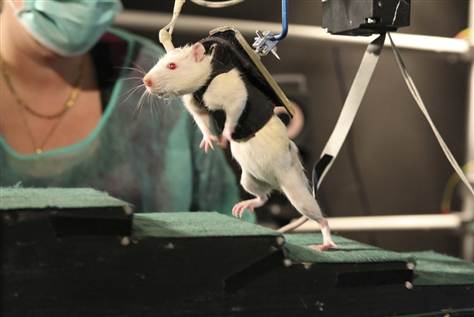
 Those who oppose animal research have to defend against this kind of very hopeful experimentation. Scientists have restored feeling in paralyzed rats using electrical and chemical stimulation of injurd spinal cords. From the MSNBC story:
Scientists in Switzerland have restored full movement to rats paralyzed by spinal cord injuries in a study that spurs hope that the techniques may hold promise for someday treating people with similar injuries. Gregoire Courtine and his team at Ecole Polytechnique Federale de Lausanne saw rats with severe paralysis walking and running again after a couple of weeks following a combination of electrical and chemical stimulation of the spinal cord
together with robotic support.
“Our rats are not only voluntarily initiating a walking gait, but they are soon sprinting, climbing up stairs and avoiding obstacles,” said Courtine, whose results from the five-year study will be published in the journal Science on Friday. Courtine is quick to point out that it remains unclear if a similar technique could help people with spinal cord damage but he adds the technique does hint at new ways of treating paralysis.

Do we sacrifice rats and monkeys so that the paralyzed may walk? I say yes. At the very least, it demonstrates the great value we receive from animal research—denied by PETA and their ilk.
Another note: Pay close attention to the caveats in the story. They are important. But I couldn’t help notice that we rarely saw such appropriate cautionary reportage back when embryonic stem cell research was touted so often in the media as the “only” source of future treatments for spinal cord injury. Glad to see journalism recovering its proper approach.

YOU MIGHT ALSO LIKE
The Church in the Age of Therapy
In 1966, Philip Rieff wrote in The Triumph of the Therapeutic that “Religious man was born to…
Canada’s Deadliest Blind Spot
On September 20, the Daily Mail ran a story with the provocative headline, “Our 83-year-old Christian grandmother…
The Faithful Joy of Dolly Parton and Fulton Sheen
Dolly Parton and Fulton Sheen seem to have had little in common. She favored rhinestones; he wore…
