
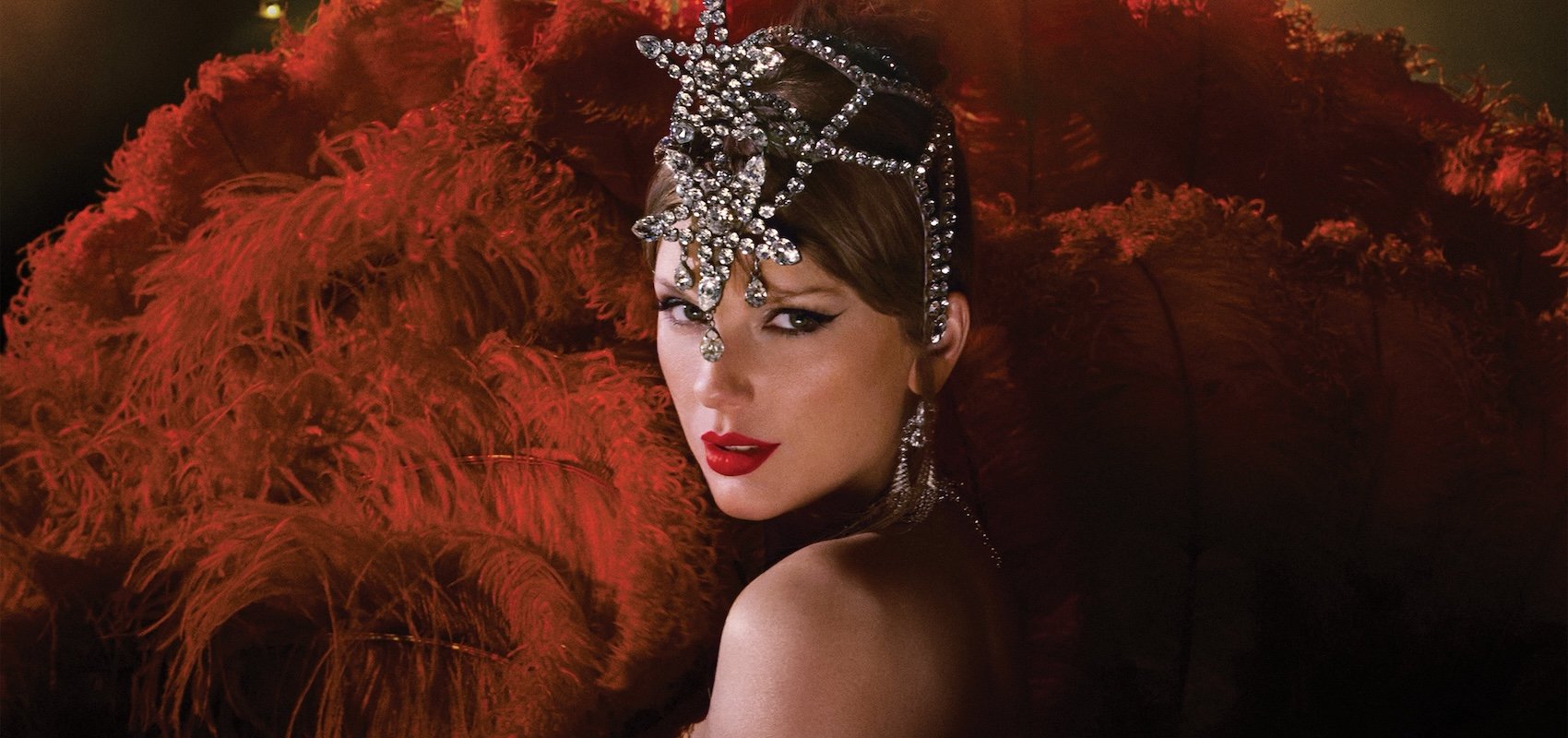
Whether you are a fan or foe of Taylor Swift, you cannot deny she is a titan of contemporary culture and society. She is a lightning rod for discourse and debate in politics, art, morality, you name it. Her every move provokes a response. The Life of a Showgirl, released on October 3, deserves to be read not just as another entry in Taylor Swift’s discography, but as a cultural text. On the twelve tracks (her shortest album to date), she seems to be dancing around an unsung question: What if the ultimate showgirl dreams not of another encore, but of home, marriage, children—the things contemporary culture has taught ambitious women to outgrow? It’s a “hot take” that’s been circulating for years, perhaps even to the point of cliché. But when Taylor Swift, the ultimate “girl boss” and quasi-matriarch of a generation of modern women, begins to voice those anxieties, it’s worth listening.
Musically, Showgirl is a sharp departure from the sprawling and moody The Tortured Poets Department, her previous album. Thematically, however, it’s a sequel. Swift’s longing for marriage and commitment was all over Tortured Poets, and she repeatedly despaired that she would ever realize that hope: “I’m so afraid I sealed my fate / No sign of soulmates” (“The Prophecy”). Showgirl celebrates the victory of her new love with fiancé Travis Kelce, a love that, any fan of Swift will know, was hard-won. On the opening track, “The Fate of Ophelia,” she is not shy about her triumph, nor about casting this as a quintessential fairy-tale ending, akin to Hamlet’s Ophelia being saved from insanity: “If you’d never come for me / I might’ve drowned in the melancholy.” She is the princess who was saved by Kelce: “All that time / I sat alone in my tower / You were just honing your powers.” On the one hand, this is classic Swiftian fare, but on the other, it does not sound very “showgirl” or empowered: Where is the girl who once sang “In your life you’ll do things / Greater than dating the boy on the football team” (“Fifteen”)? Now she’s pledging “allegiance to your hands / your team.” It’s not very “self-made billionaire” behavior.
Swift is the consummate showgirl and businesswoman, mesmerizing the masses and making millions doing so, yet also humiliatingly honest about how dependent her sense of fulfillment remains on love and a vision of a traditional family. On “Wi$h Li$t,” Swift playfully mocks the Millennial impulse to replace children with pets: “They want those three dogs that they call their kids.” (It’s hard not to find this line ironic from the self-professed “childless cat lady,” as she once called herself in her endorsement of Kamala Harris.) But Swift’s own wish list is old-fashioned: “I just want you / Have a couple kids, got the whole block looking like you / . . . Got me dreaming ‘bout a driveway with a basketball hoop.” Whether or not she literally envisions a neighborhood of mini-Kelces and herself behind the wheel of a mom-van is beside the point. It’s a fantasy of abundance and domesticity, a vision that works against the idea that female fulfillment lies solely in careerism. Even if delivered with a wink, Swift’s suburban daydream will ripple through the cultural conversation, just as her engagement already has. When she voices a longing, the world listens.
No one would mistake Swift for a spokesperson for conservative values, yet certain lyrics betray her. Feminist and mogul that she is, she’s long let slip small signs of discomfort with the fractured demands of modern womanhood and the pressure to be endlessly self-sufficient. Beneath the glamour and bravado, there’s a recurring doubt whether relentless ambition has truly served women’s happiness. In “Elizabeth Taylor,” she admits to being “the girl who has everything and nothing all at once.” But is Swift really speaking to a ubiquitous female experience, or simply to her own? Her level of fame is unique, but the sentiment—that success can feel isolating, that strength can become a trap—is more universal.
That tension surfaces on the track named “Eldest Daughter.” Swift initially refused to meet Kelce when he attended her Eras Tour, claiming she did not speak to visitors. On this record, she revises that story: “When you found me, I said I was busy / That was a lie.” The quintessential “girl boss” always has a full calendar. But Swift admits it was a performance: “I’ve been dying just from trying to seem cool.” The song captures the exhaustion of performing modern womanhood: hyper-sexualized in image, hyper-productive in spirit. “Every eldest daughter / Was the first lamb to the slaughter / So we all dressed up as wolves,” she sings, a metaphor for generations of women encouraged to harden themselves. But in the song’s bridge, she rediscovers softness: “Ferris wheels, kisses, and lilacs / And things I said were dumb / ‘Cause I thought that I’d never find that / Beautiful, beautiful life that / Shimmers that innocent light back.”
The sentiment aligns with a growing cultural shift, seen everywhere from “tradwife” discourse to the idea of “soft femininity” or “soft womanhood” circulating in many corners of the internet. Swift’s lyrics tap into a shared fatigue with the hustle of empowerment. She isn’t rejecting ambition so much as wondering aloud whether the idolization of masculine strength and constant productivity has cost women something essential: gentleness, ease, even joy. This track also includes the confession: “When I said I don’t believe in marriage / That was a lie.” It’s hardly surprising to anyone who has listened to her work, but many women will be grateful she finally said the quiet part out loud.
Whether Swift is truly ready to trade the stage for the home, or simply exploring the fantasy, remains to be seen. After all, on tracks like “Father Figure,” she revels in being the “Godfather” of her industry, singing in the voice of a man. She may not realize it, but this reveals just how much modern feminism demands the masculinization of women. There is nothing gentle about threatening: “You’ll be sleeping with the fishes before you know you’re drowning.” We can’t expect the album to interrogate the failures of modern womanhood. But for those listening, they can hear the question many of us ask: What gets lost in the pursuit of power?

YOU MIGHT ALSO LIKE
How to Write a Russian Novel
The Prodigal of Leningradby daniel taylorparaclete press, 256 pages, $21.99 There is of course no generic “Russian…
Knausgaard’s Mephistopheles
Back in college, one of my literature professors once remarked that the first hundred pages of a…
Living with Wittgenstein
In the autumn of 1944, Ludwig Wittgenstein noticed a young doctoral student in attendance at his lectures…
