
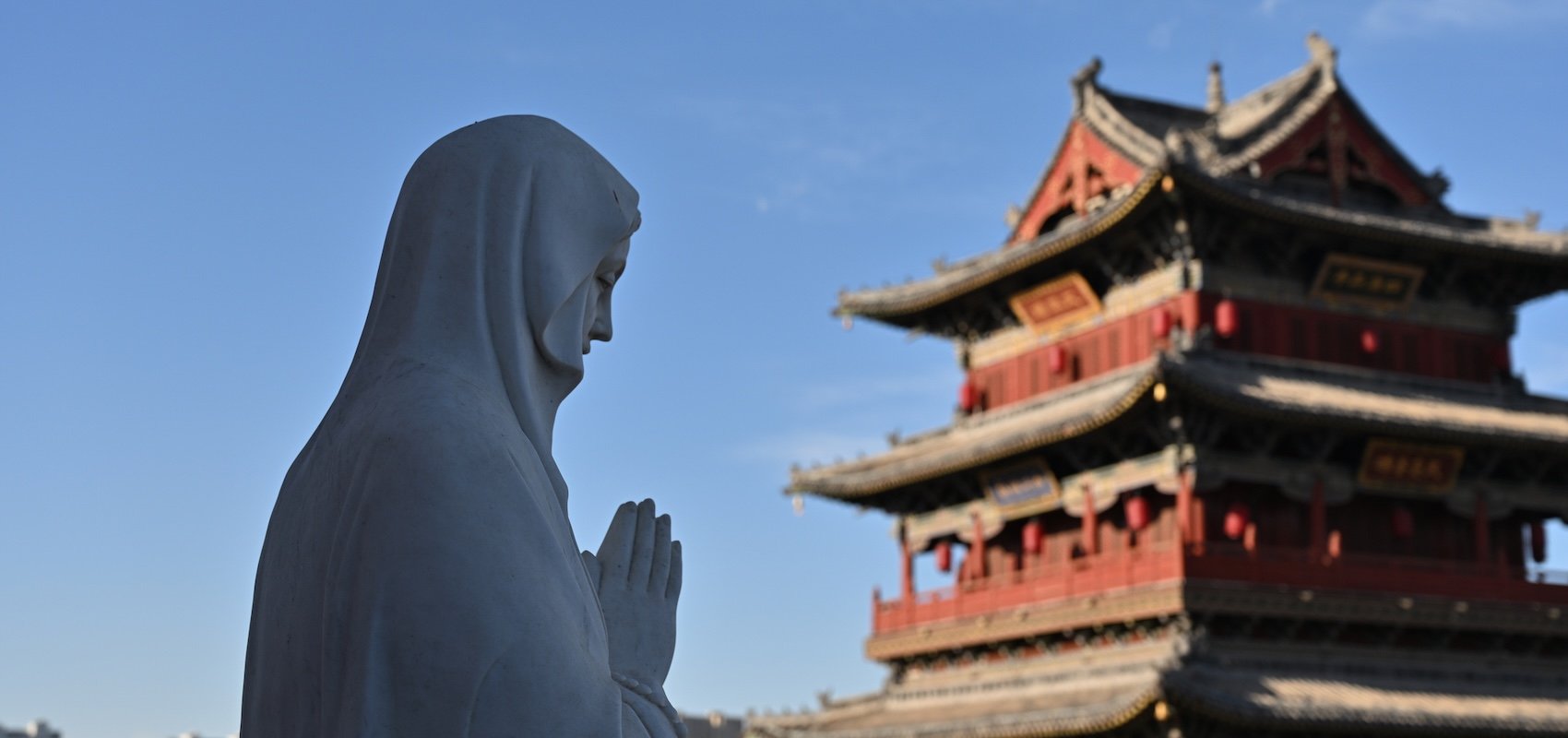
There is good news and bad news about the Vatican’s policy of engagement with the People’s Republic of China. The good news is that the Vatican is talking to China. The bad news is that the Vatican is talking to China.
The Vatican knows it cannot simply ignore the Chinese Communist Party (CCP). It has governed China since 1949, and its current hold over the country seems secure. Furthermore, China is both the second largest economy in the world as well as the second most populous country.
Current CCP orthodoxy holds that China was the center of the world until it proved no match for Western powers. This led to the “hundred years of shame,” which lasted from about 1850 to 1950, when the CCP saved China. Only now does it have the capacity to reassert its rightful place on the world stage. Such is the party’s nationalist and messianic vision.
Naturally, such a grand narrative leaves out important parts of the true history, such as the colonial powers’—and the Church’s—role in education and healthcare in China. It also conveniently leaves out the excesses of the party against its own people. The CCP is now at the center of everything, however, and Xi Jinping is its core leader. The change is easily perceivable. In all my travels to China over the past decades, it was only on my last visit that I often saw the CCP flag with its hammer and sickle nearly as much as I saw the national flag.
The CCP is so self-referential that whenever the Vatican talks to the party, it comes at a high price. Ever since Xi took office as president in 2013 (a day after Pope Francis’s election), he has tightened control over all aspects of society. Increasingly draconian regulations have been imposed on the religious sphere, such that religious leaders must be vetted and indoctrinated by the party, and all finances reported to it. In addition, the CCP has enforced an old rule in which no one under the age of eighteen is allowed to attend religious services.
These policies redound to the Vatican as well. The Vatican has been forced to keep silent about any “embarrassing” situations in China. This silence is seen as complicit in the suppression of the country’s underground Church, which has been a major goal of the CCP. Because of this, the pope himself is never invited to set foot on Chinese soil.
How does the current engagement policy play out in Shanghai, the place I know best? The current bishop there is Joseph Shen Bin. The good news is that there is no second-guessing. Catholics know who their bishop is. Normal functioning of the Church can go on, parishes can be staffed, and the sacraments can be administered. The bad news again is that it comes at a high price. Shen was originally the bishop of a much smaller neighboring diocese. The CCP then brought him to Shanghai and declared him bishop of the city. This was news to the Vatican. Even so, a few months later, it acquiesced to the fait accompli.
There were further difficulties. Shanghai already had a bishop, Thaddeus Ma Daqin, who was consecrated in July 2012. Both Church and state had signed off on him, but he lost the party’s favor within minutes of his consecration as bishop when he announced his resignation from the Catholic Patriotic Association, a party-controlled entity. Since then, Ma has been under close surveillance and confined to a seminary. The Vatican was then forced to sideline him.
One would think this would leave a power vacuum for control of the Church. In reality, this has never been the case, because the CCP controls the Church. Examples of this control speak volumes. In the rest of the Catholic world, the local bishop signs letters to his flock. Not so in China. Official diocesan documents are signed by “the diocese.” The Shanghai diocese is yet one more cog in the machine of the party-state. The same is true for the current bishop. I am told that Shen was from a rural area that relied mainly on the largesse of the government. He has never trained outside of China, and worked his way up through entities controlled by the party. This makes Shen far more a creature of the CCP than of the Church itself.
Where will Pope Leo go from here? So far, he has been following the appeasement policy championed by his predecessor. This appeasement policy is showing its limits, however. It’s possible there will be a course correction after the pope meets with his cardinals in January. Perhaps he will choose to ever so gently push back against the CCP’s overreach. This is especially important in a place like Hong Kong, which still has some freedoms that the mainland does not.
In my book Church Militant, I showed how the CCP dismantled the Church in Shanghai in the 1950s. In its sequel, China’s Church Divided, I showed how, in the 1980s, the CCP allowed greater religious freedom, but it still tried to control the Church. A golden thread runs through this history: The CCP has deep anxieties about any underground Church. It knows the power of underground organizations because, ironically, that is how the CCP began.
The Church has another card to play. It knows it has outlasted both the Roman Empire and the Eastern Bloc. While empires rise and fall, the gates of hell shall not prevail against the Church. I am convinced that this supernatural perspective can best inform our current-day political reality.

YOU MIGHT ALSO LIKE
Turned Away on Palm Sunday
In politics, diplomacy, war, or pretty much any field of human interaction, one must contend not only…
A Medieval Pilgrimage in Modern Assisi
When you go to the hilltop town of Assisi, you’re immediately struck by how medieval it is:…
Via Crucis, 2026
The Way of the Cross—and the third, seventh, and ninth stations in particular—has been an especially appropriate…
